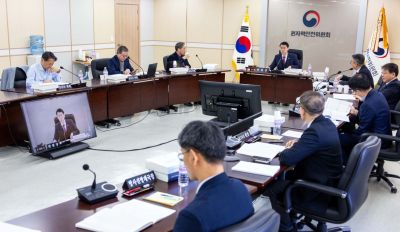
The Nuclear Safety and Security Commission announced on June 25 that it had identified a total of 75 cases of non-compliance (omissions) with self-disposal procedures during a special inspection of all nuclear power plants operated by Korea Hydro & Nuclear Power over a four-month period starting in February this year. The commission stated that it plans to impose fines for these violations.
Self-disposal refers to the process of treating radioactive waste whose concentration of radionuclides has been confirmed to be below the permissible standards set by the Nuclear Safety Act. In such cases, the waste can be incinerated, landfilled, or recycled in the same manner as general waste.
This special inspection was conducted as a follow-up to the results of an audit of Korea Hydro & Nuclear Power announced by the Board of Audit and Inspection in February this year. At that time, the Board of Audit and Inspection had issued a 'caution' notice, stating that Korea Hydro & Nuclear Power had disposed of 4,569 items of radioactive waste, such as batteries and lighting fixtures, within radiation-controlled areas (hereinafter referred to as controlled areas) from 2018 to 2023 without approval from the Nuclear Safety and Security Commission. Controlled areas are locations where there is a risk that the radiation dose rate or concentration of radioactive materials could exceed the standards set by the commission's regulations.
Because items used in radiation-controlled areas may be contaminated with radioactive materials, the commission requires that, for self-disposal, documentation proving that the radionuclide concentration is below the permissible self-disposal standards must be submitted for approval.
The commission expanded the scope of this special inspection to include additional items and periods, in order to check for violations beyond those identified by the Board of Audit and Inspection. As a result, the commission found additional cases where Korea Hydro & Nuclear Power disposed of certain radioactive waste from controlled areas without approval, after checking only the surface contamination rather than the radionuclide concentration.
The items identified include batteries, lighting equipment, fire and smoke detectors, constant temperature and humidity devices, and fire extinguishers. Including the cases previously identified by the Board of Audit and Inspection, the total number of items amounts to 5,412, across 75 cases.
Meanwhile, the commission explained that, after checking the radionuclide concentration of the items disposed of without approval, the average value was about 2.37% (minimum 0.03% to maximum 14.0%) of the permissible self-disposal standard. This means the items were within the self-disposal criteria, the radiological impact was negligible, and there were no safety concerns.
The commission stated that it will impose fines for the violations and will also require Korea Hydro & Nuclear Power to revise relevant procedures and strengthen self-disposal management as part of measures to prevent recurrence of such cases in the future.
© The Asia Business Daily(www.asiae.co.kr). All rights reserved.

















