Beds and Essential Medical Services Severely Lacking, Poorest in Busan by 2027
65% of Emergency Patients Transferred to Other Regions, Lives at Risk
Gijang-gun, Busan, has been classified as a "medically underserved area" in a regional healthcare diagnostic study released by the Health Insurance Review and Assessment Service (HIRA). This designation refers to regions where residents are unable to receive appropriate treatment and medical demand is diverted to other areas due to insufficient healthcare accessibility and facilities.
Although the population of Gijang-gun has recently surged to about 180,000 due to the development of the Jeonggwan and Ilgwang new towns, there is not a single tertiary general hospital, and the only general hospital is the Dongnam Institute of Radiological & Medical Sciences. While this hospital was originally established as a cancer specialty institution, it has recently been strengthening its general medical services, including pediatrics, cardiovascular and cerebrovascular centers, and rehabilitation medicine. However, there are concerns that the hospital faces limitations in providing essential medical services due to a shortage of medical staff and beds.
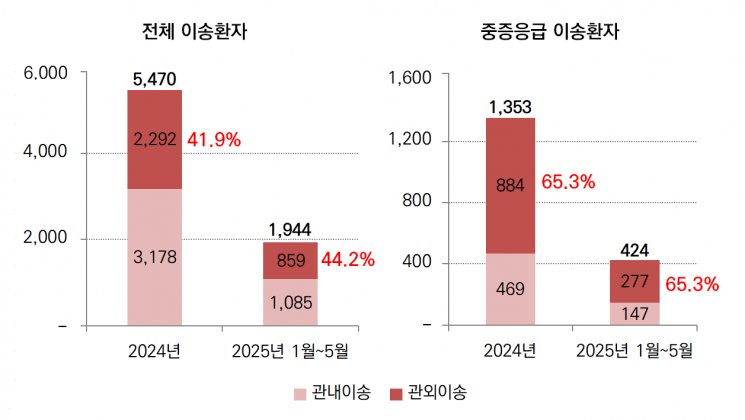
In reality, limitations have also been revealed in emergency medical response. According to the Gijang Fire Station, 42% of the 5,470 emergency patients transported in 2024 were taken to hospitals outside the region. In particular, among emergency patients classified as LV1 or LV2, who require treatment within 1015 minutes, 65% were transferred to medical institutions in other areas. This trend continued in the first half of 2025.
According to the HIRA report, the number of hospitals and clinics per 100,000 people in Gijang-gun is 54.8, which is significantly lower than the national average (73.2) and the Busan urban average (86). There is only one medical institution at the general hospital level or higher, and the number of beds per capita (471.1) is two-thirds of the national average and half that of urban areas in Busan. Most of the specialized beds and medical equipment are also reported to be outdated.
The city of Busan is managing bed supply by dividing the city into three regions?East, Central, and West. However, there are no plans to establish a new hospital in the eastern region, which includes Gijang-gun. In contrast, in the western region, where the shortage of beds has been severe, a general hospital and the West Busan Medical Center are scheduled to open sequentially.
Lee Changhun, director of the Dongnam Institute of Radiological & Medical Sciences, stated, "With the establishment of the cardiovascular and cerebrovascular center, some emergency care is now possible, but due to the shortage of beds and medical staff, 24-hour response is difficult," adding, "We need to expand to a 500-bed scale to strengthen essential and emergency medical services."
In April of this year, the Gijang County Council submitted a formal request to the Ministry of Health and Welfare, the Ministry of Science and ICT, and the city of Busan, calling for an increase in hospital beds. The council argued, "Medical infrastructure is severely lacking compared to the rapidly increasing population, and once the heavy ion therapy center begins operation, the demand for beds will rise even further," insisting that the Dongnam Institute of Radiological & Medical Sciences should be expanded to at least 500 beds.
HIRA also identified the expansion of public hospital beds and the strengthening of the emergency medical system as top priorities for Gijang-gun in its report, emphasizing, "It is urgent to establish a regionally self-sufficient public healthcare system in underserved areas."
© The Asia Business Daily(www.asiae.co.kr). All rights reserved.

















