National Assembly Budget Office Releases Analysis of Supplementary Budget Bill
Growth Rate Fluctuates Depending on Livelihood Recovery Coupon Effect
Concerns Raised Over 3.7 Trillion Won Fiscal Burden on Local Governments
It is projected that the government's second supplementary budget (extra budget) for this year, amounting to 30.5 trillion won, will boost the economy by 0.14 to 0.32 percentage points. However, the actual economic growth effect is expected to vary depending on how much the livelihood recovery consumption coupons stimulate the economy.
On June 25, the National Assembly Budget Office released a report titled "Analysis of the 2025 Second Supplementary Budget Bill," forecasting that the government's supplementary budget would have a stimulative effect on the economy. In particular, the Budget Office cited the economic growth rate falling below 1%, downward pressure on the economy, increased uncertainty due to export slowdown and tariff conflicts, among other factors. The report stated, "Considering the overall situation of our economy and the need to support small business owners and vulnerable groups who are struggling as a result, there appears to be a necessity for drawing up a supplementary budget." There is thus a consensus that the economy needs to be revitalized, even if it requires a supplementary budget.
The Budget Office estimates that an increase of 20.2 trillion won in expenditure will have an economic effect of 0.28 to 0.46 percentage points. However, due to expenditure restructuring of about 5.3 trillion won in previously planned projects, the economic effect is expected to decrease by 0.14 percentage points. The net economic growth effect of the supplementary budget is calculated by subtracting the effect of expenditure restructuring from the effect of increased expenditures.
However, the range of economic effect estimates varies by up to 0.18 percentage points, mainly due to the significant share of the "livelihood recovery consumption coupon distribution project," which introduces considerable uncertainty regarding the economic impact. The extent to which these coupons stimulate private consumption depends on household consumption tendencies, and there is significant uncertainty regarding changes in economic conditions and consumer sentiment in the second half of 2025.
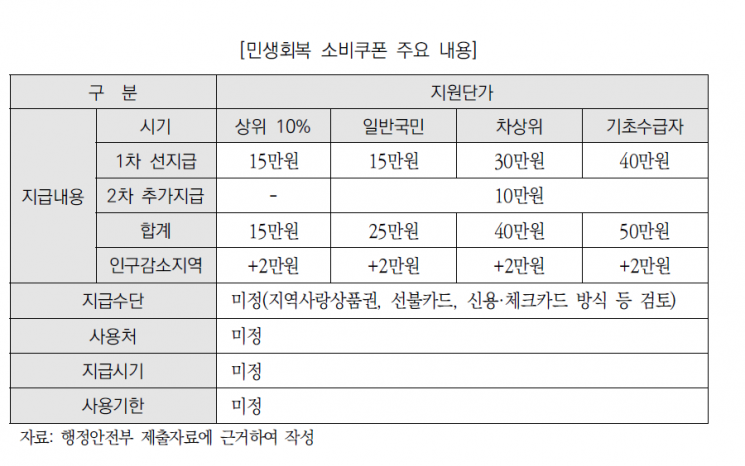
According to the government's budget proposal, 10.3 trillion won has been allocated for the livelihood recovery consumption coupons, which are characterized by being distributed according to income groups. Specifically, those in the top 10% income bracket will receive 150,000 won, the general public will receive 250,000 won, those in the lower-income bracket (such as single-parent families) will receive 400,000 won, and basic livelihood security recipients will receive 500,000 won.
However, many details have yet to be finalized, which introduces further variables. For example, the usage period must be determined. If the period is set too short, those who apply late may have limited time to use the coupons. Conversely, if the period is too long, the stimulative effect on the economy could be reduced and administrative costs could increase.
Additionally, if the coupons are distributed differentially based on health insurance premiums, the criteria for the top 10% will differ between workplace subscribers and regional subscribers, which could lead to heightened concerns about fairness.
The burden on local governments is also a point of concern. With the national treasury subsidy rate set at 80% (70% for Seoul), the local government share is expected to be about 2.9 trillion won, and there may be significant disparities in fiscal capacity among local governments. For example, some areas may have sufficient fiscal capacity but a small population, while others may have limited fiscal resources but a large population. Furthermore, since this time the distribution is selective based on income level, the fiscal burden could increase further. In this regard, an official from the Budget Office suggested, "If we include other national treasury subsidy projects in this supplementary budget, the total matching local government funds will amount to about 3.7147 trillion won. Therefore, a more nuanced differentiation of subsidy rates according to fiscal capacity is necessary, considering the substantial burden on local governments."
Meanwhile, the National Assembly will begin deliberations on the supplementary budget in full committee meetings of the Culture, Sports and Tourism Committee; the Trade, Industry, Energy, SMEs and Startups Committee; the Environment and Labor Committee; the Land, Infrastructure and Transport Committee; and the Agriculture, Food, Rural Affairs, Oceans and Fisheries Committee, among others.
© The Asia Business Daily(www.asiae.co.kr). All rights reserved.


















