Faitouch Institute Report
Non-Regular Workers' Working Hours Decrease with Minimum Wage Hike
When Minimum Wage Rises 2.8 Times, Working Hours Gap Expands 2.6 Times
"Economic Growth Rate Should Be the Cap for Wage Increases"
A study has found that if next year's minimum wage is raised as demanded by labor groups, the gap in monthly working hours between regular and non-regular workers will widen by 17 hours.

According to the report "The Impact of Minimum Wage Increases on the Gap in Working Hours Between Regular and Non-Regular Workers," released on June 25 by Park Sungbok, head of research at the Faitouch Institute, a 1% increase in the minimum wage would widen the monthly working hours gap between regular and non-regular workers by 2.04% (1.15 hours). Specifically, the monthly working hours of regular workers would decrease by 0.02% (0.03 hours), while those of non-regular workers would decrease by 1.12% (1.19 hours).
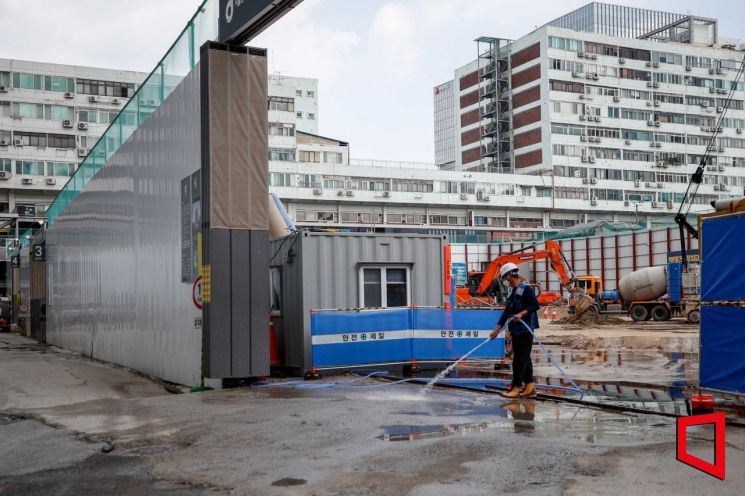 A worker is spraying water to cool the geothermal heat at a construction site in Seoul. Photo by Kang Jinhyung
Park explained, "When the minimum wage is increased, small businesses that pay wages based on the minimum wage reduce the working hours of non-regular workers who are subject to the minimum wage, whereas the working hours of regular workers, who are not directly affected by the minimum wage, decrease only slightly." He added, "Because the reduction in working hours for non-regular workers is much greater than that for regular workers, the gap in working hours expands."
If this analysis is applied to the 14.7% minimum wage increase rate demanded by labor groups for next year, the monthly working hours gap between regular and non-regular workers would widen by 16.9 hours (203 hours annually). Using the same method, a 5% increase in the minimum wage would widen the monthly working hours gap by 5.8 hours (69 hours annually), and a 10% increase would widen the gap by 11.5 hours (138 hours annually).
In fact, as the minimum wage rose from 3,480 won in 2007 to 9,860 won last year?an increase of 2.8 times?the monthly working hours gap between regular and non-regular workers expanded from 21.8 hours to 56.4 hours, a 2.6-fold increase.
Park stated, "If the gap in working hours between regular and non-regular workers grows due to minimum wage increases, it could actually further widen the income gap between the two groups." He suggested, "The cap on minimum wage increases should be set at the economic growth rate, and the increase rate should be determined within that range to curb minimum wage hikes as much as possible."
© The Asia Business Daily(www.asiae.co.kr). All rights reserved.













