Professor Myungsoo Kim and Professor Taesik Yoon's Team Develops Vanadium Oxide Memristor-Based RF Switch
Variable Filter Circuit for Frequency Selection Created Using the Switch... Published in Advanced Science
A low-power, non-volatile wireless communication semiconductor device, ideal for the era of autonomous driving and 6G, has been developed.
This device can be used to create a variable filter circuit that adjusts the center frequency band, which is expected to help develop smaller and more energy-efficient communication equipment.
A research team led by Professor Myungsoo Kim from the Department of Electrical and Electronic Engineering at UNIST and Professor Taesik Yoon from the Graduate School of Semiconductor Materials and Components announced on June 25 that they have developed a vanadium oxide (Vanadium Oxide) memristor-based RF switch.
 Research team, from left: Professor Myungsoo Kim, Researcher Changwoo Pyo, Researcher Seungchan Lee, Researcher Dahyun Kim (first author), Researcher Dabin Seo (first author), Researcher Jiyeon Ryu, Professor Taesik Yoon. Provided by UNIST
The RF switch is an essential semiconductor device for modern wireless communications such as autonomous driving, smartphones, and VR·AR. It controls the flow of high-frequency signals within a circuit by connecting or blocking them at specific points.
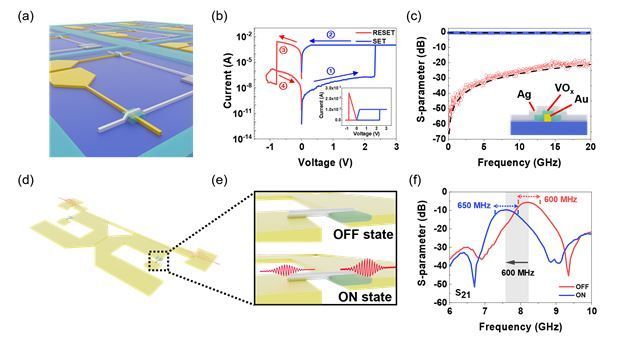
The newly developed RF switch consumes no standby power and operates effectively even in high-frequency bands suitable for high-speed, high-capacity communications. This is because the switch is structured as a memristor device. A memristor has a non-volatile property, meaning its resistance state, once changed by current flow, is retained even when the power is off. As a result, it can maintain its set state without standby power, reducing electricity consumption. Additionally, the switching speed of the resistance state is on the order of a few nanoseconds (ns), allowing for rapid on/off switching and minimal signal processing delay.
In experiments, this semiconductor device successfully transmitted high-frequency signals up to 67 GHz. In the ON state, it maintained a low insertion loss (below 0.46 dB), and in the OFF state, it maintained a high isolation (above 20 dB). Lower insertion loss and higher isolation both contribute to better communication quality.
Simulations also confirmed that the device can operate up to 4.5 terahertz (THz), which is the highest cut-off frequency reported for oxide-based RF switches to date.
The research team also developed a variable band-pass filter using this RF switch. The filter is an electronic circuit that selects and passes only a specific range of frequency components based on the center frequency. The developed filter could adjust the center frequency within a range of about 600 MHz. This allows a single filter to cover multiple frequency bands, simplifying and miniaturizing circuit configurations compared to conventional filters, making it advantageous for highly integrated wireless communication devices.
Professor Myungsoo Kim stated, "We have demonstrated that memristor-based RF switches can make a practical contribution to realizing compact RF front-ends with both frequency selectivity and energy efficiency," adding, "This could serve as a foundation for the development of next-generation wireless communication systems."
This research was published in the international journal 'Advanced Science' on May 28 and was supported by the National Research Foundation of Korea under the Ministry of Science and ICT and the Korea Institute for Advancement of Technology under the Ministry of Trade, Industry and Energy.
© The Asia Business Daily(www.asiae.co.kr). All rights reserved.


















