"Legal Standards and Companies' Payment Capacity Must Be Considered...
Next Year's Minimum Wage Should Be Frozen"
The Korea Employers Federation (KEF) stated on the 25th, "The wage payment capacity of small, micro-sized enterprises and small business owners has reached its limit, and business conditions are steadily deteriorating. These factors must be fully considered when determining next year's minimum wage."
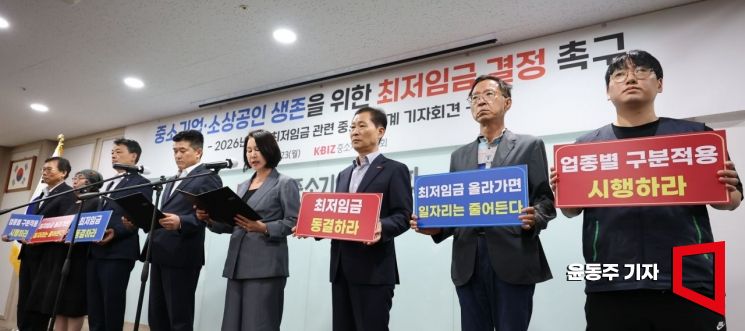 On the 23rd, small and medium-sized enterprises and small business owners attending the "Press Conference of the Small and Medium Business Community Urging the Determination of the Minimum Wage for the Survival of Small and Medium Enterprises and Small Business Owners, and the Minimum Wage for 2026" held at the Korea Federation of SMEs in Yeouido, Seoul, are shouting slogans. 2025.06.23 Photo by Yoon Dongju
At the 6th plenary session of the Minimum Wage Commission held on the 19th, the employer representatives proposed a "freeze" as the initial proposal for next year's minimum wage. KEF explained, "This is the result of comprehensively reflecting the minimum wage determination criteria stipulated by law and, most importantly, the wage payment capacity of companies."
KEF explained, "Our minimum wage has already reached 60% of the median wage, which is considered an appropriate upper limit, and is significantly higher than the average of G7 countries (50.1% as of 2024), which are among the most advanced economies." KEF pointed out that in some sectors, such as accommodation and food service, the minimum wage exceeds 80% of the median wage for the industry, making it difficult for businesses in these sectors to cope with the current minimum wage level.
KEF stated, "Over the past 10 years, while nominal wages have increased by 39.2%, the minimum wage has risen by 89.3%." They also argued, "For workers working at least 15 hours a week (who are eligible for the statutory weekly holiday allowance), the legal minimum wage increase rate reaches 127.3%."
As a result of these minimum wage hikes, the rate of workers earning less than the minimum wage rose to 12.5% last year, about three times the 4.3% recorded in 2001, and the number of such workers increased from 577,000 in 2001 to 2,761,000 in 2024. In the accommodation and food service industry, where many workers earn less than the minimum wage, the rate is as high as 33.9%, while the value added per worker is very low at 28.11 million won.
KEF further pointed out, "Over the past 10 years, the hourly labor productivity growth rate was 12.7%, which is far below the minimum wage increase rate of 89.3%." They added, "Our hourly labor productivity (54.6 dollars) is only 77.4% of the OECD average (70.6 dollars) and 67.8% of the G7 average (80.6 dollars)."
KEF estimated that the monthly conversion of the minimum wage amounts to 2.06 million won, which is sufficient to cover the living expenses of workers targeted by minimum wage policy.
KEF also pointed out, "Over the past five years, the cumulative minimum wage increase rate was 18.1%, higher than the inflation rate of 14.8% over the same period. Over the past 10 years, the cumulative minimum wage increase rate was 89.3%, which is 4.2 times the inflation rate of 21.2% during the same period." KEF criticized, "It is not appropriate logic to argue that the minimum wage should be raised significantly just because inflation in a particular year exceeds the minimum wage increase rate."
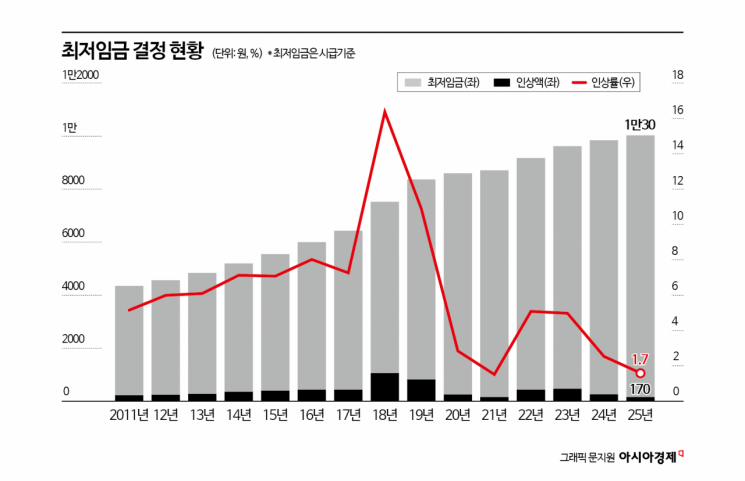
KEF also noted that while income distribution indicators based on the minimum wage have reached their targets, increases in the minimum wage have not had a clear effect on improving overall income distribution.
KEF stated, "As the minimum wage increased from 3,480 won in 2007 to 9,860 won in 2024, a rise of 183.3%, the minimum wage as a percentage of the median wage also rose significantly from 48.6% to 63.4% during that period." They added, "The goal for income distribution indicators based on the minimum wage (60% of the median wage) has already been achieved."
However, KEF pointed out, "Overall income distribution indicators have barely improved." They explained, "This is because the positive effects of minimum wage increases on income distribution have been offset by employment reductions and income declines among the self-employed resulting from the minimum wage hikes."
Ha Sangwoo, Director General of KEF (employer representative on the Minimum Wage Commission), emphasized, "With the prolonged slump in domestic demand and increasing internal and external uncertainties, the difficulties faced by small business owners and small and micro-sized enterprises will only intensify." He added, "Since it will no longer be possible to apply different minimum wages by industry next year, the minimum wage should be set based on the industries that are already struggling to cope with the current minimum wage level."
© The Asia Business Daily(www.asiae.co.kr). All rights reserved.


















