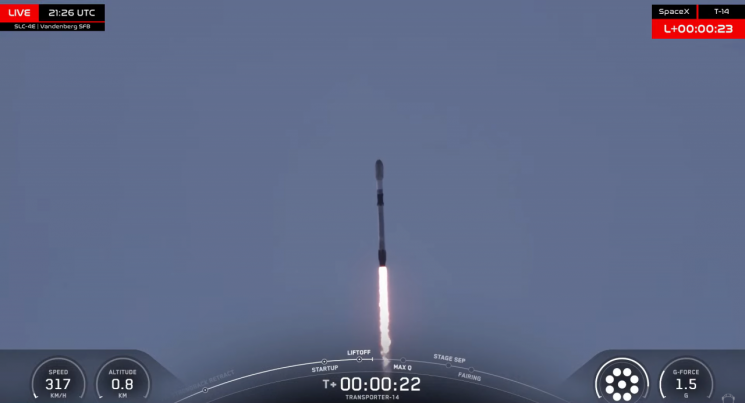
Sejong 2, a civilian Earth observation satellite developed by Hancom InSpace, a subsidiary of Hancom Group and led by CEO Choi Myungjin, was launched at 6:25 a.m. on June 24 (local time in the United States, 2:25 p.m. on June 23) from Vandenberg Air Force Base in California, United States, aboard a SpaceX Falcon 9 rocket. Sejong 2 successfully entered orbit, as confirmed by the completion of communication with the ground station after launch.
The successful launch of Sejong 2 marks the starting point for Hancom InSpace's initiative to build a satellite constellation system consisting of a total of 50 satellites. Through this, the company aims to dramatically improve the density and frequency of satellite data collection and to establish a privately-led satellite network.
Beginning with Sejong 2, Hancom InSpace plans to launch Sejong 4, equipped with domestically developed flight software (FSW), on the fourth launch of the Nuri rocket in November, to secure image data specialized for agricultural and forestry monitoring. In February 2026, Sejong 3, equipped with a hyperspectral camera (442 bands), will be launched on a SpaceX Falcon 9. In June of the same year, Sejong 5 will be launched on the fifth Nuri rocket, aiming to secure precision analysis data and to carry out a verification mission for low Earth orbit satellite-based navigation technology (LEO-PNT). Each satellite is equipped with different sensors and specialized missions to maximize industry-specific utility and strategic value, while gradually establishing a data infrastructure based on precise real-time monitoring.
Sejong 2 is an ultra-small satellite of the 6U class (200mm wide, 300mm long, 100mm high, weighing approximately 10.8kg), operating in a low Earth orbit about 500 to 600km above ground. It is equipped with a multi-spectral camera featuring eight spectral bands, providing Earth observation images with 5-meter resolution across a swath width of 20km. In addition, Sejong 2 carries a space-coated specimen of a satellite synthetic aperture radar (SAR) antenna currently being developed by Hanwha Systems, which will provide data for the localization and reliability verification of space components and materials.
Hancom InSpace has independently developed "InStation," an integrated platform that automatically consolidates and analyzes vast amounts of data collected from satellites, drones, ground cameras, and other sources, providing necessary information and even issuing alerts. InStation utilizes multi-INT technology to integrate and analyze various heterogeneous data, including satellite data from the Sejong series, drones, ground sensors, and Internet of Things (IoT) devices, in real time on a single platform.
The core of InStation is "Janus," a workflow engine that automates the entire data lifecycle from collection, preprocessing, alignment, analysis, and visualization to notification, as well as MLOps technology that automates AI model training and deployment. Leveraging these technologies, Hancom InSpace integrates and analyzes various data types such as geospatial intelligence (GEOINT), imagery intelligence (IMINT), and signals intelligence (SIGINT), leading high-value-added markets including disaster detection, agricultural yield prediction, defense surveillance, and industrial safety monitoring. The effectiveness of these technologies has been demonstrated in more than 100 actual projects both domestically and internationally.
Choi Myungjin, CEO of Hancom InSpace, stated, "The launch of Sejong 2 signifies more than just a satellite launch; it marks the full-scale implementation of Hancom InSpace's precision data-driven industrial platform strategy. We will continue to grow into a globally competitive company through our K-Mission Platform, which provides integrated services from data collection to fusion and analysis."
Meanwhile, Hancom InSpace recently completed a successful technical evaluation for KOSDAQ listing, recognized for its unrivaled technological prowess and marketability by a professional technology evaluation agency designated by the Korea Exchange. This is significant as it is the first time a domestic company has received the highest rating from an accredited institution for AI-based complex data fusion and analysis technology. Hancom InSpace plans to accelerate its preparations for a KOSDAQ listing in the first half of 2026, including investor relations (IR) activities and presentations for institutional investors.
© The Asia Business Daily(www.asiae.co.kr). All rights reserved.

















