Seoul Announces First "Seoul Metropolitan Youth Statistics"
Youth Population Reaches 2.86 Million, Making Up 30% of Total
Proportion of Single-Person Households Rises by 10 Percentage Points in Six Years
A recent survey found that the proportion of "youth" aged 19 to 39 living in Seoul has reached 30%. Among them, 60% are single-person households, and more young people have moved into Seoul than have left.
On June 25, the Seoul Metropolitan Government released, for the first time, the "Seoul Metropolitan Youth Statistics (2023)," a comprehensive analysis of the population, housing, employment, and health of young people residing in Seoul. This report is a reprocessing of 17 existing statistics, including Seoul’s registered population, Seoul Survey, Statistics Korea’s statistical registers, National Pension, Private School Teachers’ Pension, and National Health Insurance data.
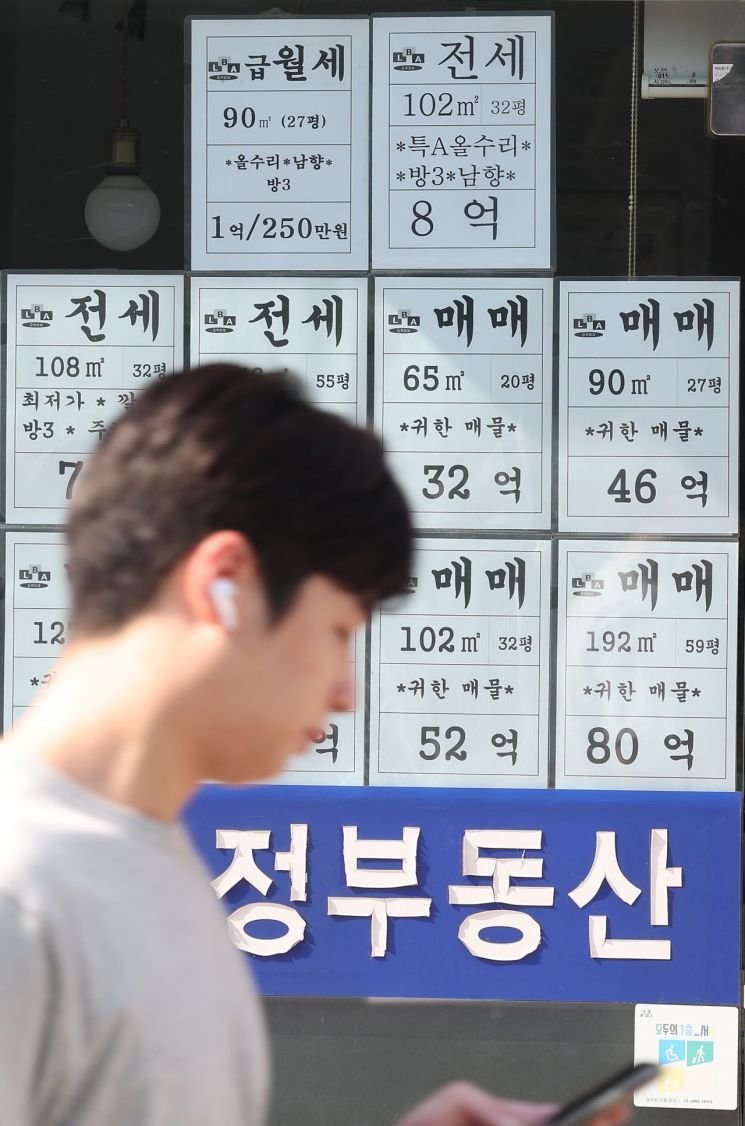 It was found that the proportion of "youth" aged 19 to 39 living in Seoul reaches 30%. Their housing types have diversified from apartments to multi-family houses and officetels due to the burden of housing costs. Yonhap News
As of 2023, the youth population residing in Seoul was 2.86 million, accounting for 30.5% of the city’s total population. Although this is a decrease from 3.18 million in 2016, the net inflow of young people into Seoul was 31,551 in 2022, 27,704 in 2023, and 15,420 in 2024. While the net inflow has decreased each year, it has remained positive for three consecutive years.
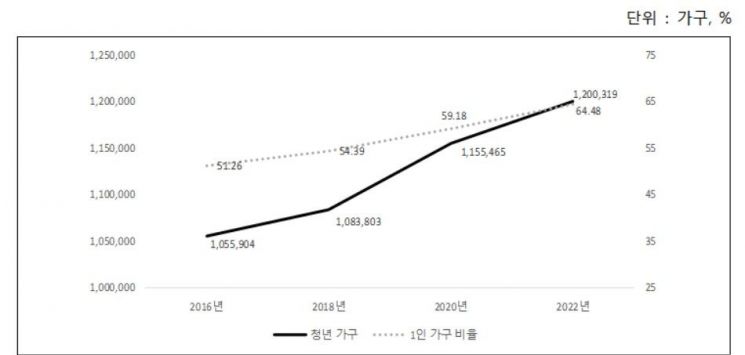
Youth households, defined as households headed by someone aged 19 to 39, numbered 1.2 million in 2022, an increase of 13.7% compared to 2016. This represents 29.3% of all households in Seoul (4.09 million). The proportion of single-person youth households rose from 51.3% in 2016 to 64.5% in 2022. The proportion of single-person youth households headed by women was 70.6%, higher than that of men, which was 59.1%.
Due to the sharp rise in housing costs, the housing types of these households have also diversified. The proportion of apartments among homes owned by youth household heads decreased from 30.0% in 2016 to 26.8% in 2022. During the same period, the proportion of single-family homes also fell from 33.3% to 28.3%, while non-residential accommodations such as officetels increased from 11.8% to 18.5%. In terms of land area, 44.2% of homes owned by youth household heads were less than 50 square meters. This figure increased by about 11 percentage points over six years, from 32.7% in 2016 to 44.2% in 2022.
As of 2023, the economically active youth population in Seoul was about 2.08 million, of whom approximately 1.98 million were employed. The number of economically active youth and employed youth declined during the COVID-19 pandemic but has recently shown a tendency to recover to pre-pandemic levels.
Among the businesses where Seoul’s young people work, corporations accounted for 58.0%, and by company size, businesses with more than 300 employees accounted for the largest share at 39.9%. Kang Okhyun, Director of the Seoul Metropolitan Government’s Digital City Bureau, stated, "We will utilize the statistics analyzed based on data covering all aspects of youth life?housing, employment, health?as foundational material for policy-making, allowing us to more precisely identify and implement policies and projects that are truly necessary for young people living today."
© The Asia Business Daily(www.asiae.co.kr). All rights reserved.


















