Relief Rally on Middle East Ceasefire News
Trump: "China Can Continue to Buy Iranian Oil"
Oil Prices Drop on Expectations of Secondary Sanctions Withdrawal Against Iran
Powell Warns of Summer Inflation... Dismisses July Rate Cut
On June 24 (local time), all three major U.S. stock indexes staged a relief rally as a ceasefire between Israel and Iran took effect. The easing of geopolitical tensions in the Middle East significantly boosted investor sentiment. In addition, international oil prices plunged by 6% after President Donald Trump signaled a withdrawal of the secondary sanctions against Iran that he had previously announced.

On this day at the New York Stock Exchange, the blue-chip Dow Jones Industrial Average closed at 43,089.02, up 507.24 points (1.19%) from the previous trading day. The large-cap S&P 500 index rose 67.01 points (1.11%) to 6,092.18, and the tech-heavy Nasdaq index jumped 281.56 points (1.43%) to finish at 19,912.53.
International oil prices fell by more than 6% on this day, following a drop of over 7% the previous day. West Texas Intermediate (WTI) crude plunged $4.14 (6.0%) to $64.37 per barrel, while Brent crude, the global oil price benchmark, dropped $4.34 (6.1%) to $67.14 per barrel. President Trump mentioned that, following the ceasefire agreement between Israel and Iran, China would be able to continue purchasing Iranian crude oil, signaling a withdrawal of sanctions against Iran. This led to the sharp drop in oil prices. Previously, in May, President Trump had warned that "all purchases of Iranian crude oil or petrochemical products must stop immediately," and that "any country or individual purchasing these products from Iran will be subject to secondary sanctions by the United States." Secondary sanctions prohibit companies or individuals who do business with entities directly sanctioned by the U.S. government from engaging in trade or financial transactions with the United States.
By sector, airline stocks surged due to the drop in oil prices. United Airlines rose 2.66%, while Delta Air Lines and Frontier jumped 2.69% and 7.56%, respectively. As risk appetite increased, technology stocks also soared. Nvidia surged 2.59%, and Broadcom soared 3.94%.
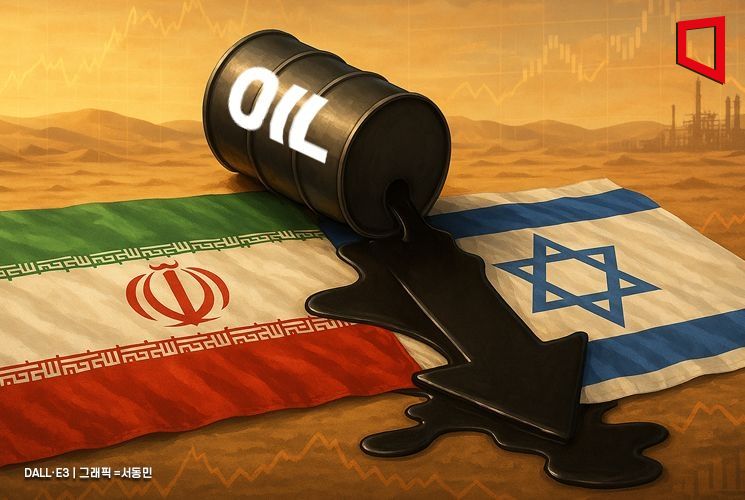
The ceasefire between Israel and Iran drove the stock market higher. At around 1 a.m., President Trump posted on his own social media platform, Truth Social, saying, "The ceasefire is now in effect. Do not violate it." After the ceasefire was declared, Iran launched missiles at Israel, and Israel intercepted them, keeping the situation tense. President Trump then expressed his dissatisfaction, stating that both Israel and Iran had violated the ceasefire agreement, and warned Israel to refrain from a military response. Despite the unstable ceasefire agreement between the two sides, the market consensus is that an immediate collapse of the ceasefire is unlikely.
John Brager, portfolio manager at Palmer Square Capital Management, commented, "What was important in the market this time was that the U.S. intervention was swift and limited, and Iran's 'weak' response was essentially a staged fireworks display for domestic audiences." He added, "Even though ceasefires often lead to renewed conflict, the market now regards this risk as a thing of the past." He further analyzed, "The focus is likely to shift back to tariffs and fiscal policy."
Solita Marcelli, Chief Investment Officer (CIO) at UBS Global Wealth Management, stated, "The market's reaction to the recent escalation and hopes for a ceasefire aligns with our view that geopolitical shocks have only a temporary impact on global financial markets." She predicted, "Investors are likely to refocus on fundamentals, and strong fundamentals will help lift the stock market over the next 12 months."
The market also paid close attention to remarks by Jerome Powell, Chair of the U.S. Federal Reserve, before Congress on this day. Appearing at the House Financial Services Committee's semiannual monetary policy report, Powell was asked whether a rate cut was possible in July. He replied, "If inflationary pressures continue to ease, we could resume rate cuts," but also said, "I don't want to single out any particular meeting. There is no need to rush because the economy remains strong." He especially noted that the impact of tariffs on the economy could become more pronounced from June to August, effectively dismissing the possibility of a July rate cut that has been suggested by some within the Fed.
Although the inflationary impact of tariffs remains limited so far, there are voices within the Fed calling for a rate cut in July. The previous day, Fed Vice Chair Michelle Bowman, following Fed Governor Christopher Waller, indicated that she could support a rate cut next month if inflation remains subdued. Vice Chair Bowman, nominated by President Trump, took office as Vice Chair for Supervision earlier this month, and Governor Waller is considered one of the candidates for the next Fed Chair.
As risk appetite strengthened due to the easing of Middle East tensions, the U.S. dollar weakened. The dollar index, which measures the value of the U.S. dollar against six major currencies, fell 0.48% from the previous day to 97.54.
U.S. Treasury yields were slightly lower. The yield on the U.S. 10-year Treasury note, the global benchmark for bond yields, fell by 2 basis points (1bp=0.01 percentage point) from the previous day to 4.29%. The yield on the 2-year Treasury note, which is sensitive to monetary policy, remained at 3.82%, the same level as the previous day.
© The Asia Business Daily(www.asiae.co.kr). All rights reserved.


















