Analysis of Greenland Economic Council's Semi-Annual Report
Severe Crisis of Local Population Disappearance
Fragile Foundation for Sustainable Economy
It has been confirmed that Greenland, an autonomous territory of Denmark, perceives the crisis of local extinction caused by population decline and the resulting wealth gap as a greater threat than the territorial ambitions of former U.S. President Donald Trump. The Greenland Economic Council recently released its semi-annual economic report, expressing concerns about the "diseconomies of scale" facing Greenland.
According to the report released on the 21st, out of the total 72 inhabited settlements (villages) in Greenland, 14 have fewer than 50 residents, with most of these concentrated in the southern region of Greenland. The report also stated that the proportion of the population living in 67 small- and medium-sized villages with fewer than 700 residents was 7% as of last year, a significant decrease from 12% in 1977. Furthermore, it warned that all residents have disappeared from 18 villages over the past 45 years, and the number of uninhabited villages is expected to increase further.
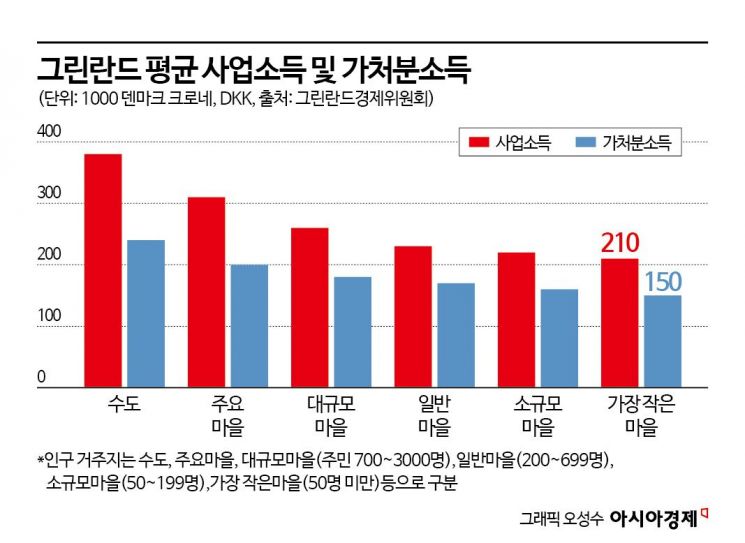
The issue of local extinction is occurring due to urban concentration. In 1975, 38% of the population lived in cities, but by 2023, this proportion had risen to 57%. As the number of people working in the fishing industry declined, more people moved to cities in search of new jobs in sectors such as tourism.
As a result, the wealth gap between regions has continued to widen. Recently, there has been an increase in high-income earners in Greenland's major cities, while only low-income residents remain in small rural villages. According to estimates by the Greenland Economic Council, the average business income per capita in the city of Nuuk is approximately 380,000 Danish kroner (about 80.5 million won), while in small towns, the average business income per capita is 200,000 Danish kroner (about 42.3 million won), highlighting a significant disparity.
As the population leaves, the survival of small villages has become precarious. In particular, as fewer people remain to share costs, the average fixed costs for schools, healthcare, and elderly welfare have increased. This has resulted in a "diseconomies of scale" phenomenon, where the unit cost of production actually rises as production scale expands.
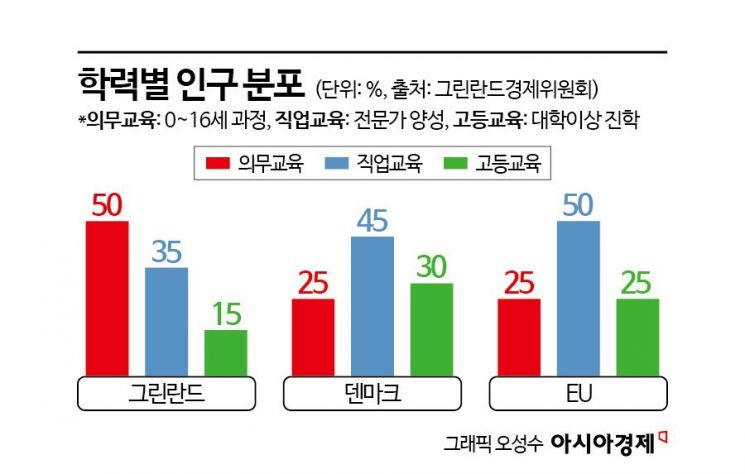
Education is one of the sectors where this vulnerability is most pronounced. Of Greenland's 75 elementary schools, half have 19 students or fewer. During the 2023-24 academic year, 106 out of a total of 631 classes were taught without being divided by grade. The report pointed out that inequality in education could lead to inequality in future employment, stating, "Opportunities in education and the future labor market must be the same for all children and adolescents."
Meanwhile, the Greenland Economic Council projects that the population will decrease by about 11,000 by 2045. Torben M. Andersen, Chair of the Greenland Economic Council and professor at Aarhus University, said, "Considering that Greenland's total population is 56,000, this represents a decrease of about 20%." He added, "Greenland's crisis is progressing regardless of President Trump's involvement, and the more serious issue is that small villages facing extinction are in an economically and socially vulnerable state."
© The Asia Business Daily(www.asiae.co.kr). All rights reserved.


















