Advocating for Climate Crisis Response System
Consistently Proposing Energy and Renewable Policies
Tasks Ahead: Handling Four Major Rivers Weirs and Climate Dam Policy
Kim Sung Hwan, a Democratic Party of Korea lawmaker who has led efforts to address the climate crisis and drive energy transition in the 22nd National Assembly, has been nominated as the first Minister of Environment under the Lee Jae Myung administration. If Kim officially assumes the post, it is expected that his first major task will be to establish a new Ministry of Climate and Energy and to oversee organizational restructuring.
Kim is widely recognized within the party as a leading expert on climate and energy issues. He is a legislative specialist who has consistently advocated for energy justice, the expansion of renewable energy, and the establishment of systems to respond to the climate crisis. Throughout the 20th to 22nd National Assemblies, he has continuously introduced related bills, many of which have either been passed or reflected in government policy.
In particular, the bills Kim has sponsored in the 22nd National Assembly clearly reflect his policy philosophy. Most recently, in April of this year, he introduced an amendment to the “Act on the Promotion of Development, Use, and Distribution of New and Renewable Energy.” This amendment pointed out the issue of fossil-based energy classified as “new energy” being included in renewable energy statistics, and improved the definitions to clarify the characteristics of renewable energy. Kim emphasized, “To prevent distortion of renewable energy distribution statistics, only truly eco-friendly energy should be used as the policy standard.”
He has also sought to strengthen democratic oversight of electricity policy. He introduced an amendment to the Electricity Business Act that would require the “Basic Plan for Electricity Supply and Demand,” formulated under the Ministry of Trade, Industry and Energy, to obtain the “consent” of the relevant National Assembly standing committee, rather than merely being “reported” to it. This legislation aims to ensure transparency in energy supply and enable the National Assembly to exercise meaningful policy oversight.
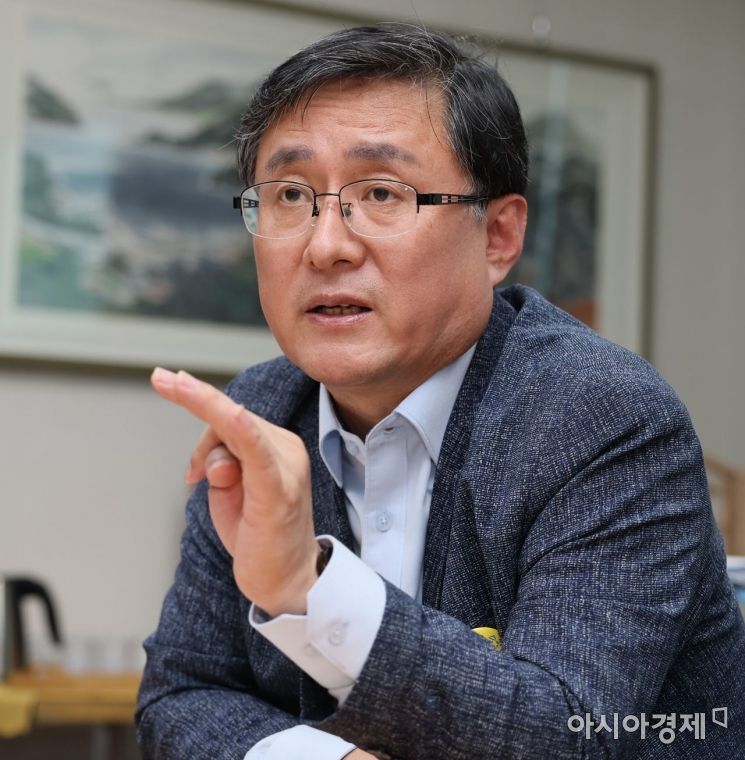 Sung-Hwan Kim, Policy Committee Chair of the Democratic Party of Korea. Photo by Dong-Joo Yoon doso7@
Kim also led and passed the “Special Act on the Management of High-Level Radioactive Waste” to clarify the responsibilities and procedures for managing high-level radioactive waste. This law is regarded as an effort to institutionalize the social responsibility associated with operating nuclear power plants.
Most of the bills Kim has introduced focus on designing systems to drive energy transition. Notably, his “Mandatory Bidirectional Charging for Electric Vehicles Act” and the “Hydrogen Economy Promotion Act,” which supports production costs for zero-carbon hydrogen produced using renewable energy, are seen as legislation that facilitates the shift from the existing energy system to a decarbonized, distributed model. Many of his bills have emphasized not only energy supply but also the transformation on the demand side. For example, the “Agro-Photovoltaic Support Act,” which aims to expand solar power in rural areas, is a representative bill that demonstrates an energy democracy approach, taking into account the acceptance of local residents and communities.
If Kim officially assumes the ministerial post, a key challenge will be how he concretizes the integrated structure of climate and energy policy currently being discussed by the National Policy Planning Committee, and how he coordinates interests among different ministries. In addition, major policy issues such as the handling of the Four Major Rivers weirs and the shift in climate dam policy are awaiting resolution. Kim will also have to address sensitive issues such as balancing the speed of energy transition with public acceptance, securing financial resources for climate policy, and introducing a carbon tax.
© The Asia Business Daily(www.asiae.co.kr). All rights reserved.

















