Cultural Heritage Administration Signs Donation Agreement with Japanese Temple... Components Transported
First Time an Entire Building Has Returned; Dismantling Costs Covered by Japan
"Hoping It Will Regain Its Original Value at an Appropriate Location in Korea"
The building Gwanwoldang, which had been taken to Japan during the Japanese colonial period, has returned to Korea after more than 100 years.
The Cultural Heritage Administration and the Overseas Cultural Heritage Foundation announced on the 24th that they had signed an agreement with Kotokuin, a temple in Kamakura, Japan, to receive the components of Gwanwoldang. Last year, Kotokuin dismantled the building and sequentially transported each component, including roof tiles, stone materials, and timber, to Korea. Eungcheon Choi, director of the Cultural Heritage Administration, said, "This is a meaningful achievement made possible through long-term consultations and cooperation between Korea and Japan," and added, "It was only possible thanks to the sincere donation by the owner and the efforts of experts from both countries."
This is the first time an entire Korean building located overseas has been returned to Korea. In 1995, 110 tons of remains from Jaseondang of Gyeongbokgung, discovered along the garden promenade of the Okura Hotel in Tokyo, were returned, but most of these were stone materials such as the foundation and cornerstone.
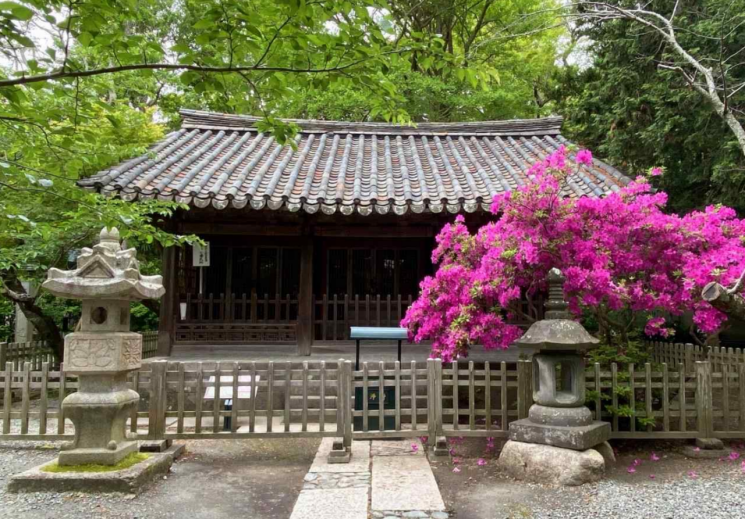
Gwanwoldang is believed to be a building related to the Joseon royal family. With a frontage of three bays and a gabled roof, it passed into Japanese hands in the 1920s and ended up behind the Great Buddha of Kamakura, a Japanese national treasure that stands 11.3 meters tall (excluding the pedestal), experiencing a tragic fate. Kotokuin explained, "In 1924, (Japanese entrepreneur) Kisei Sugino relocated the building from his home in Meguro, Tokyo, and donated it to the temple."
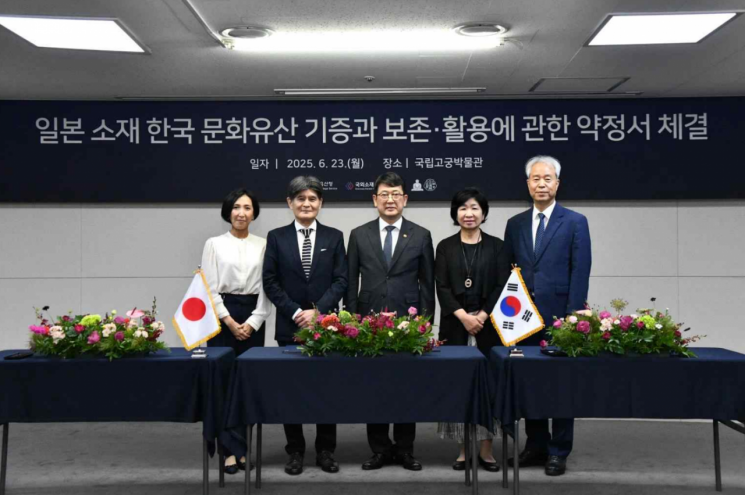 Officials posing for a commemorative photo after signing the donation agreement. From the left, Maiko Sato, Takao Sato, head monk of Godeokwon, Eungcheon Choi, director of the Cultural Heritage Administration, Junghui Kim, chairman of the Overseas Cultural Heritage Foundation, and Changyong Kwak, secretary general of the Overseas Cultural Heritage Foundation.
Sugino later became the first president of Yamaiichi Partnership, which would become Yamaiichi Securities. He is considered one of the key figures who led the Japanese economy in the modern era. Some believe that the Joseon royal family used Gwanwoldang as collateral when borrowing money, and that the building was transferred to Sugino when the Joseon Industrial Bank received a loan due to financial difficulties. There is also a view that the building was originally located in Gyeongbokgung, but its exact location and use remain unknown.
The Cultural Heritage Administration believes it is highly likely that Gwanwoldang was used as a royal shrine building related to the Joseon royal family in the 18th or 19th century. An official explained, "Architecturally, it corresponds to the scale of a royal shrine for a prince of the highest rank. Its elaborate decorations and diverse patterns demonstrate its high status."
Gwanwoldang could have returned to Korea earlier. In 2010, the Jogye Order of Korean Buddhism announced that it had reached an agreement with the Japan-Korea Buddhist Exchange Association to bring Gwanwoldang back to Korea. However, the negotiations were suddenly halted afterward.
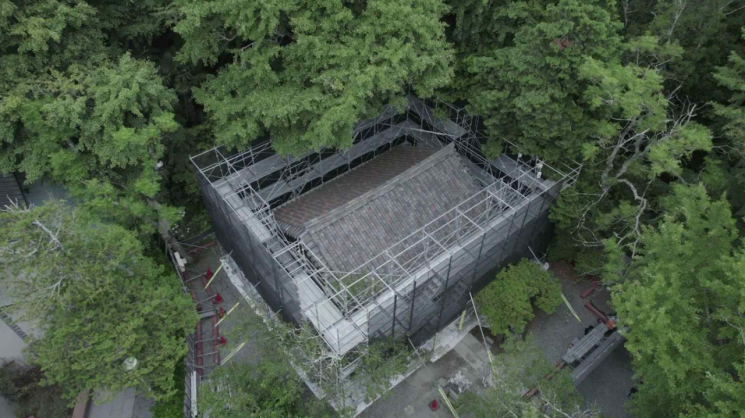
In 2019, the Cultural Heritage Administration and the Overseas Cultural Heritage Foundation reopened the discussion by exchanging opinions with Kotokuin on the preservation of the building. Takao Sato, the head monk of Kotokuin who expressed his intention to donate, cooperated by personally covering the costs of dismantling the building and transporting its components in Japan. He also expressed his intention to donate a separate fund to the Overseas Cultural Heritage Foundation to continue research on cultural heritage between Korea and Japan. He said, "I hope that, while remembering the historical significance and value that Gwanwoldang held at Kotokuin for the past 100 years, it will regain its original value at an appropriate location in Korea."
© The Asia Business Daily(www.asiae.co.kr). All rights reserved.



















