Selected for Greenhouse Gas Reduction Support Project by Ministry of Economy and Finance and Export-Import Bank of Korea
Utilizing Palm Oil Wastewater in Indonesia... 120,000 Tons Reduced Annually
"Reducing Methane and Recovering Biofuel Feedstock" Business Model
GS Caltex is launching an international reduction project to decrease greenhouse gases and secure biofuel feedstock by utilizing wastewater generated from palm oil production plants in Indonesia.
On June 24, GS Caltex announced that it had been selected as a target company for the "2025 International Greenhouse Gas Reduction Project Main Feasibility Study Support Program," promoted by the Ministry of Economy and Finance and the Export-Import Bank of Korea. This program is a government-supported system that assists companies in reducing greenhouse gases overseas, and is one of the measures to achieve the national greenhouse gas reduction target (NDC) by 2030.
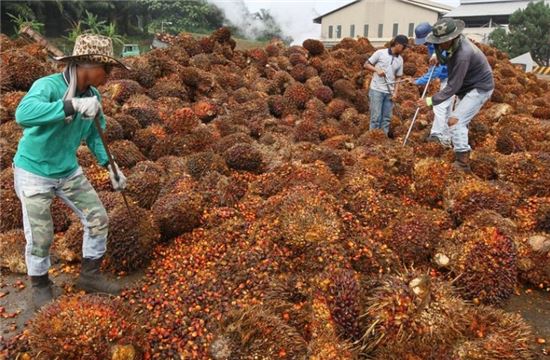 Palm oil production farm in Malaysia. Not directly related to the article. Bloomberg
This project will focus on wastewater generated at palm oil plants in eastern Indonesia. Although Indonesia is the world's largest producer of palm oil, the manufacturing process produces large volumes of wastewater. The traditional method of decomposing this wastewater in open ponds releases significant amounts of methane (CH₄), a greenhouse gas. According to the Intergovernmental Panel on Climate Change (IPCC), methane has a greenhouse effect 28 times more potent than carbon dioxide (CO₂).
GS Caltex plans to install palm oil wastewater evaporation and concentration treatment facilities locally in Indonesia to process the wastewater immediately, before it decays, thereby reducing methane emissions. At the same time, "POME Oil" (Palm Oil Mill Effluent Oil) extracted during this process can be used as a feedstock for eco-friendly fuels such as sustainable aviation fuel (SAF). Water and sludge (sediment) recovered during treatment will be reused as irrigation water and fertilizer for palm plantations.
The company expects a significant reduction in greenhouse gas emissions. It is estimated that each treatment facility can reduce approximately 120,000 tons of greenhouse gases per year, which is equivalent to the amount of carbon absorbed annually by about 14 million 30-year-old pine trees. The reduced carbon emissions can be recognized as carbon credits, contributing to the achievement of NDC targets for both Korea and Indonesia.
GS Caltex plans to determine the scale and schedule of investment after conducting a main feasibility study over the next six months to evaluate the greenhouse gas reduction effect and business viability. A GS Caltex official said, "Palm oil wastewater evaporation and concentration treatment is easier than the conventional methane capture method, and by treating the wastewater immediately upon generation, it prevents decay and has a significant methane reduction effect." The official added, "Depending on the results of the main feasibility study, we will consider expanding the project to palm plantations in Indonesia."
© The Asia Business Daily(www.asiae.co.kr). All rights reserved.
















