Yoon's Legal Team Argues
"Special Prosecutor's Assumption of Case Is Unconstitutional"
On June 23, the special prosecutor team led by Cho Eunseok, investigating the 12·3 Martial Law-related insurrection case, appeared in person for the first time at the trial of former President Yoon Seokyoul on charges of insurrection.
The Seoul Central District Court’s Criminal Division 25 (Presiding Judge Ji Guyoun) held the 8th trial on June 23 for former President Yoon Seokyoul, who is charged with being the leader of an insurrection and abuse of power by obstructing the exercise of official authority.
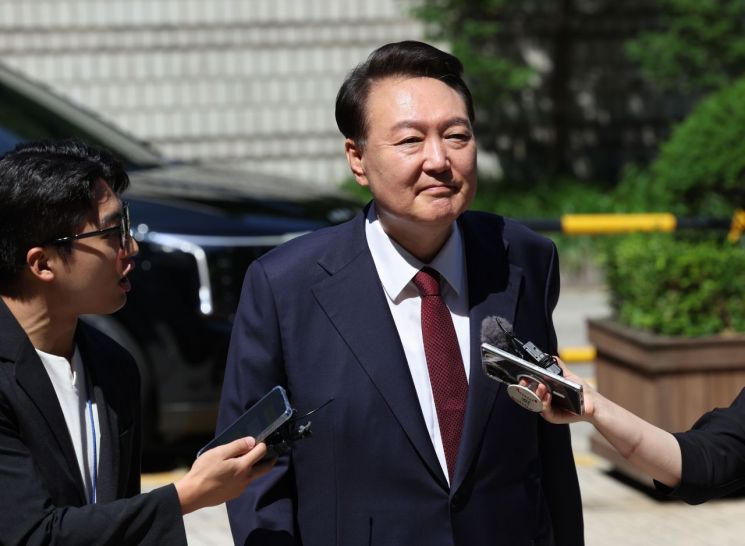 Former President Yoon Seokyoul is attending the 8th trial on charges of insurrection on the 23rd. Photo by Yonhap News
On this day, Lee Jaesik, former Director of Operational Readiness Inspection at the Joint Chiefs of Staff and Chief of Planning and Coordination at the Martial Law Command during the martial law period, appeared as a witness.
Park Eoksu, an assistant special prosecutor who attended the court that day, directly questioned the witness and asked Brigadier General Lee, "Does the strict control over the process of designating martial law operational forces mean, in a way, that even the president cannot arbitrarily exercise martial law-related authority?"
To this, Brigadier General Lee replied, "Even if martial law is declared, at a minimum, the martial law troops tasked with physical operations are not designated or deployed arbitrarily. You could see this as another form of control."
When Yoon Seokyoul’s lawyer, Yoon Gapgeun, asked, "Have you ever heard of the term 'preventive martial law'?" Brigadier General Lee responded, "Preventive martial law is not an official term, and the manuals state that martial law cannot be declared preventively."
When lawyer Yoon asked, "In this instance, martial law was maintained with the minimum number of troops, so it appears that orders were given to the Martial Law Commander after actions were taken. Isn’t this possible under martial law?" Brigadier General Lee replied, "It does seem to be an unusual case."
On the same day, Kwon Younghwan, an Army Colonel who was the Chief of the Martial Law Division at the Joint Chiefs of Staff during the martial law period, was also questioned as a witness. Colonel Kwon stated, "I did not believe the conditions for declaring martial law were met," and added, "There were no instructions to carry out related procedures in advance."
Former President Yoon Seokyoul was given the opportunity to speak directly in court to refute the testimony.
Regarding testimony by Lee Jaesik that the Martial Law Division, assuming the Chairman of the Joint Chiefs of Staff would be appointed as Martial Law Commander, set and presented all directions and orders related to martial law, former President Yoon Seokyoul argued, "Even if a local war, not a full-scale war, breaks out, the Chairman of the Joint Chiefs of Staff cannot serve as Martial Law Commander. If a military conflict occurs, the Chairman of the Joint Chiefs of Staff would not be in the right state of mind to handle martial law affairs."
Former President Yoon Seokyoul further stated, "The duties of martial law basically involve deploying the military, so it is more of an operational command task than a military administration one. That is the only reason why the Martial Law Division was placed under the Joint Chiefs of Staff," and added, "Today, the two witnesses said that the Chairman of the Joint Chiefs of Staff becomes the Martial Law Commander and prepares for martial law based on wartime procedures, but this does not align with the intent of the system."
He continued, "Moreover, the 12·3 Martial Law was a situation in which soldiers who were not in operational positions were deployed with the minimum possible personnel in order to send a strong message to the public. Not everything said by those working in the Martial Law Division is correct. I am offering a different perspective."
Meanwhile, prior to the trial, former President Yoon Seokyoul’s legal team raised an objection to the special prosecutor’s assumption of the case and maintenance of the indictment. His team argued, "The Special Prosecutor Act for insurrection contains more than one or two unconstitutional provisions," and asserted, "It is unprecedented in history for a specific political faction to recommend a special prosecutor, for a president from the same party to appoint them, and for prosecutorial powers to be exercised repeatedly." The legal team also stated that they plan to raise constitutional issues regarding this matter with the Constitutional Court.
The court plans to call Colonel Kwon and Ko Donghee, former Director of Planning at the Defense Intelligence Command, as witnesses for questioning at the 9th trial scheduled for July 3, as their testimony was not completed on this day.
© The Asia Business Daily(www.asiae.co.kr). All rights reserved.

















