"Sufficient rest and healing" (43.7%) most common
Followed by stress relief, recharging, and making memories with family and friends
People in their 20s say "cost-effectiveness is most important"
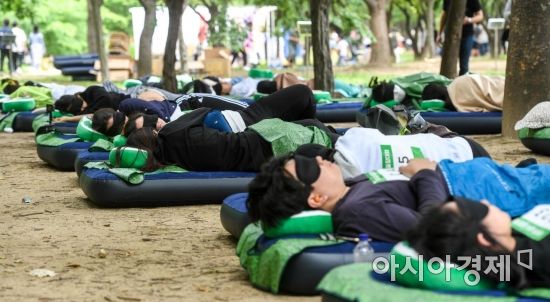 At an event held at Seoul Forest Family Yard in Seongdong-gu, Seoul, young adults in their 20s and 30s are taking naps. Photo by Asia Economy
According to a recent survey conducted ahead of this year's summer vacation season, the majority of respondents expressed a desire to focus on "rest," such as making memories and relieving stress.
On June 23, data consulting company PMI conducted a special survey on "2025 Summer Vacation Trends" through "GS&Panel," targeting 1,000 adults aged 20 to 69 nationwide who have plans for a summer vacation this year.
The results showed that the most popular times for summer vacation departures this year are expected to be "mid to late August" (29.6%) and "late July to early August" (28.5%). This was followed by "late vacation after September" (19.1%), "early to mid-July" (13.2%), "mid to late June" (5.3%), and "other" (4.3%).
Regarding the duration of vacations, "3 to 4 nights" (39.7%) and "1 to 2 nights" (38.2%) were almost equally common, while "5 nights or more" (13.7%) and "day trips" (4.8%) were relatively less frequent.
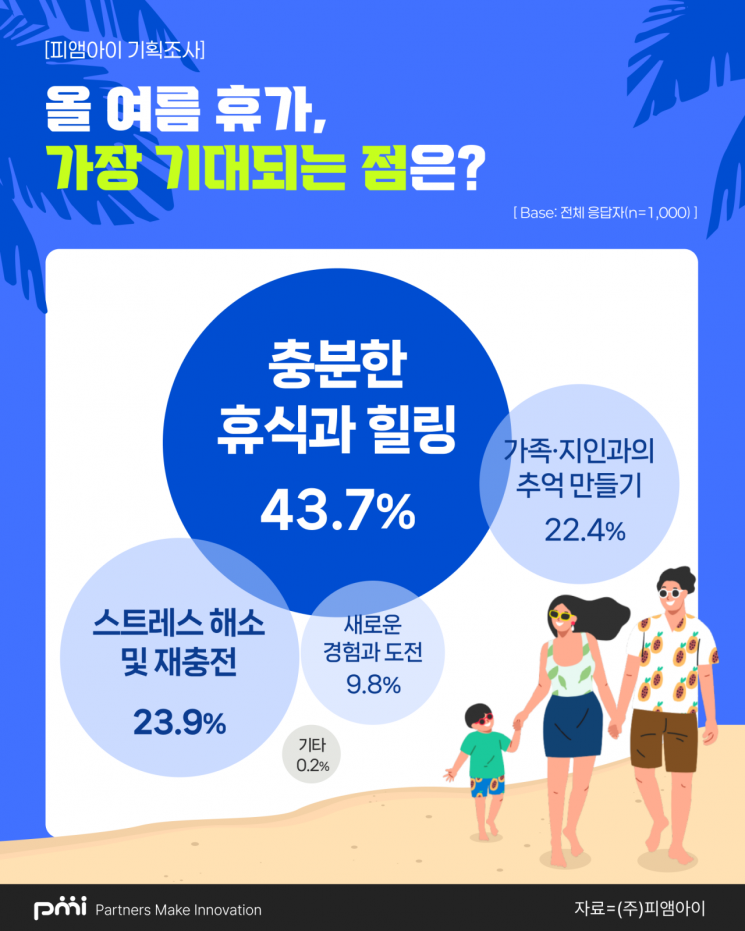 Data consulting company PMI conducted the '2025 Summer Vacation Trends' survey through 'GS&Panel'. PMI
When asked what they most look forward to during this year's summer vacation, "sufficient rest and healing" was the top response at 43.7%. This was followed by "stress relief and recharging" (23.9%), "making memories with family and friends" (22.4%), and "new experiences and challenges" (9.8%).
As for the most important factors when choosing a vacation destination, "domestic destinations" (25.3%) and "places for rest and healing" (24.7%) together accounted for about half of all responses. Other factors included "cost-effectiveness and value for money" (16.5%), "overseas destinations" (13.0%), "accessibility and convenience" (11.5%), "popular destinations on social media" (4.3%), "places for new experiences and special activities" (4.1%), and "other" (0.6%).
By age group, respondents in their 20s most frequently cited "cost-effectiveness and value for money" as important, while those in their 30s and 40s were relatively more likely to prioritize "rest and healing" as their main criteria.
Regarding the travel style they want to try this summer, "local restaurant and cafe tours" was the most popular at 41.3%, followed by "resort stays focused on private accommodations" at 34.9%. Other responses included "camping and glamping" (8.2%), "unique activity experiences" (7.1%), and "workation" (5.4%).
By age group, those in their 20s preferred food-focused trips centered on local experiences, while those in their 30s and 40s showed a relative preference for relaxing in private spaces. Notably, the response rate for "workation," or combining work and vacation, was more than five times higher among those in their 20s compared to other age groups, highlighting the tendency of Generation Z to view travel as an extension of everyday life.
As for sources of travel information, "portal sites" were the most common at 44.9%, followed by "social networking services (SNS)" (20.4%), "accommodation and travel booking platforms" (20.2%), and "recommendations and word-of-mouth from acquaintances" (13.1%). The recent trend of strengthening blog content exposure and changes in portal-based search environments may be contributing to a renewed focus on text-based information searches.
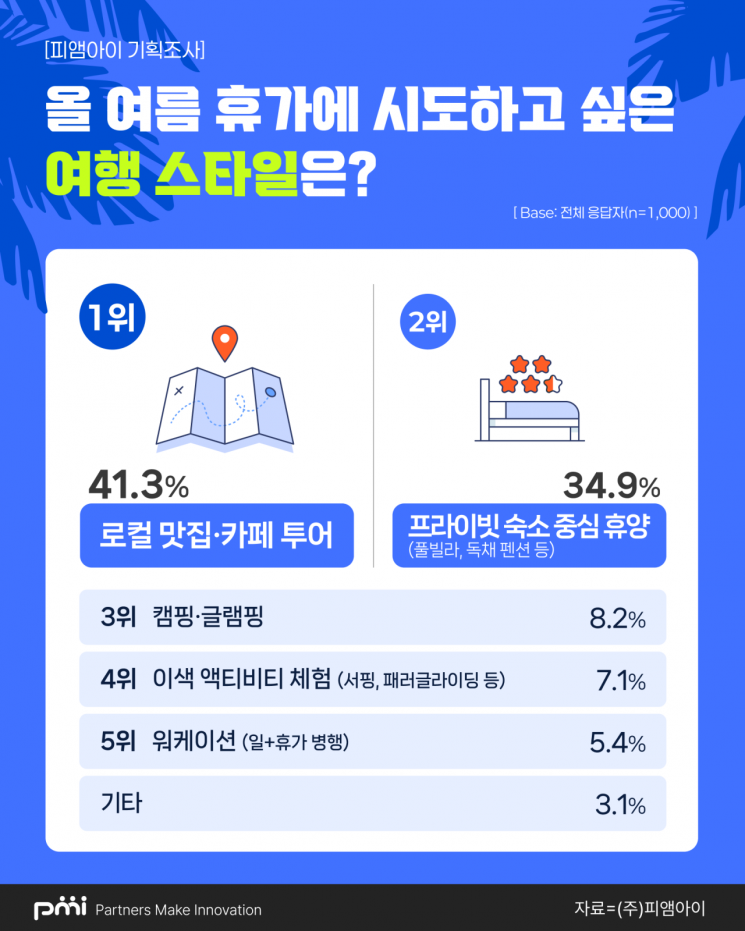 Data consulting company PMI conducted the '2025 Summer Vacation Trends' survey through 'GS&Panel'. PMI
The most common sources of stress when planning or returning from a vacation were "financial burdens such as exceeding the budget" (30.7%), "crowds and congestion at tourist sites" (29.9%), and "weather conditions such as heat waves or the rainy season" (28.4%), all cited at similar levels. "Difficulties in booking accommodations and transportation" (9.5%) was also mentioned as a stress factor by some respondents.
A PMI representative stated, "The results of this survey show that summer vacation is becoming more than just leisure time; it is establishing itself as a way for individuals to recover and adjust their life rhythm." The representative added, "As demand grows for planning satisfying vacations within limited time and budget constraints, there is a need for travel information services and environmental support to become more practical and user-oriented."
© The Asia Business Daily(www.asiae.co.kr). All rights reserved.
![Clutching a Stolen Dior Bag, Saying "I Hate Being Poor but Real"... The Grotesque Con of a "Human Knockoff" [Slate]](https://cwcontent.asiae.co.kr/asiaresize/183/2026021902243444107_1771435474.jpg)

















