Temporary Closure of Muan Airport Runway Causes Business Difficulties
Collecting On-site Feedback... Developing Practical Solutions
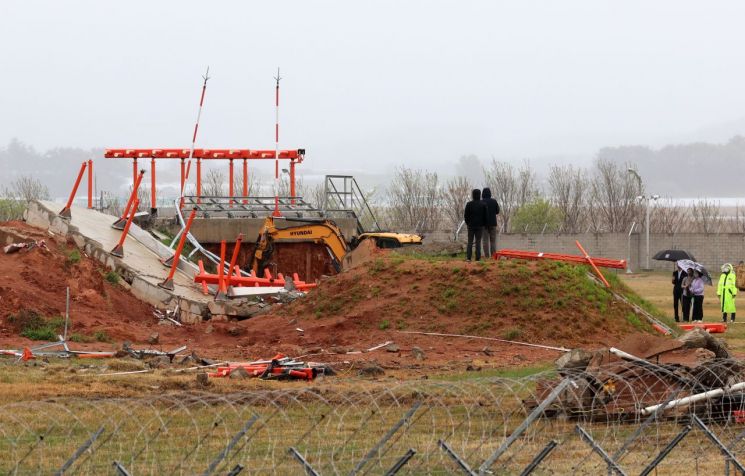 On April 22, officials from the Aviation and Railway Accident Investigation Board investigating the cause of the Jeju Air passenger plane accident at Muan International Airport in Jeonnam are conducting an on-site inspection of the localizer facility. Photo by Yonhap News
The Ministry of Land, Infrastructure and Transport announced on the 23rd that it will hold a kick-off briefing session on June 24 for the research project titled "Study on Measures to Revitalize the Economy in Areas Affected by the December 29 Passenger Plane Disaster," and will begin formulating measures to restore the economies of the Gwangju and Jeonnam regions.
After the passenger plane accident at Muan Airport in December last year, the runway was closed for a period of time, causing shops inside the airport, aircraft handling companies, and local tourism businesses to experience reduced sales and operational difficulties. Both local residents and industry stakeholders have consistently pointed out that the economic shock has spread not only to businesses directly affected by the accident but also throughout the entire region.
Accordingly, the government will conduct an accurate analysis of the damage and develop tailored support measures. The Ministry of Land, Infrastructure and Transport's December 29 Passenger Plane Accident Victims Support Team, in consultation with six ministries including the Ministry of Culture, Sports and Tourism and the Ministry of SMEs and Startups, as well as local governments in Gwangju and Jeonnam and experts, has decided to launch a research project aimed at objective damage assessment and the development of practical support measures.
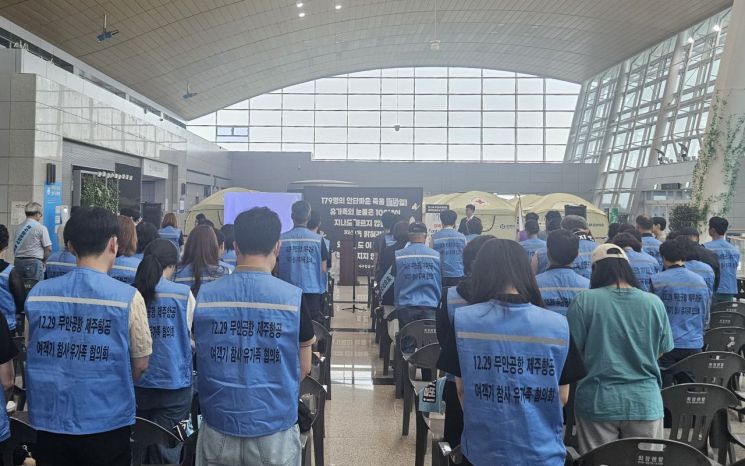 The Families' Council of the December 29 Muan Airport Jeju Air Passenger Plane Disaster held a press conference on the 21st on the 2nd floor of Jeonnam Muan International Airport, demanding that the Aviation and Railway Accident Investigation Board (ARAIB) secure independence from the Ministry of Land, Infrastructure and Transport and disclose to the families the engine damage areas and black box records. Provided by the Families' Council
The research will be conducted by the Korean Association for Regional Development Studies, which is composed of researchers specializing in regional development and disaster response. The study will be carried out over the next six months. First, it will examine the current economic conditions in the Gwangju and Jeonnam regions and investigate the actual damages caused by the passenger plane disaster, categorizing them by industry and sector.
The research team plans to directly gather on-site feedback by holding discussion sessions, surveys, and interviews with local government officials, small business owners, and tourism industry workers. The opinions of experts from local research institutes, chambers of commerce, and universities will also be incorporated.
Based on the collected data, the team will establish practical economic recovery plans and individual project proposals, and will review their feasibility through consultations with relevant ministries and local governments.
This initiative is in accordance with the "Special Act on Relief and Support for Victims of the December 29 Passenger Plane Disaster," which will take effect on June 30. The law stipulates that the state must develop support measures to revive the cultural and tourism industries and restore the regional economy in areas affected by the disaster.
Park Jeongsu, head of the Ministry's support team, stated, "An aviation accident is not just a disruption to air transport, but a disaster that has a wide-ranging impact on the entire regional economy. We will ensure the timely development of customized, comprehensive government support measures to help restore the regional economy."
© The Asia Business Daily(www.asiae.co.kr). All rights reserved.


















