3rd Anniversary Press Conference on the 23rd... Announcement of the "3.4.5 Project"
Triple Station Area: Sosa Station to Welcome KTX Era, Gyeongin Line Undergrounding Planned
Quadruple Station Area: Daejang to Become a Hub for Advanced Industries and UAM Future Mobility
Quintuple Station Area: Bucheon Sports Complex Aims for "Urban Innovation Zone" Designation
Bucheon City in Gyeonggi Province has decided to accelerate efforts to revitalize the local economy and achieve balanced regional development by transforming large-scale urban spaces centered around Sosa Station, Daejang Station, and Bucheon Sports Complex Station, which together form the "3·4·5 multiple station area."
On the 23rd, Mayor Jo Yongik of Bucheon held a press conference to mark the third anniversary of the 8th local government, where he announced the "Bucheon 3.4.5 Project," a roadmap for urban growth and balanced development.
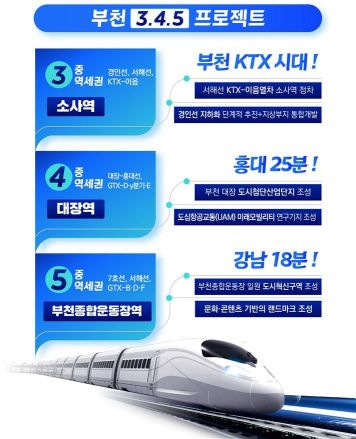 Development Blueprint for Sosa, Daejang, and Bucheon Sports Complex Stations: 'Bucheon 3.4.5 Project'
First, the city will promote the stopping of KTX-Eum trains at Sosa Station and will begin full-scale regeneration of the old downtown area through the undergrounding of the Gyeongin Line and integrated development of the above-ground land. The Seohae Line KTX-Eum is a semi-high-speed train that connects Gyeonggi, Chungcheong, and Jeolla provinces via the Seohae and Janghang lines.
Mayor Jo emphasized, "As of last year, Sosa Station, where the Gyeongin Line and Seohae Line intersect, had an average daily ridership of about 38,000 people, which is significantly higher than other Seohae Line stations in the region. The stopping of KTX-Eum trains at Sosa Station will provide a solution to improve transportation convenience for Bucheon citizens and nearby residents, and I will do my utmost to usher in the era of KTX in Bucheon."
Regarding the Bucheon section of the Gyeongin Line undergrounding, which passes through a total of five stations including Sosa, Yeokgok, Bucheon, Jungdong, and Songnae, Mayor Jo stated, "We will create a prosperous residential environment and a green ecological base, providing the residents of the old downtown with a vibrant environment where culture and commerce flourish. I will make every effort to ensure that the undergrounding of the Gyeongin Line is included in the government's comprehensive plan for integrated railway underground development."
The city also plans to develop the Bucheon Daejang Urban High-Tech Industrial Complex, centered around Daejang Station, as a research hub for advanced industries that will lead future changes and create new opportunities. In the future, Daejang Station will become a "quadruple station area" as it will be served by the Daejang-Hongdae Line, the GTX-D and Y branches, and the GTX-E Line.
Leading companies in the fields of future mobility, eco-friendly energy, and precision machinery, such as Korean Air, SK Green Techno Campus, and DN Solutions, will be located in the Bucheon Daejang Industrial Complex. The city plans to sign occupancy and land sales contracts with companies by the end of this year, and to complete land sales and construction by 2029.
Mayor Jo stated, "In particular, together with Korean Air, we plan to establish an urban air mobility (UAM) research base worth approximately 1.2 trillion won. We will also prepare a comprehensive plan linked to the development roadmaps of the Ministry of Land, Infrastructure and Transport and Gyeonggi Province, to firmly establish the urban air mobility industrial ecosystem as a new global growth engine."
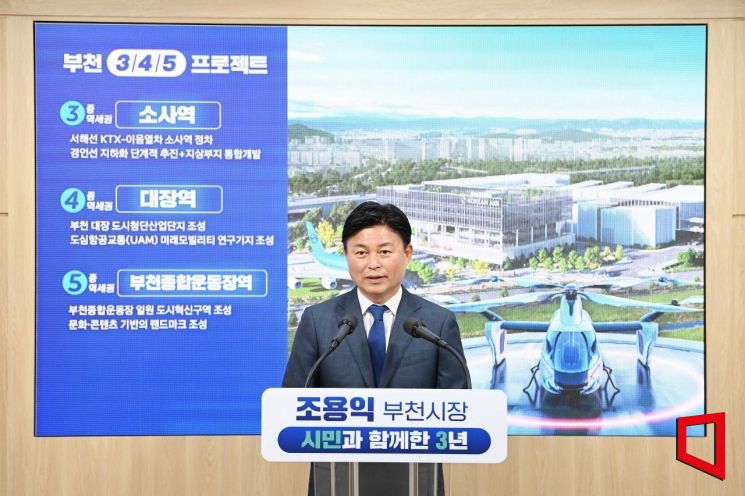 Mayor Jo Yongik of Bucheon held a press conference on the 23rd at City Hall to mark the 3rd anniversary of the 8th local government, announcing the "Bucheon 3.4.5 Project," a roadmap for urban growth and balanced development. Bucheon City
The area around Bucheon Sports Complex, which will become a "quintuple station area" served by Line 7, the Seohae Line, and the GTX-B, D, and F lines, is planned to be developed as an "urban innovation zone" responsible for the city's appeal and vitality.
The urban innovation zone, also known as the "White Zone," allows for flexible planning of land use, building coverage, and floor area ratios once designated by the Ministry of Land, Infrastructure and Transport, making it possible to attract investment and establish creative plans. Singapore’s landmark Marina Bay Sands was developed through the designation of such an urban innovation zone.
Mayor Jo stated, "Bucheon Sports Complex Station will offer excellent transportation infrastructure, allowing access to Seoul’s Gangnam area in just 18 minutes and providing connections in all directions. We will attract innovative industries to the area and introduce the convention and MICE (Meetings, Incentives, Conferences, and Exhibitions) industries, making it a vibrant and attractive hub where people, capital, culture, and content converge."
The plan is to create the hottest spot in the western metropolitan area by establishing a Bucheon landmark that harmonizes with the green landscapes connecting Wonmisan and Chuni Mountain. To achieve this, the city will begin by formulating a specialized plan and will actively pursue the designation of the urban innovation zone.
© The Asia Business Daily(www.asiae.co.kr). All rights reserved.
![Clutching a Stolen Dior Bag, Saying "I Hate Being Poor but Real"... The Grotesque Con of a "Human Knockoff" [Slate]](https://cwcontent.asiae.co.kr/asiaresize/183/2026021902243444107_1771435474.jpg)












