Iran Says "Enriched Material Moved to Safety"
"Nuclear Tracking More Difficult"... Some Say "2-5 Year Delay"
IAEA: "Difficult to Assess Fordow Damage"
On the early morning of June 22 (local time), the United States carried out an airstrike on Iran's Fordow nuclear facility using the so-called "bunker buster" GBU-57 bomb. There is considerable debate over the extent of actual damage inflicted on Iran's nuclear facilities. President Donald Trump announced that Iran's uranium enrichment facility had been completely destroyed, but Iran countered that only the above-ground structures of the nuclear site were damaged. Some observers have expressed concern that this airstrike has made it even more difficult to track Iran's nuclear development.
Immediately after the airstrikes on Iran's three nuclear facilities, President Trump described the operation as highly successful, stating, "Fordow is finished." In a national address, he also declared, "Iran's main uranium enrichment facility has been entirely eliminated." U.S. Vice President J D Vance also commented in an interview with NBC that "we believe we have significantly set back Iran's nuclear program."
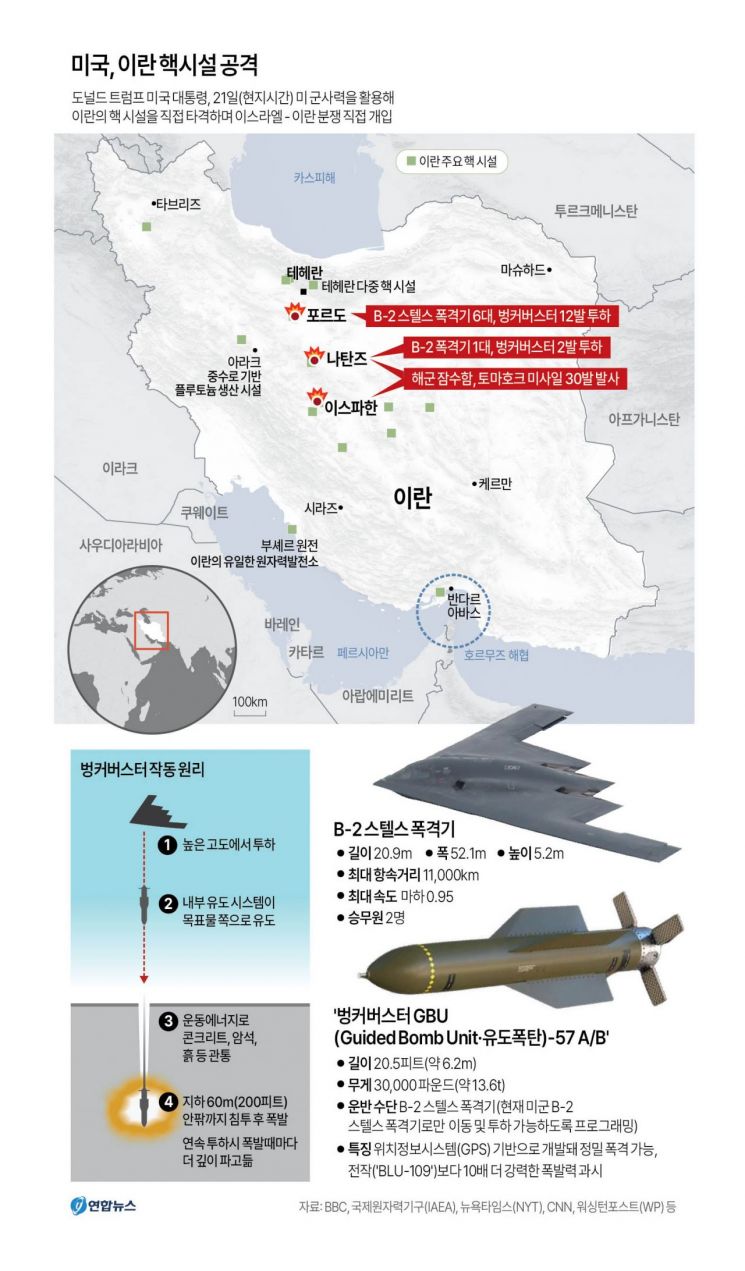
The Fordow nuclear facility is a key uranium enrichment site in Iran. According to a recent report by the International Atomic Energy Agency (IAEA), 2,700 centrifuges have been installed there. It is estimated that the purity of enriched uranium produced at Fordow and other locations has reached 60%, which is near weapons-grade.
The Fordow facility is located underground in the mountainous region of Qom Province to avoid external attacks, with the depth of the facility reaching 80 to 90 meters. Experts assess that while it would be difficult to destroy with weapons possessed by the Israeli military alone, the United States' bunker buster bomb, which can penetrate up to 60 meters below the surface, could cause substantial damage if deployed.
The New York Times (NYT) reported that satellite imagery analysis immediately after the airstrike revealed clear changes in the surface terrain and gray dust near the impact site. Bloomberg News, citing satellite imagery company Maxar Technologies, reported that a new crater with a diameter of 5.5 meters was observed directly above the underground enrichment facility. In satellite photos taken by Maxar Technologies the day after the airstrike, six holes believed to have been made by the bunker buster bomb penetrating the Fordow facility are visible.
However, Iran maintains that the damage from the airstrike was limited because it had preemptively moved enriched material from its main nuclear facilities to other locations. On June 20, Mohsen Rezaei, a general of the Islamic Revolutionary Guard Corps (IRGC), stated in a state media interview, "All enriched material has been transferred to a safe location." After the airstrike, Iran's state-run PressTV, citing sources, reported that "the three facilities were evacuated long ago, and the enriched uranium was also moved to a secure location."
After Israel and Iran exchanged large-scale airstrikes on each other's territory in October last year, the possibility of targeting Iran's nuclear facilities was actively discussed within Israeli political circles, making it plausible that Iran actually relocated its enriched materials. The NYT, citing satellite imagery and two Israeli officials, reported that there were indications Iran had recently moved some equipment and uranium in advance.
Bloomberg also stated, citing three sources, that it could not verify the U.S. claim that Iran's nuclear facilities were completely destroyed, and that the attack has made efforts to curb Iran's nuclear development even more complicated. Tariq Rauf, former head of nuclear verification policy at the IAEA, also said that tracking Iran's uranium has become more complex due to the bombing.
However, unlike uranium, core equipment such as centrifuges is difficult to move and is therefore believed to have been mostly destroyed, according to the NYT. Mick Mulroy, a former CIA officer who served at the Department of Defense during the first Trump administration, assessed that the attack is likely to delay Iran's nuclear program by two to five years. According to the IAEA, there has been no confirmed increase in external radiation levels as a result of the attack on Iran's nuclear facilities.
Rafael Grossi, Director General of the IAEA, explained at an emergency United Nations Security Council meeting in New York that the confirmation of a "large crater" at the Fordow facility suggests the use of a penetrating bomb by the United States.
He added that regarding the extent of underground damage at the Fordow facility, "At this point, no one, including the IAEA, is in a position to assess the situation underground at Fordow."
© The Asia Business Daily(www.asiae.co.kr). All rights reserved.
![User Who Sold Erroneously Deposited Bitcoins to Repay Debt and Fund Entertainment... What Did the Supreme Court Decide in 2021? [Legal Issue Check]](https://cwcontent.asiae.co.kr/asiaresize/183/2026020910431234020_1770601391.png)
















