Trade Surplus Reaches $2.62 Billion
Exports to the United States Also Increase
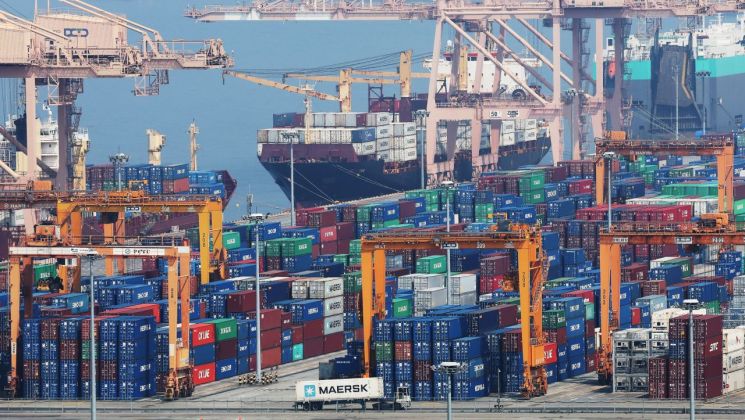
Exports from June 1 to 20 showed an increase of nearly 10%, driven by strong performance in key sectors such as semiconductors, automobiles, and ships. As exports recover in earnest, the trend of improving the trade balance is also continuing.
According to the "Export and Import Status for June 1-20 (provisional customs clearance data)" released by the Korea Customs Service on June 23, exports during this period reached $38.7 billion, up 8.3% ($2.97 billion) compared to the same period last year. Imports during the same period totaled $36.1 billion, an increase of 5.3% ($1.81 billion), resulting in positive growth for both exports and imports. The trade balance recorded a surplus of $2.62 billion, expanding from the $1.45 billion surplus in the same period last year.
From January to June 20 this year, cumulative exports amounted to $313.588 billion, up 0.1% from the previous year, while cumulative imports were $292.274 billion, down 1.6%. The cumulative trade surplus was calculated at $21.314 billion.
Despite the number of working days decreasing from 14.5 days last year to 14 days this year, average daily exports reached $2.76 billion, a 12.2% increase year-on-year.
By item, semiconductors recorded $8.858 billion, up 21.8% from the same period last year. The share of semiconductors in total exports rose by 2.5 percentage points to 22.9%. Passenger cars ($3.659 billion, up 9.2%) and ships ($1.578 billion, up 47.9%) also drove export growth. In particular, ships showed a clear recovery centered on high value-added vessels.
Other items such as computer peripherals ($780 million, up 32.6%) and auto parts ($1.222 billion, up 5.2%) also performed well. On the other hand, wireless communication devices ($719 million, down 33.1%) and home appliances ($356 million, down 26.0%) continued to struggle. Steel product exports rose by only 1.6%, while petroleum products saw a slight decrease (down 0.5%).
By country, exports to the United States ($7.423 billion, up 4.3%), the European Union (EU, $4.098 billion, up 23.5%), and Taiwan ($2.232 billion, up 46.3%) increased. In particular, exports to Greater China markets such as Taiwan and Hong Kong ($1.663 billion, up 30.2%) showed a marked recovery.
In contrast, exports to China ($6.972 billion, down 1.0%), Vietnam ($3.38 billion, down 4.3%), and Singapore ($860 million, down 3.0%) declined. The top three export destinations (the United States, China, and the EU) accounted for 47.8% of total exports.
Although energy imports decreased, imports of semiconductors and auto parts increased, resulting in overall import growth. Semiconductor imports rose to $4.568 billion, up 19.0%, while automobiles ($810 million, up 35.6%) and semiconductor manufacturing equipment ($1.409 billion, up 15.9%) also increased. Imports of gas ($1.602 billion, up 9.3%) and machinery ($1.816 billion, up 8.8%) also grew.
On the other hand, most energy-related items showed a downward trend. Crude oil imports were $4.519 billion, down 0.6%, petroleum products fell by 17.4%, and coal plunged by 28.4%. As a result, total energy imports (crude oil, gas, coal) decreased by 1.6% compared to the same period last year.
By country, imports from China ($7.991 billion, up 3.4%), the United States ($4.392 billion, up 4.8%), and Japan ($2.841 billion, up 12.1%) increased, while imports from the EU ($3.786 billion, down 1.5%) and Australia ($1.416 billion, down 10.6%) decreased. China maintained its position as the largest source, accounting for 22.2% of total imports.
An official from the Korea Customs Service stated, "While the recovery in exports centered on semiconductors is continuing, it is positive that both total exports and average daily exports increased despite the decrease in the number of working days." The official added, "However, as the performance gap between items and countries widens, it is necessary to diversify the export base."
© The Asia Business Daily(www.asiae.co.kr). All rights reserved.

















