The Research and Development Special Zone Promotion Foundation (hereinafter referred to as the Special Zone Foundation) recently visited the National Science Foundation (NSF) in Washington D.C., USA, and discussed ways to strengthen the foundation for collaboration and technology commercialization projects with the NSF's Regional Innovation Engines (RIE), the foundation announced on the 23rd.
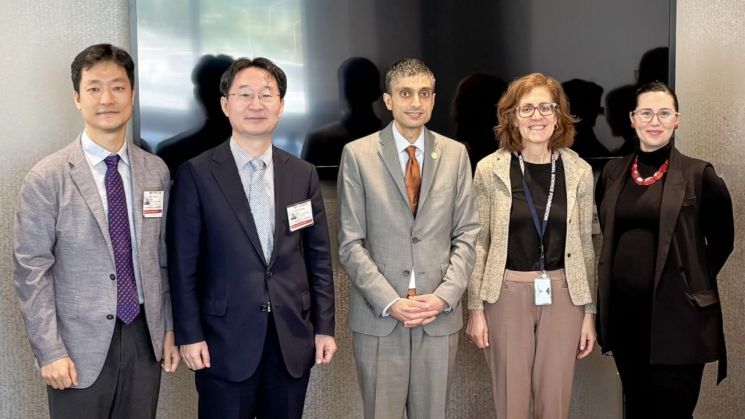 Jung Heegwon, chairman of the Special Zone Foundation (second from the left), recently met with Irwin Gianchandani, deputy director of the NSF Office of Technology, Innovation, and Partnerships (third from the left), in Washington D.C., USA, to discuss collaborative projects and took a commemorative photo afterward. Provided by the Research and Development Special Zone Promotion Foundation
The NSF, a leading science and technology support agency established by the U.S. government in 1950, has launched and operated RIEs in 10 regions, including New York and North Carolina, since last year.
The collaborative project between the two organizations was planned starting with the "Korea-U.S. Technology Commercialization Infrastructure Roundtable" held in July last year.
The purpose of the collaborative project is to build a global technology commercialization support system that covers the entire cycle, by connecting the innovation networks of both countries. This includes joint utilization of research resources, activation of joint research and personnel exchanges, support for local proof of concept (PoC) of technologies and products, and the creation of economic outcomes.
Through the visit to the NSF, the Special Zone Foundation reached a consensus on expanding the foundation for collaboration between domestic research and development special zones and local RIEs in the United States, and agreed to continue working-level consultations to further expand future collaborative projects.
Jung Heegwon, chairman of the Special Zone Foundation, said, "Through the collaborative project, we are now able to utilize local U.S. industry-academia-research channels with commercialization capabilities. The Special Zone Foundation will continue to strengthen its collaborative network with global innovation clusters and expand support to help deep-tech companies within the special zones more easily enter overseas markets."
Meanwhile, the collaborative project is being operated through the "Global Cluster R&BD Support Project" promoted by the Special Zone Foundation. A total of 10 projects were submitted for the support program by the end of May. The Special Zone Foundation plans to select one final project (for up to 18 months and up to 3 billion KRW) from among the submitted projects and officially launch the program starting next month.
© The Asia Business Daily(www.asiae.co.kr). All rights reserved.

















