Volatility in Financial Markets Rises After U.S. Airstrike on Iran
Major Financial Groups Hold Emergency Meetings
Lim Jongryong, Chairman of Woori Financial Group: "Financial Markets May React Sensitively, Countermeasures Needed"
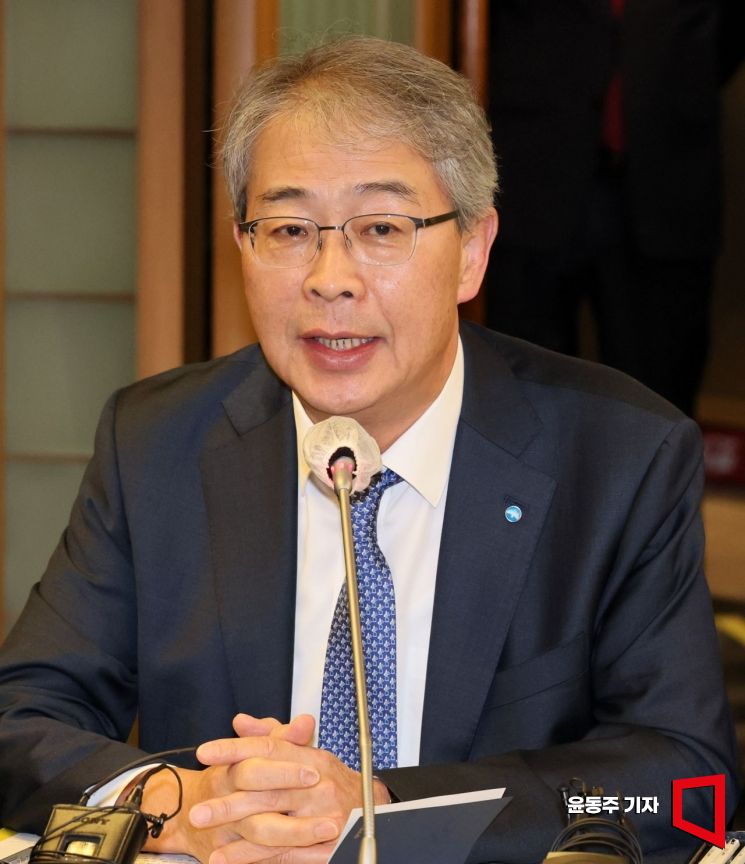
As the United States launched an airstrike on Iran's nuclear facilities, volatility in the financial markets increased, prompting the financial sector to enter an emergency response mode.
According to the financial industry on the 23rd, major domestic financial holding companies and banks have convened emergency management meetings and are closely monitoring the financial markets. They are also maintaining emergency response systems to enable swift action should volatility escalate.
On the previous day, Woori Financial Group held an "Emergency Review Meeting on the Middle East Situation" presided over by Chairman Lim Jongryong, where they examined the impact of the U.S. attack on Iran's nuclear facilities on domestic and international economic and financial markets and discussed response strategies. The meeting was attended by all key executives from major affiliates, including Chairman Lim, Woori Bank President Chung Jinwan, and Woori Financial Management Research Institute CEO Park Junghoon.
Chairman Lim emphasized, "Based on past experience, the domestic financial and foreign exchange markets may react sensitively, such as with a rise in the won-dollar exchange rate and a decline in stock indices. We must closely monitor market conditions and calmly focus on our respective responsibilities." He added, "We need to monitor market conditions in real time and frequently check the group's liquidity, asset soundness, and capital ratios. It is also necessary to cooperate promptly and seamlessly with government measures and to provide emergency support to export and domestic companies experiencing temporary funding difficulties."
KB Financial Group stated that it is operating a standing emergency response system, involving all executives and key affiliate executives, to ensure rapid response in the event of increased market volatility. The company has enhanced its internal decision-making system to identify major risk factors in advance and take proactive measures, such as adjusting asset portfolios, should market uncertainty intensify. A KB Financial official explained, "We are closely monitoring the overall financial markets, including global markets, and are also checking capital market profits and losses on a daily basis."
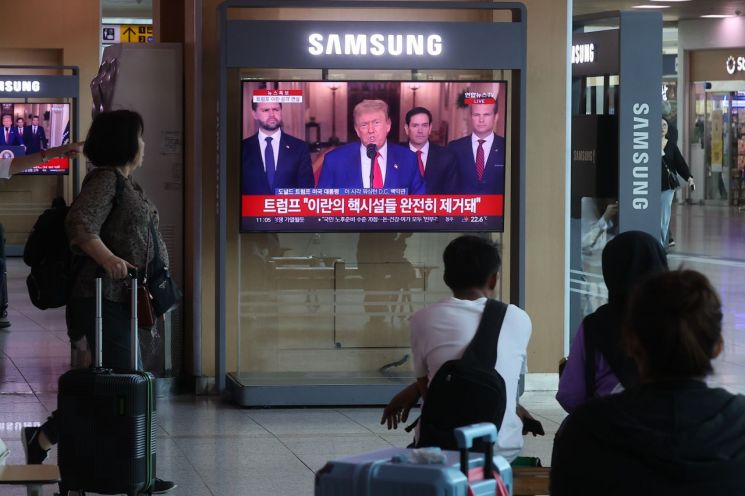 On the 22nd, citizens are watching the national address by U.S. President Donald Trump regarding the Iranian airstrike in the waiting room of Seoul Station. Photo by Yonhap News
Shinhan Financial Group is also strengthening its monitoring to respond to increased market volatility. Given concerns over exchange rate and oil price volatility, the group plans to assess liquidity risks in the foreign exchange and money markets and activate its response system. It has also established a support system based on macroeconomic analysis by research teams at both the group and subsidiary levels.
Hana Financial Group is preparing for potential liquidity crises and maintaining its role in the smooth supply of financial resources by monitoring funding rate conditions in real time. To maintain adequate capital levels, each affiliate is checking for unusual trends through daily monitoring of asset increases and decreases. A Hana Financial official stated, "We are implementing various measures to respond to increased market volatility and financial and real economic crises resulting from the Middle East conflict. If financial market uncertainty expands due to an escalation of the Middle East conflict, we plan to respond according to pre-established scenarios, including securing additional liquidity and supporting the real economy as necessary."
© The Asia Business Daily(www.asiae.co.kr). All rights reserved.


















