A tactile sensor with a three-dimensional electronic structure capable of accurately and rapidly detecting faint breaths, low pressure, and even small sounds has been developed.
Tactile sensors are technologies that allow robots to detect 'pressures' at their fingertips when grasping objects or enable medical devices to sense pulses. Existing sensors have been limited by slow response times or reduced accuracy after repeated use. However, the newly developed tactile sensor is being recognized as an innovative technology that overcomes these limitations.
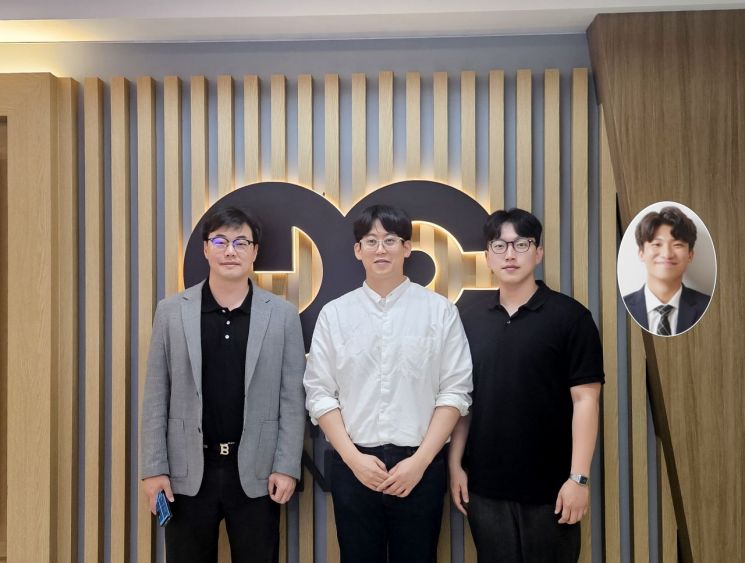 (From left) Professor Inkyu Park, Dr. Jungrak Choi, PhD candidate Donho Lee, Master Chan-gyu Han. Provided by KAIST
On June 23, KAIST announced that a research team led by Professor Inkyu Park from the Department of Mechanical Engineering, in collaboration with the Electronics and Telecommunications Research Institute (ETRI), has developed a customized tactile sensor using the 'thermoformed 3D electronics' (T3DE) method, overcoming the structural limitations of existing tactile sensor technologies.
This sensor achieves flexibility, precision, and repeatable durability simultaneously. In particular, it overcomes the structural issues of conventional sensors based on soft elastomers such as rubber and silicone, including slow response speed, high hysteresis (where the result is not always the same even with identical stimuli), and creep error (where materials deform slowly under prolonged force). At the same time, it can operate precisely in a variety of environments.
The T3DE sensor is manufactured by precisely forming electrodes on a two-dimensional film and then molding it into a three-dimensional structure using heat and pressure.
The electrode and supporting leg structures on the upper part of the sensor are designed so that their mechanical properties can be adjusted according to the intended application. By fine-tuning structural parameters such as the thickness, length, and number of supporting legs, the sensor's Young's modulus can be set over a wide range, from 10 Pa to 1 MPa.
Young's modulus is an indicator of material stiffness. The joint research team has enabled adjustment to levels that match various biological tissues. This makes it possible for the sensor to be used for actual bio-interface applications, as it can mimic the properties of skin, muscle, tendons, and other biological tissues.
The T3DE sensor utilizes air as a dielectric to reduce power consumption, while also demonstrating excellent performance in terms of sensitivity, response speed, temperature stability, and repeatability.
In practice, the joint research team visualized the pressure distribution on the soles of feet in real time during movement using a total of 2,800 sensors, and confirmed the potential for vascular health assessment by measuring wrist pulses. They also achieved successful results in sound detection experiments at the level of commercial acoustic sensors. This confirmed that the T3DE sensor can accurately and rapidly measure pressure, pulse, and sound.
The joint research team also applied T3DE technology to an augmented reality (AR)-based surgical training system. By assigning different Young's modulus values to each sensor element, they were able to replicate stiffness similar to actual biological tissues.
According to the joint research team, the system is capable of providing simultaneous visual and tactile feedback depending on the intensity of pressure applied during surgical incisions, and can issue real-time warnings if an incision is too deep or a dangerous area is touched. This technology is also being recognized as a breakthrough for significantly enhancing the immersion and accuracy of medical education.
Professor Inkyu Park said, "This sensor can be precisely adjusted from the design stage, allowing it to operate reliably in various environments. We expect it will be useful not only in daily life, but also in fields such as medicine, rehabilitation, and virtual reality."
This research was led by Professor Inkyu Park, with Dr. Jungrak Choi from ETRI, Master Chan-gyu Han from KAIST, and PhD candidate Donho Lee participating as co-first authors. The results were published in the May issue of Science Advances and were also introduced through the official SNS channels of Science Advances.
© The Asia Business Daily(www.asiae.co.kr). All rights reserved.

















