Gyeonggi Province has issued an anthracnose warning for major crops such as chili peppers.
The Gyeonggi-do Agricultural Research and Extension Services urged preemptive disease control measures, citing concerns that rising temperatures and frequent rainfall could lead to outbreaks of anthracnose in key crops such as chili peppers and apples.
Anthracnose is a fungal disease characterized by spots on fruit or leaves that resemble scalding with hot water. The lesions expand into circular or irregular concentric patterns, eventually forming yellowish-brown spores. The disease spreads easily through wind and rain in hot and humid weather, and failure to control it can result in crop losses before harvest.
This year, the Korea Meteorological Administration forecasts that the rainy season will begin earlier than usual and bring higher precipitation. In addition, climate change is leading to more localized heavy downpours, which increases the risk of anthracnose spreading and calls for heightened vigilance.
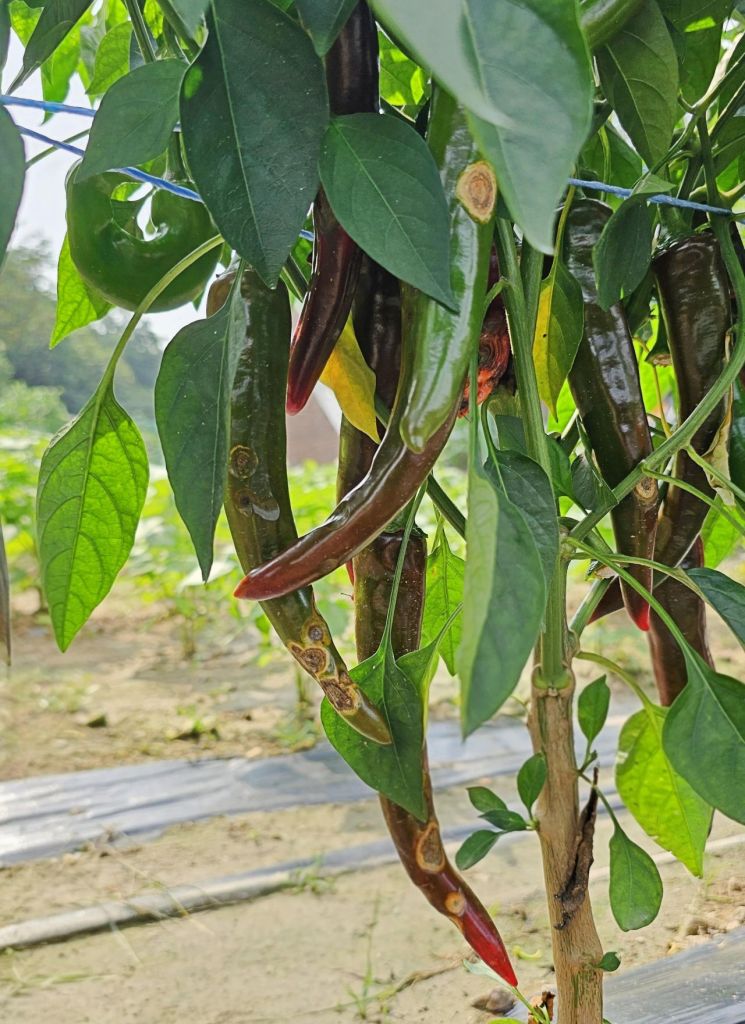 The chili peppers are withering from anthracnose. Provided by Gyeonggi-do Agricultural Research and Extension Services.
To prevent anthracnose, the provincial research institute recommends selecting resistant varieties, maintaining adequate planting distances, managing ridges and mulching, and applying protective fungicides (with 'K' mode of action) before and after the rainy season. If the disease has already occurred, infected fruit should be removed, and curative fungicides with different modes of action should be alternated at intervals of 7 to 10 days.
The provincial research institute currently operates the 'Agricultural Weather and Pest System,' which predicts and provides information on the occurrence of 31 types of diseases and pests affecting seven crops, including chili peppers, apples, and pears, based on meteorological data such as temperature and precipitation.
Park Joongsu, head of the Environmental Agriculture Research Division at the provincial research institute, said, "The risk of anthracnose outbreaks has increased due to the combination of high temperatures and humidity during the rainy season," adding, "We will focus on developing disease control strategies that take into account pesticide resistance issues and on building a precise pest and disease forecasting system."
© The Asia Business Daily(www.asiae.co.kr). All rights reserved.
![Clutching a Stolen Dior Bag, Saying "I Hate Being Poor but Real"... The Grotesque Con of a "Human Knockoff" [Slate]](https://cwcontent.asiae.co.kr/asiaresize/183/2026021902243444107_1771435474.jpg)
















