As of This Month, 40,000 U.S. Troops Stationed
U.S. Military Facilities at 19 Locations in the Middle East
The elite Islamic Revolutionary Guard Corps (IRGC) of Iran warned of retaliation on June 22 (local time in Iran), referencing U.S. military bases in the Middle East in response to a U.S. military airstrike on Iranian nuclear facilities.
According to the semi-official Tasnim News Agency, the IRGC stated in a declaration that day, "We have identified and monitored the flight paths of aircraft involved in the aggression," adding, "The number, distribution, and scale of U.S. military bases in the region are not strengths but vulnerabilities." The IRGC further warned, "The United States has repeated its previous failed and reckless actions, exposing its strategic incompetence and ignorance of the realities in the region. Due to the aggression of the U.S. terrorist regime, Iran has chosen its right to self-defense, and the aggressors should expect a regrettable response."
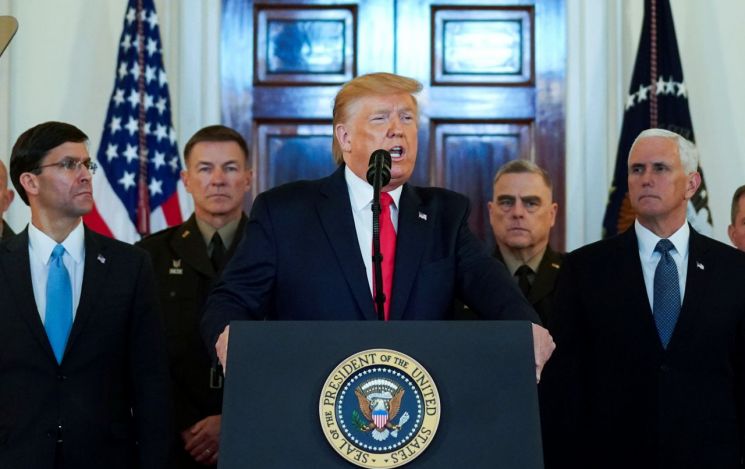
It is realistically impossible for Iran to launch a military or terrorist attack on U.S. territory, at least in the short term. Therefore, if Iran attempts to retaliate directly against the United States, it is highly likely to target U.S. military bases located relatively nearby. In fact, on January 3, 2020, after a U.S. drone strike killed IRGC Quds Force commander Qasem Soleimani?then a key military leader?near Baghdad Airport, the IRGC retaliated five days later by launching more than ten ballistic missiles at two U.S. military bases in Iraq.
According to the Council on Foreign Relations (CFR), a Washington, D.C.-based think tank, as of this month, approximately 40,000 U.S. troops are deployed in the Middle East. A significant portion of these personnel are stationed on naval vessels such as aircraft carriers. Although this is fewer than the 43,000 troops deployed in October last year, it remains higher than the peacetime estimate of about 30,000 U.S. troops typically stationed in the region in recent years. During major operations, the numbers were much higher, such as 160,000 troops in Iraq in 2007 and 100,000 in Afghanistan in 2011.
Currently, the United States operates at least 19 military facilities in the Middle East, including in Bahrain, Egypt, Israel, Jordan, Kuwait, Qatar, Saudi Arabia, and the United Arab Emirates (UAE). Of these, eight appear to be permanent bases. Except for Syria?which has been pursuing normalization of relations with the United States since the fall of the Assad regime in December last year?all countries hosting U.S. troops have agreed to and signed agreements regarding the use of these bases.
The Al Udeid Air Base in Qatar houses the forward headquarters of U.S. Central Command (CENTCOM), which oversees operations in the Middle East, North Africa, and Central Asia. The forward headquarters for CENTCOM’s Air Force and Special Operations Forces, as well as the headquarters of the 379th Air Expeditionary Wing, are also located there. The U.S. Naval Support Activity (NSA) base in Bahrain hosts the headquarters of the U.S. Fifth Fleet and CENTCOM’s naval headquarters. This naval base features deep-water ports capable of accommodating supercarriers and other large warships. The U.S. Navy took over this base from the British Navy in 1948. Several U.S. Coast Guard vessels are also stationed in Bahrain.
In Iraq, there are several U.S. military bases, including Al Asad Air Base and Erbil Air Base, which collectively host about 2,500 troops as part of international coalition operations against the Islamic State (IS). In Syria, U.S. troops are deployed as part of multinational cooperation to eliminate IS. The U.S. Department of Defense announced in April this year its plan to reduce the number of U.S. troops in Syria to fewer than 1,000. Since the outbreak of the Gaza Strip war in October 2023, U.S. bases in Iraq and Syria have been repeatedly attacked by pro-Iranian militias, but such attacks have recently subsided. However, there is a possibility that attacks could resume in response to the U.S. strike on Iranian nuclear facilities.
In Kuwait, the Arifjan base hosts the Army forward headquarters of U.S. Central Command, and the Ali Al Salem Air Base hosts the headquarters of the 386th Air Expeditionary Wing. In the UAE, the Al Dhafra Air Base houses the headquarters of the 380th Air Expeditionary Wing. Separately from these bases, naval assets such as aircraft carriers and destroyers are also deployed in Middle Eastern waters.
Currently, a carrier strike group centered on the aircraft carrier Carl Vinson has been deployed near the eastern coast of Oman in the northern Indian Ocean since March, and another carrier strike group centered on the Nimitz is moving through the Indian Ocean toward Middle Eastern waters. Additionally, destroyers are deployed in the eastern Mediterranean and the Red Sea, while mine countermeasures vessels (MCMV) and littoral combat ships (LCS) are stationed in the Persian Gulf to clear mines and secure safe passage. The destroyer Thomas Hudner is also prepared to move from the western Mediterranean to the eastern Mediterranean, closer to the Middle East, if necessary. Although not under the jurisdiction of Central Command, there are also large U.S. bases in Djibouti, located between the Red Sea and the Gulf of Aden, and in T?rkiye in the eastern Mediterranean, which can support U.S. operations in the Middle East if needed.
© The Asia Business Daily(www.asiae.co.kr). All rights reserved.

















