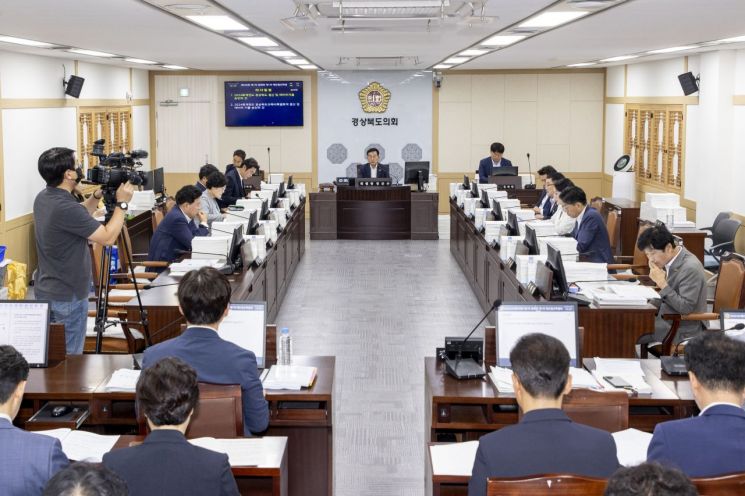
The Gyeongbuk Provincial Council Budget and Accounts Special Committee (Chairman Jung Geunsoo) conducted a review and approved the original proposal for the 2024 fiscal year settlement of accounts and reserve fund expenditure, submitted by the Gyeongbuk Governor and the Gyeongbuk Superintendent of Education, over two days from June 19 to June 20.
During the review process, the committee members sharply pointed out issues in budget execution, urging institutional improvements and thorough post-management regarding the problems that surfaced this time. They also presented various opinions to ensure the appropriateness of expenditure budget execution and the soundness of fiscal management.
Kim Changhyuk (Gumi) pointed out the lack of prior forecasting and planning at the budget formulation stage, emphasizing the need for accurate statistical data and collaboration with the autonomous police for the Safe Way Home project. He criticized the failure to properly execute the budget for school violence prevention and counseling, stressing the urgent need for realistic budget formulation in the future, as well as administrative support to strengthen teachers' educational authority.
Kim Jaejun (Uljin) mentioned that Gyeongbuk Province's net world surplus increased by 30 to 40 percent compared to the previous year, pointing out problems of excessive budget formulation and low execution rates. He suggested the need to review conservative revenue estimates and strengthen prior review. In particular, he criticized poor management regarding the occurrence of unspent funds at the education support office, calling for systematic management measures to improve budget execution efficiency and minimize carryovers.
Nam Youngsook (Sangju) pointed out that despite a large budget being invested in the construction of the East Sea Regional Headquarters building and related facilities, the budget for the multipurpose stadium project within the headquarters was formulated and executed without accurately assessing the on-site situation, resulting in wasted or unused funds. She emphasized the importance of thorough project planning to ensure fiscal efficiency when promoting large-scale projects.
Park Youngseo (Mungyeong) strongly pointed out the need to consolidate or close schools due to the sharp decline in the number of students, criticizing cases where tens of billions of won in remodeling budgets are allocated to schools with almost no students. He also stressed the need for a rational and realistic approach in the budget formulation and execution process, recognizing the reality of declining school-age population when implementing policies to reduce educational disparities between regions.
Yoon Seungo (Yeongcheon) expressed concerns about the possibility of blind spots in the procedures of the Gyeongbuk Provincial Subsidy Review Committee, urging institutional improvements to ensure accurate procedure compliance and political neutrality. He also highly praised the achievements of the education office staff and called on the Gyeongbuk Office of Education to realize the superintendent's educational philosophy and strive for the advancement of education in Gyeongbuk so that it can set the global standard.
Yoon Cheolnam (Yeongyang) pointed out that the age criteria for the Young Farmers Support Project are unclear and inconsistent, stating that institutional improvements, such as raising the criteria through consultation with the government, are necessary. In addition, he highlighted the lack of effectiveness in the AI service robot support project due to its low execution rate and lack of demand, emphasizing the urgent need for structural reform and a comprehensive review of the entire project.
Lee Cheolsik (Gyeongsan) criticized the delay in the Family-Type Wee Center project, where only the budget was allocated but the actual project has been delayed, stressing that supporting at-risk youth is an essential and top-priority responsibility of the education office. He argued for the urgent need to move beyond administrative planning that ignores the serious realities of rising suicide rates and mental health crises, and to establish feasible measures and promptly implement the project.
Lee Chilgu (Pohang) emphasized the need to establish legal and financial support at the Gyeongsangbuk-do level for compensation lawsuits related to Pohang earthquake victims, as well as the necessity for joint response between Pohang City and Gyeongbuk Province. He also pointed out the lack of on-site verification for provincial subsidy projects, suggesting that the effectiveness of execution should be more closely examined and proposing the discovery and expansion of support for highly effective projects.
Lim Byungha (Yeongju) stressed the need for thorough analysis of social perceptions and changes regarding the low birth rate issue during policy formulation and budget planning. He also requested that Gyeongbuk Province play an active mediating role, conduct continuous monitoring, and establish reasonable solutions among stakeholders to resolve issues related to the licensing of Yeongju City's waste treatment facility.
Jung Kyungmin (Proportional Representation) mentioned the issue of duplicate support for private subsidies by the provincial government and the education office, pointing out the lack of an integrated inspection system to screen for duplicate support in advance. She strongly demanded the establishment of a system to check for duplicate subsidies from other agencies at the application stage, as well as measures to address inappropriate cases that have persisted for years and to prevent recurrence in the future.
Cha Joosik (Gyeongsan) criticized the lack of achievements and outcomes despite the increase in contributions to the Gyeongbuk Research Institute, calling for strengthened responsibility and roles of research institutions to prevent the waste of residents' tax money. He also pointed out the need to verify the expertise of organizations implementing subsidy projects, stating that careful review and management are necessary to ensure that subsidies are executed in line with the purpose and content of the projects.
Choi Taerim (Uiseong) emphasized that Gyeongbuk Province needs to strengthen practical programs, not just simple promotion, to regain its status as the origin of the Saemaeul Movement, suggesting the need to include practical elements such as volunteer activities in program design. He also pointed out concerns about the increased burden of local bond interest and the lack of reserve funds, proposing the expansion of reserve fund allocation to respond to unexpected disasters.
Chairman Jung Geunsoo stated, "This settlement review has served as an important opportunity to examine the actual state of budget management by the provincial government and the education office and to enhance the transparency and efficiency of future budget formulation and execution. The Budget and Accounts Special Committee will continue to monitor and propose improvements so that taxpayers' money can be used to improve the quality of life and education for residents."
© The Asia Business Daily(www.asiae.co.kr). All rights reserved.

















