Government Activates 24-Hour Emergency Response System
Monitoring Middle East Situation and Economic Impact
Swift Measures Planned for Potential Logistics Disruptions
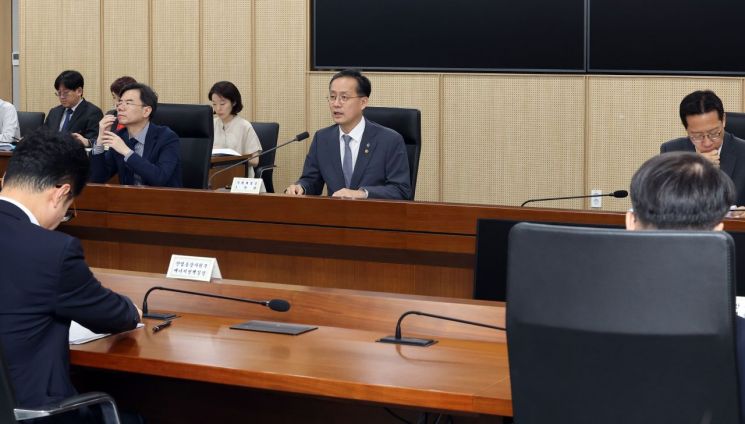
As the United States has directly intervened in the Israel-Iran conflict by attacking Iranian nuclear facilities, the South Korean government announced that it has activated a 24-hour emergency response system. The government also stated that, if necessary, relevant ministries will cooperate closely and respond according to contingency plans. If concerns about logistics disruptions grow due to a worsening situation, the government plans to implement additional measures such as deploying temporary vessels.
On the afternoon of the 22nd, Lee Hyungil, Acting Minister and First Vice Minister of the Ministry of Strategy and Finance, presided over a joint emergency response team meeting with related agencies regarding the Middle East situation. The meeting was attended by the Ministry of Foreign Affairs, Ministry of Trade, Industry and Energy, Ministry of Oceans and Fisheries, Financial Services Commission, Bank of Korea, Financial Supervisory Service, and the Korea Center for International Finance.
Lee assessed, "The U.S. airstrike on Iranian nuclear facilities has brought a new phase to the Middle East situation, and the level of uncertainty remains extremely high depending on Iran's response going forward."
He also urged, "All agencies should maintain heightened vigilance, closely monitor developments in the Middle East situation and the impact on both financial and real economies, and swiftly implement necessary measures in close inter-agency cooperation if any unusual developments occur."
The government is closely monitoring the impact of this situation on the Korean economy and is continuously strengthening its monitoring system. Lee explained, "Since Israel's airstrike on Iran on the 13th (local time), international oil prices have risen and volatility in domestic and international financial markets has somewhat increased. However, so far, domestic energy reserves and supply are being managed without disruption, and our 31 vessels operating near the Middle East continue to sail safely, with no unusual incidents reported in shipping or logistics."
The market is watching for the possibility that Iran, as a retaliatory measure, may block the Strait of Hormuz?a key route for Korea's crude oil imports?or that Yemen's Houthi rebels may attack ships in the Red Sea. If such scenarios materialize, it would inevitably lead to a surge in international oil prices and increased transportation and logistics costs, resulting in inflation and other impacts. The Strait of Hormuz is a major import route for Middle Eastern oil to Korea, with about 20% of the world's crude oil and about 40% of seaborne crude oil passing through this area.
However, Lee explained, "Given the extremely high uncertainty regarding future developments, the government will have the joint emergency response team at the center to monitor on-site conditions in the Middle East and trends in finance, energy, exports and imports, and shipping and logistics around the clock. If necessary, we will respond swiftly according to situation-specific contingency plans."
In particular, if the financial market shows excessive volatility disconnected from the fundamentals of the Korean economy, the government will take immediate and bold actions, and will also make every effort to manage energy supply and demand.
Additionally, to minimize the impact on exports, imports, and logistics, the government will steadily implement support measures such as liquidity support for export-affected companies in the Middle East and providing dedicated shipping space for small and medium-sized enterprises. If concerns about logistics disruptions grow, the government also plans to implement additional support measures such as deploying temporary vessels.
On the 21st (local time), U.S. President Donald Trump directly intervened in the Israel-Iran conflict by using U.S. military force to strike Iran's nuclear facilities. The U.S. attack on Iran came nine days after Israel launched a preemptive airstrike on Iran on the 12th, which triggered an exchange of military clashes between the two countries.
© The Asia Business Daily(www.asiae.co.kr). All rights reserved.

















