Paper by the Korean Association of Public Finance:
"Fiscal Deficits Significantly Raise Inflation Risks"
Study Finds 1% Increase in Government Debt Can Boost Consumer Prices by Up to 0.15%
Expansionary Fiscal Policy During Deficits May Lead to Prolonged High Inflation
Researchers Stress Importance of Fiscal Soundness for Price Stability
A study has found that a 1% increase in government debt can raise consumer prices by up to 0.15%. The effect on inflation is particularly pronounced when expansionary policies are implemented during fiscal deficit situations.
On June 22, Yonhap News reported, citing the Korean Association of Public Finance, that a paper titled "The Impact of Fiscal Soundness on Inflation," authored by Junsang Lee and Sungwoo Jang of Sungkyunkwan University's Department of Economics and Hyungseok Lee, Associate Research Fellow at the Bank of Korea, was published in the May issue of the Journal of Public Finance Studies.
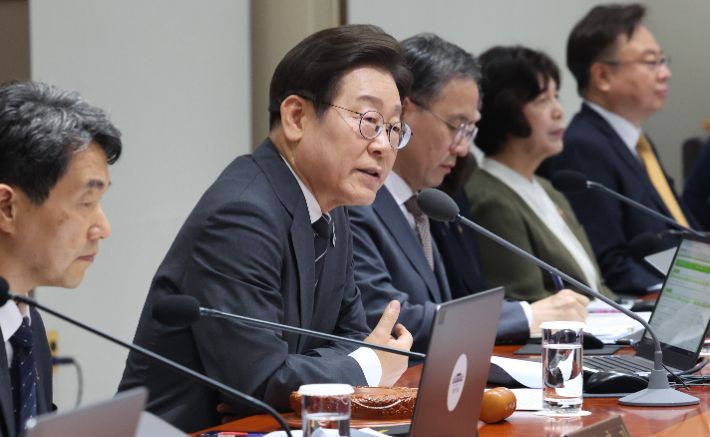
The research found that when the primary fiscal balance deteriorates and government debt and expenditures increase, consumer prices rise in a statistically significant manner.
The analysis period covered from October 2000 to November 2023, utilizing monthly data on government debt (including government bonds, grain bonds, national housing bonds, and foreign exchange stabilization bonds), government expenditures, and the primary fiscal balance. The study applied a "Bayesian VAR" model, which statistically analyzes the interactions among variables to forecast future trends.
The analysis suggests that a deterioration in fiscal soundness can trigger an immediate rise in inflation. It can also raise "expected inflation" by shaping expectations that prices will increase in the future, thereby causing further inflation.
The report stated, "Korea, as a small open economy, is highly sensitive to external economic factors. The impulse response analysis using Bayesian VAR, which includes external variables, shows that fiscal deterioration in Korea exerts upward pressure on prices."
It continued, "These results were statistically significant at the 68% confidence level," but also emphasized, "The findings indicate that the stance of fiscal policy has an important impact on inflation in Korea as well."
The research team suggested, "Fiscal authorities should design policies with the understanding that both fiscal policy and fiscal soundness can cause inflation," and added, "Improving fiscal soundness is also an important factor for price stability."
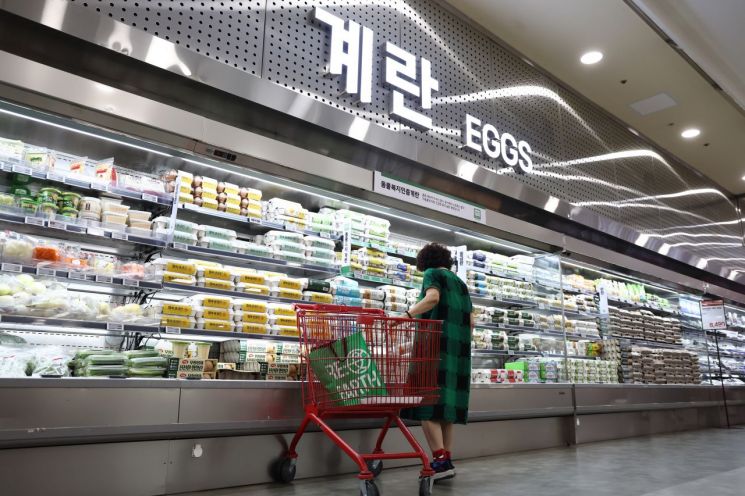 A large supermarket in Seoul on the 22nd. (The photo is not directly related to the article.) Photo by Yonhap News.
They further noted, "It should also be kept in mind that expansionary fiscal policy without improvements in fiscal soundness can lead to long-term inflation."
This analysis offers implications for the new government's policy direction, which has suggested shifting the fiscal policy stance from 'austerity' to 'expansion' and drawing up an extra budget during a fiscal deficit. If the extra budget is finalized, the managed fiscal balance deficit will increase by 24 trillion won to 110.4 trillion won, and the deficit-to-GDP ratio is expected to worsen from -3.3% to -4.2%.
This means Korea is now on the "debt expansion during deficit" path, which the study identified as likely to cause prolonged high inflation.
The Bank of Korea and related institutions assess that the extra budget alone is unlikely to create immediate inflationary pressure. This is because the consumer price index in May rose 1.9% year-on-year, remaining below the 2.0% target and showing signs of stability.
However, with 13.2 trillion won in cash-equivalent consumption coupons and 29 trillion won in local currency issuance planned through the extra budget, and if the Bank of Korea cuts its policy rate one or two more times this year, there is a possibility that increased liquidity could intensify inflationary pressure.
The government is treating inflation as the top priority for people's livelihoods and is focused on devising countermeasures. On June 9, President Jae Myung Lee instructed the government to come up with solutions, stating that "the inflation problem is placing an excessive burden on the public." The government is currently seeking price stabilization measures, especially for food and daily necessities.
© The Asia Business Daily(www.asiae.co.kr). All rights reserved.
![Clutching a Stolen Dior Bag, Saying "I Hate Being Poor but Real"... The Grotesque Con of a "Human Knockoff" [Slate]](https://cwcontent.asiae.co.kr/asiaresize/183/2026021902243444107_1771435474.jpg)

















