Export Consultations Held with 30 Chinese Buyers
Shandong Province Emerges as a Strategic Bio Hub
KOTRA Supports Korean Companies' Entry into China
KOTRA (Korea Trade-Investment Promotion Agency) participated in a healthcare event held in Qingdao, China, expanding opportunities for entry into the Chinese healthcare market.
On June 19, KOTRA, together with the Consulate General of the Republic of Korea in Qingdao and the Korea Health Industry Development Institute, hosted the "2025 China Medical Korea" event in Qingdao, Shandong Province, China.
A total of 13 companies and institutions participated in the event, including 8 medical device companies, 4 cosmetics companies, and 1 hospital. They sought opportunities to enter the Chinese healthcare market. In particular, digital healthcare companies with advanced technologies?such as devices for treating dry eye syndrome, digital temporomandibular joint therapeutics, and AI-based anatomical solutions?drew significant interest from local buyers.
At the event, 30 Chinese buyers held one-on-one export consultations with Korean participants, exploring possibilities for business cooperation. KOTRA also organized the "Korea-China Healthcare Cooperation Forum" and an "Export Roadshow," attended by about 80 healthcare professionals from both countries, to showcase Korea's digital healthcare technologies and products in depth.
This event was organized based on the growth potential of the Chinese healthcare market and the technological competitiveness of Korean companies. As of 2024, 15.6% of China's population is aged 65 or older, and by 2030, the country is expected to become a "super-aged society," with the proportion of those aged 65 or older reaching 20% of the total population. With the increase in the elderly population, demand for chronic disease management, rehabilitation medicine, and healthcare IoT (Internet of Things) is rapidly expanding.
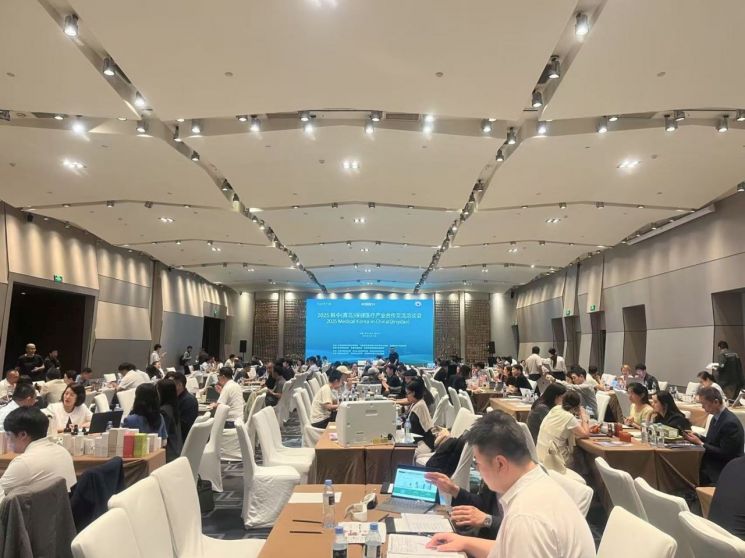 The scene of the "2025 China Medical Korea" held on the 19th in Qingdao, Shandong Province, China. KOTRA.
In fact, the Chinese medical device market grew from 600 billion yuan in 2019 to 1.2 trillion yuan in 2024, doubling in just five years. During the same period, annual per capita spending on medical and healthcare consumption also increased about 2.4 times, from 1,045 yuan to 2,547 yuan, indicating a steady rise in both interest in and spending on personal health.
Amid this growth, Shandong Province is emerging as a strategic entry point for Korean companies. Thirteen of China's top 100 pharmaceutical companies are based in Shandong, and the province, with a population of over 100 million, offers comprehensive policy support, infrastructure, and market accessibility for the medical and bio industries.
At the event, Wonkwang University Hospital signed an additional memorandum of understanding with Qingdao Municipal Hospital to expand clinical cooperation and clinical training. The two institutions had already signed an agreement in 2024 to attract foreign patients and have further strengthened their partnership.
Qingdao-based Buyer A, who participated in the export consultation, said, "With the growing elderly population in China and the spread of digital technology, there is increasing interest in the treatment of joint and ophthalmic diseases. We plan to actively expand cooperation with Korean companies as a result of this event."
Hwang Jaewon, head of KOTRA's China Regional Headquarters, stated, "The healthcare industry is a promising area for cooperation between the two countries, making a win-win partnership possible. We will spare no effort to support our companies with outstanding technological capabilities in using Shandong as a strategic bridgehead for successful entry into the Chinese market."
© The Asia Business Daily(www.asiae.co.kr). All rights reserved.
![Clutching a Stolen Dior Bag, Saying "I Hate Being Poor but Real"... The Grotesque Con of a "Human Knockoff" [Slate]](https://cwcontent.asiae.co.kr/asiaresize/183/2026021902243444107_1771435474.jpg)
















