Some Say "Limited Impact on Domestic Industry"
As foreign media reports suggest that the Donald Trump administration may block South Korean semiconductor companies from supplying U.S.-made equipment to their factories in China, there is growing attention on the potential impact on the domestic semiconductor industry. At the same time, expectations are rising that exceptions may be granted for South Korean companies.
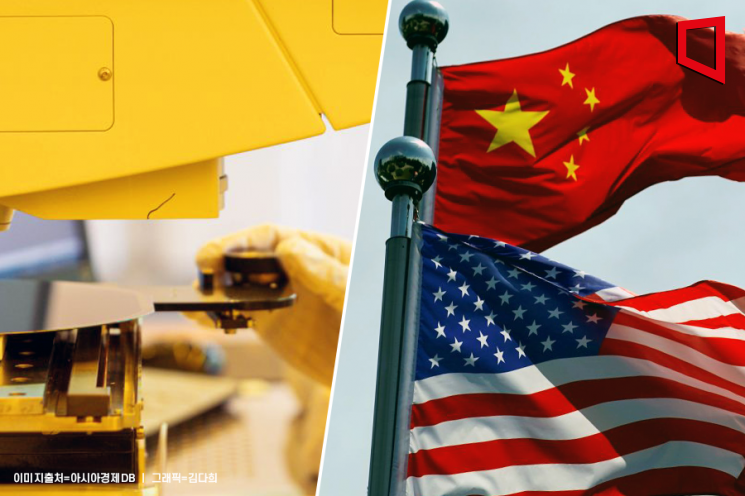
The Wall Street Journal (WSJ) reported on June 20 (local time) that Jeffrey Kessler, Assistant Secretary for Export Administration at the U.S. Department of Commerce, notified Samsung Electronics and SK Hynix of this policy earlier this week. The core of the policy is to revoke the measure that allowed these companies to supply U.S. semiconductor manufacturing equipment to their factories in China without separate approval each time. The same policy was reportedly communicated to TSMC, the leading company in the foundry (semiconductor contract manufacturing) industry.
This measure is seen as an effective attempt to block U.S. semiconductor equipment from companies such as Applied Materials (AMAT), Lam Research, and KLA from entering factories in China. ASML's EUV (extreme ultraviolet) lithography equipment, which is essential for advanced semiconductor manufacturing, has already been banned from being imported into China since 2019.
Tension is rising among domestic semiconductor companies such as Samsung Electronics and SK Hynix. Samsung Electronics operates a NAND flash production plant in Xi'an and a semiconductor packaging plant in Suzhou, both in China. SK Hynix runs a DRAM plant in Wuxi, a packaging plant in Chongqing, and a NAND plant in Dalian that was acquired from Intel.
Some believe there is still a possibility that the U.S. may postpone or withdraw the policy. The WSJ reported that since this policy, led by the Department of Commerce's Bureau of Industry and Security, has not yet received full approval from other U.S. government departments, it has not been finalized as an official Trump administration policy.
Previously, in October 2022, the U.S. government announced export controls on semiconductor products containing U.S.-made equipment and technology to China, but granted a one-year exemption for the Chinese factories of South Korean companies such as Samsung Electronics and SK Hynix. The following year, both companies were designated as "verified end users" (VEU), effectively granting them an indefinite exemption from the policy.
Industry experts expect that even if the import of U.S.-made equipment is restricted this time, the damage to domestic companies will not be significant. This is because the "de-risking" policy, aimed at establishing U.S. dominance in semiconductors and excluding China from core technology supply chains, has been in place since the previous Biden administration.
Kim Yangpaeng, a senior researcher at the Korea Institute for Industrial Economics and Trade, said, "Restrictions on expanding factories and bringing in equipment to China have existed for some time, so companies have had time to prepare countermeasures. While the restriction on importing U.S.-made equipment may not be completely without impact, it may not be a major cause for concern."
© The Asia Business Daily(www.asiae.co.kr). All rights reserved.

















