The Ministry of Science and ICT Also Seeks Exemption from Preliminary Feasibility Study
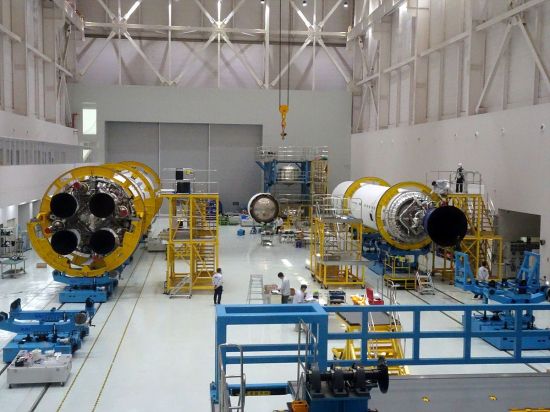 The first stage assembly (left) and second stage assembly of the Korean launch vehicle Nuriho Flight 4, unveiled last month by the Space Launch Authority. On the 20th, the Space Launch Authority announced that it will produce one additional Nuriho vehicle and improve the satellite fairing to launch two defense test satellites in 2028. Yonhap News
The Space Launch Authority will produce one additional Nuriho, a Korean launch vehicle, and improve the satellite fairing to launch two defense test satellites in 2028.
On the 20th, the Space Launch Authority unveiled its plan for the "Nuriho Heritage Project" at a forum on revitalizing the private launch vehicle industry held at the National Assembly Members' Office Building in Yeouido, Seoul.
This project was established to fill the approximately five-year gap in domestic launch vehicle launches that will occur after the sixth Nuriho launch is completed in 2027 and before the next-generation launch vehicle is scheduled for launch after 2032.
Regarding this, the Space Launch Authority formed a task force (TF) to discuss ways to stimulate the industry. Jung Hyekyung, Director of the Aerospace Industry Division at the Space Launch Authority, explained that the agency decided on the principle of launching our satellites with our own launch vehicles and on introducing a launch service procurement system after 2029.
The Nuriho Heritage Project was prepared in response to a request from the Ministry of National Defense to launch two defense test satellites into an inclined orbit using Nuriho.
Director Jung explained that to launch two test satellites, it is necessary to improve the existing Nuriho fairing, and since this will be the first time launching into an inclined orbit instead of the previously used sun-synchronous orbit, the project has been prepared in the form of a research and development (R&D) initiative.
Director Jung stated, "This project will allow us to begin implementing the principle of launching our satellites with our own launch vehicles and to establish a foundation for civil-military cooperation. Since there is significant demand for satellites in inclined orbits, successful demonstration will open up further opportunities for utilizing Nuriho in the future."
She added, "If the budget is allocated this year, production can begin next year, making a 2028 launch possible," and noted that the Ministry of Science and ICT is actively pursuing an exemption from the preliminary feasibility study.
Director Jung also said, "Because these are defense satellites, launching them overseas could result in national security leaks or difficulties in timely launches. We believe these are sufficient reasons for an exemption from the preliminary feasibility study and are actively coordinating on this issue."
After the Heritage Project, a plan was also announced to secure market demand for private launch vehicles by purchasing launch services for public satellites through open bidding starting in 2027.
To this end, he explained that a launch service procurement plan will be announced at the end of this year, and candidate companies for launch services will be certified next year.
© The Asia Business Daily(www.asiae.co.kr). All rights reserved.

















