Weekly Price Surge Hits 12-Year High... Seongdong-gu Apartments See Record-Setting Deals
"Prices Are Up, But Incomes Barely Budge"... Agents Say "This Business Is All About Endurance"
Supply Shortage Wipes Out Move-In-Ready Listings... Buyer Anxiety Grows Despite Market Peaks
Signs of Chinese Capital Inflow... "Twenty Pool Funds to Buy One Unit" in Distorted Market Structure
Seongdong-gu in Seoul has emerged as the hottest real estate market in the country this year. Major apartment complexes in areas such as Geumho, Oksu, and Haengdang have seen a series of record-high transactions, and as of the third week of this month (as of June 16), apartment prices rose by 0.76% compared to the previous week. This is the highest rate of increase nationwide. It is also the largest weekly increase in over 12 years, since the fifth week of April 2013. The cumulative increase for this year has reached 4.70%, making it the second highest in Seoul after the three Gangnam districts. As signs of overheating become more apparent, there is growing speculation that Seongdong-gu may soon be designated as a regulated area, a speculative overheating district, or a land transaction permission zone.
However, the atmosphere among local real estate agents is quite different. They point out that Seongdong-gu's market is experiencing a 'dual structure,' where apparent overheating on the surface coexists with a disappearance of actual transactions. This is due to a combination of factors: buying driven by anxiety, market disruption by foreign capital, lack of supply, a disappearance of properties suitable for actual residence, and stagnation in commission income for agents.
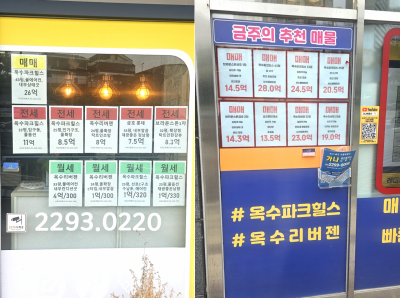 A real estate agent located in Seongdong-gu, Seoul, with recommended properties posted outside the building. Photo by Oh Yugyo.
On June 22, several agents in Oksu-dong, Geumho-dong, and Wangsimni areas of Seongdong-gu said in unison, "We've never seen a market so heavily tilted toward sellers," but added, "Despite the rising asking prices, there are hardly any actual contracts these days." Most properties that were likely to be sold have already been snapped up, and the remaining listings are mostly low-floor units, properties with existing jeonse (long-term lease) tenants, or those with only high asking prices. The combination of supply shortage, regulatory uncertainty, and inflow of foreign capital is pushing genuine buyers into a "now or never" mindset, but there are virtually no properties available for them to actually move into.
According to the Ministry of Land, Infrastructure and Transport's actual transaction price system, major complexes in Seongdong-gu are exhibiting signs of overheating, with actual transaction prices setting new records or asking prices being set near record highs. For example, an 84-square-meter unit in E Pyeonhansesang Oksu Park Hills in Oksu-dong changed hands for 2.435 billion won on June 15, setting a new record. Considering that similar units traded for around 2 billion won at the end of last year, this is an increase of about 400 million won in just half a year. Likewise, an 84-square-meter unit in E Pyeonhansesang Geumho Park Hills in Geumho-dong set a record price of 2.1 billion won on June 5. In Haengdang-dong, an 84-square-meter unit in Seoul Forest Riverview Xi traded for 2.45 billion won last month, breaking the previous record. Real estate agents say, "Listings have virtually dried up," and "The so-called 'fourth time's the charm,' where one contract is signed for every four viewings, is a thing of the past." There is plenty of pent-up demand, but with no supply, it is difficult to close deals.
Although prices have risen, agents commonly report that their actual commission income has not increased significantly. The current maximum brokerage fee rate for apartments priced over 1.5 billion won is 0.7%, but it is extremely rare for agents to actually receive the full amount. One agent in Oksu-dong said, "In the past ten years, I've had only one client who paid the maximum commission." An agent in Hawangsimni-dong added, "Even after handling everything from registration to contract preparation, I don't even get half the commission," and commented, "That's why everyone says this is a business where you just have to endure."
With the spread of self-registration and the reduction of information asymmetry, buyers' bargaining power has increased, but agents complain that legal responsibility still falls solely on them. As Seoul City has intensified crackdowns on "unusual transactions," some agencies have closed their doors and switched to phone-based operations out of concern that "a single mistake could result in hundreds of thousands of won in fines." At a real estate office near Wangsimni Centras, there was even a period of nearly a month of so-called "stealth operations" to avoid crackdowns.
Concerns about the inflow of foreign capital are also growing. Chinese capital, in particular, is reportedly making cash purchases in high-end complexes. One agent in Wangsimni explained, "For example, 20 Chinese individuals pool their money so that one person can buy an apartment for 2 billion won, and then they share the profits when it is later sold. This is how they are shopping for real estate in Seoul." He added, "There is an increasing trend of Chinese buyers acquiring properties in redevelopment or reconstruction zones and high-end complexes. Since this could be a cause of overheating, authorities should step in with regulations."
As concerns mount that foreign capital is distorting the market, there are moves to improve the system. On June 15, Seoul City announced measures to strengthen the management of foreign real estate transactions, introducing a monitoring system that includes verification of funding plans, checks on actual residence, and the imposition of compulsory fines. In cooperation with the Ministry of Land, Infrastructure and Transport, selective investigations into unusual transactions will also be carried out. In the National Assembly, a proposed amendment to the Real Estate Transaction Reporting Act has been introduced, which would require foreigners to obtain prior approval before acquiring land in speculative overheating districts or regulated areas. The bill also includes a mandatory reciprocity clause.
© The Asia Business Daily(www.asiae.co.kr). All rights reserved.
![Clutching a Stolen Dior Bag, Saying "I Hate Being Poor but Real"... The Grotesque Con of a "Human Knockoff" [Slate]](https://cwcontent.asiae.co.kr/asiaresize/183/2026021902243444107_1771435474.jpg)
















