Visit to SK and AWS AI Data Center Site
Korea's Largest Private AI-Dedicated Center
Targeting Completion in 2029 with 60,000 GPUs
Presidential Message Delivered at the Site of Hyper-Scale AI Infrastructure
Government to Support the 'Private AI Expressway'
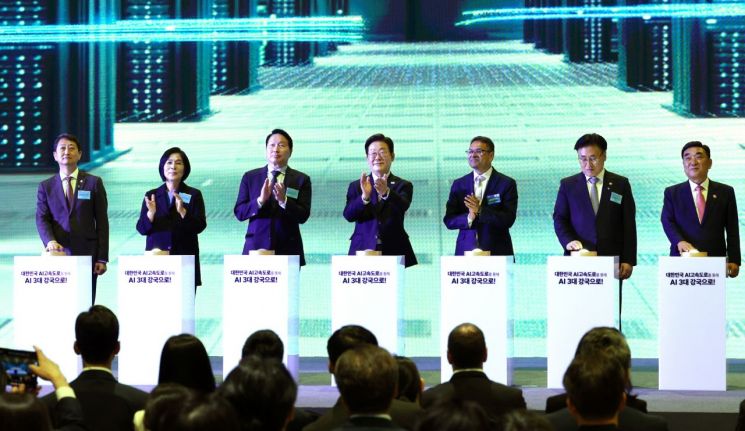
On June 20, President Lee Jaemyung personally visited the Ulsan artificial intelligence (AI) data center currently being built by SK Group. This move is interpreted as a demonstration of his commitment to fostering a private sector-led infrastructure in line with the national policy direction of advancing South Korea into one of the world’s top three AI powerhouses.
The AI data center, under construction in the Ulsan Mipo National Industrial Complex, is the largest private AI-dedicated center in Korea, being built by SK?centered on SK Telecom?in partnership with Amazon Web Services (AWS), the world’s leading cloud company. The facility is designed to accommodate approximately 60,000 graphics processing units (GPUs). It is planned with a structure that will provide 103 MW of capacity by 2029, with further expansion to a 1 GW scale considered for the future.
President Lee’s visit to the Ulsan AI data center marks the starting point for fulfilling his pledge to place AI at the heart of the national growth strategy. The industry views his on-site visit as a symbol of the government’s determination to accelerate the establishment of an AI industry value chain, led by the private sector, at the site of large-scale AI infrastructure. Immediately after taking office, the government established a new position of Chief of AI Future Planning within the presidential office and appointed Ha Jungwoo, former head of Naver Cloud Center who oversaw the development of Naver’s large language model (LLM) ‘HyperCLOVA X’, to the post. Chief Ha accompanied the president to the site on this day.
The construction of this data center is expected to mobilize the technological capabilities of major SK Group affiliates. This involves the integration of SK Telecom’s advanced communications and AI technology, SK Broadband’s expertise in data center construction, SK Hynix’s semiconductor technology, and SK Gas’s liquefied natural gas (LNG) combined heat and power generation energy. It is being evaluated as the first demonstration model of the group’s transition to an ‘AI-centered business structure’ at the group level.
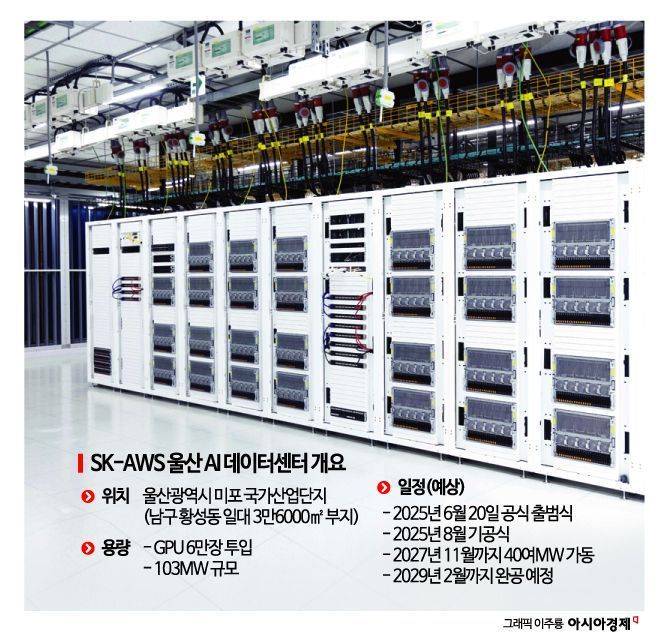
In particular, SK Telecom has indicated plans to introduce Nvidia’s latest GPU, Blackwell, at the center. The GB200 system equipped with Blackwell GPU chips offers more than five times the AI inference capability compared to the previous H100, prompting global big tech companies to adopt it rapidly. However, the Blackwell GPU generates significant heat, making stable operation difficult with traditional air-cooling methods alone. As a result, the Ulsan data center is pursuing the adoption of liquid cooling technology, which is still rare in Korea. Precise construction processes and advanced seismic design are essential for temperature control and operational stability within the data center, and this is expected to drive increased demand for high-value-added facility industries and specialized personnel.
An industry official explained, “Training large-scale AI models requires massive computational resources and power, and only large AI data centers can meet these demands. Since model competitiveness ultimately depends on computational infrastructure, such facilities are not merely IT infrastructure, but the core foundation supporting a country’s AI competitiveness.”
Globally, competition to secure AI infrastructure is fierce. In a recent report, global real estate services company Cushman & Wakefield identified Malaysia, Thailand, and Japan as the countries in the Asia-Pacific region with the fastest-growing data center capacity through 2030. Japan, in particular, stands out for its active attraction of foreign AI investment, in contrast to Korea. Cho Sungbae, professor of computer science at Yonsei University, stated, “Countries like Japan, where policy support and subsidies are provided for data center establishment, have seen active foreign investment, whereas Korea has faced regulatory barriers despite lacking AI computing infrastructure. This new large-scale AI data center presents a valuable opportunity to resolve these longstanding challenges.”
© The Asia Business Daily(www.asiae.co.kr). All rights reserved.
![Clutching a Stolen Dior Bag, Saying "I Hate Being Poor but Real"... The Grotesque Con of a "Human Knockoff" [Slate]](https://cwcontent.asiae.co.kr/asiaresize/183/2026021902243444107_1771435474.jpg)

















