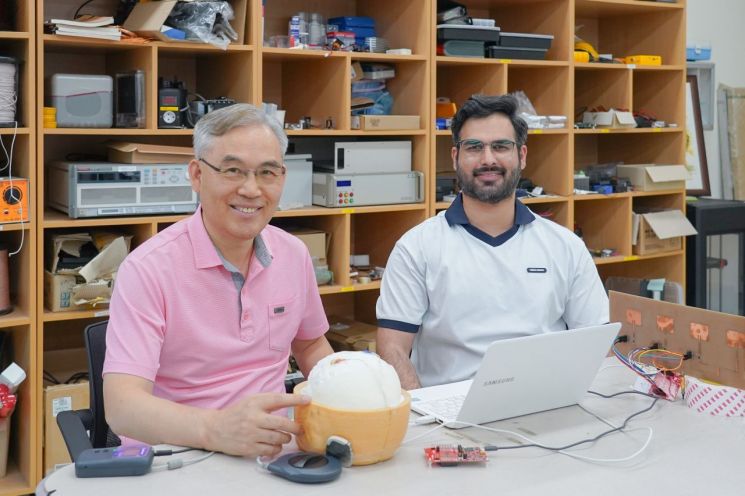
Gwangju Institute of Science and Technology (GIST) announced on June 20 that the research team led by Professor Lim Chuntaek from the Department of Electrical, Electronic, and Computer Engineering, in collaboration with OceansBio Co., Ltd., has developed a low-power Bluetooth Low Energy (BLE)-based dynamic beamforming antenna system that can be applied to implantable medical devices.
This marks the first time in Korea that BLE has been applied to implantable electronic medicine. The significance lies in expanding BLE technology, which is widely used and proven safe in the industrial and home appliance sectors, into the field of medical devices.
This technology is based on a compact phased array antenna (PAA) suitable for implantable vagus nerve stimulation (VNS) devices. By combining a BLE communication module with digital phase control technology, it enables real-time wireless neural stimulation.
VNS is a representative implantable electronic medicine used to treat intractable neurological disorders such as epilepsy and depression. However, existing products have faced frequent wireless communication interruptions due to changes in the patient’s posture or position.
The research team identified that this issue arises because the alignment between the internal antenna and the transmitter in the hospital room is disrupted by the patient's movement. When the patient moves, the direction between the two devices changes, causing a sharp decrease in the received power inside the body. This leads to unstable wireless communication, making real-time neural stimulation control difficult.
Typically, a decrease in received power can be compensated by increasing the transmission power. However, for in-body communication, strict safety regulations on electromagnetic waves prevent arbitrarily increasing the transmission power.
To address this, the research team developed a phased array antenna capable of digital beam steering in the 2.45GHz BLE frequency band. This allows not only real-time bidirectional communication but also automatic adjustment of beam direction and intensity according to the patient's movement.
The team implemented a "dynamic beamforming" technology, where a microprocessor linked to the BLE module automatically adjusts the direction and intensity of the beam based on the patient’s movement, ensuring consistent reception sensitivity anytime and anywhere.
Previously, more than two digital phase shifters were required for beam steering. However, this research proposed a simple structure that can be realized with just one phase shifter, contributing to the miniaturization and improved efficiency of the device.
The research team demonstrated through various experiments?including tests using gel that simulates human tissue and animal models with actual pigs?that stable communication and neural stimulation delivery are possible even inside the human body. As a result, this research is evaluated as evidence that BLE-based phased array antenna technology can become a core technology for next-generation implantable electronic medicine commercialization.
Professor Lim Chuntaek explained, "The global market for implantable electronic medicine is expected to reach about 35 trillion won by 2025, with the VNS market alone valued at approximately 1.4 trillion won and growing at an annual rate of 11.4%. The technology we have developed is expected to contribute to enhancing the export competitiveness of our medical device industry in the future."
This research, supervised by Professor Lim Chuntaek of GIST, involved Dr. S. Ahson A. Shah (first author), Lee Hyunwoong, CEO of OceansBio Co., Ltd. (second author), and researcher Jang Yurim (third author), and was supported by the National Research Foundation of Korea.
© The Asia Business Daily(www.asiae.co.kr). All rights reserved.

















