Warning Issued to Heads of 10 Institutions for Poor Performance in 2024 Public Institution Management Evaluation
Last year, 13 public institutions received ratings of "insufficient" or lower in the government management evaluation.
For the head of Korea Housing & Urban Guarantee Corporation (HUG), who received an "insufficient" rating for two consecutive years, a dismissal recommendation was issued. Additionally, warnings were issued to the heads of 10 institutions whose management performance was insufficient or where serious industrial accidents occurred.
On June 20, the government held the 6th Public Institution Management Committee meeting at the Government Complex Seoul, presided over by Second Vice Minister of Economy and Finance Lim Kigeun, and approved the "2024 Public Institution Management Performance Evaluation Results and Follow-up Measures," which included these decisions.
A total of 15 institutions (17.2%) received an "excellent (A)" rating, including five public enterprises such as Korea Electric Power Corporation, Korea Hydro & Nuclear Power, and Korea South-East Power, as well as 10 quasi-governmental institutions such as the Health Insurance Review & Assessment Service and the National Pension Service. Twenty-eight institutions (32.2%), including Korea Land & Housing Corporation (LH), received a "good (B)" rating, while 31 institutions (35.6%), including Korea Railroad Corporation, received an "average (C)" rating.
In contrast, nine institutions (10.3%), including Korea Housing & Urban Guarantee Corporation (HUG), Grand Korea Leisure, and Korea Coal Corporation, received an "insufficient (D)" rating. Four institutions (4.6%), including Korea Mine Rehabilitation & Mineral Resources Corporation and Korea Tourism Organization, received a "very insufficient (E)" rating.
As in the previous year, no institution received the highest "outstanding (S)" rating this year.
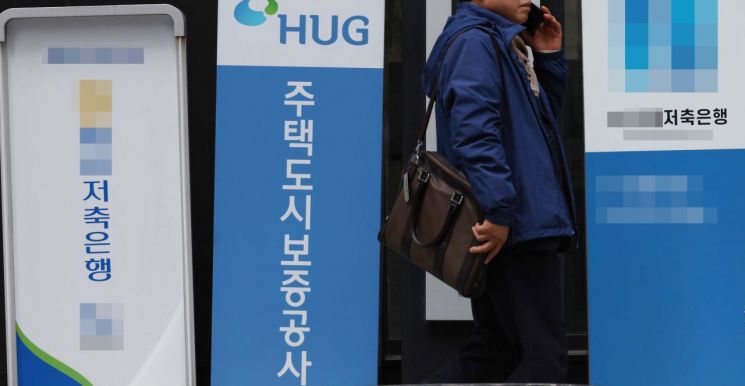 Savings Banks Post Consecutive Losses for Two Years Due to PF Defaults
(Seoul=Yonhap News) Reporter Jinwook Lee = The domestic savings bank industry recorded nearly 400 billion won in net losses last year, marking losses for two consecutive years.
Amid the fallout from real estate project financing (PF) defaults, the delinquency rate soared to the mid-8% range. The photo shows the branch of a savings bank and the signboard of the Korea Housing & Urban Guarantee Corporation located in a building in Seoul on the 21st. 2025.3.21
Photo by Jinwook Lee
cityboy@yna.co.kr (End)
Among the five institutions that received a "very insufficient (E)" overall rating or an "insufficient (D)" rating for two consecutive years, the head of Korea Housing & Urban Guarantee Corporation, who had served for more than six months as of the end of last year, was recommended for dismissal. The requirements for dismissal recommendations are as follows: heads of institutions who received an "E" rating and served for more than six months as of the end of last year, or those who received a "D" rating for two consecutive years and served for more than one year as of the end of last year.
The committee explained the reasons for Korea Housing & Urban Guarantee Corporation receiving a "D" rating for two consecutive years, stating, "The institution performed poorly overall in management areas such as ethical management, job creation, and mid- to long-term financial planning." The committee also pointed out that, in terms of major business operations, the institution was evaluated as lacking in measures to prevent rental fraud and in risk management for guarantee accidents.
This year's evaluation covered a total of 87 institutions, including 32 public enterprises and 55 quasi-governmental institutions. Institutions that excelled in major business performance or demonstrated strong management, such as financial results, received an "excellent (A)" rating. In contrast, institutions with poor management performance and oversight received "insufficient (D)" or "very insufficient (E)" ratings. Compliance with social responsibilities required of all public institutions, such as preventing safety accidents and misconduct, was also a key evaluation criterion.
The 13 institutions that received "insufficient" or lower ratings plan to review reductions in next year's general operating expenses. Specific details will be reflected in the budget management guidelines for public enterprises and quasi-governmental institutions for the next year. These institutions must submit management improvement plans and undergo management improvement consulting. Separately, institutions where serious industrial accidents occurred must submit safety improvement plans.
Institutions recognized as the best performers in the introduction and operation of job-based pay will receive an additional 0.1 percentage point incentive in next year's total personnel cost increase rate. Institutions that received an "average" or higher overall rating will receive performance bonuses differentiated by type and grade, ranging from 60% to 250%. For executives of financially at-risk institutions, such as public enterprises that recorded net losses last year or whose financial situation has deteriorated, the government intends to ensure management accountability by reducing performance bonuses based on evaluation results.
© The Asia Business Daily(www.asiae.co.kr). All rights reserved.
![Clutching a Stolen Dior Bag, Saying "I Hate Being Poor but Real"... The Grotesque Con of a "Human Knockoff" [Slate]](https://cwcontent.asiae.co.kr/asiaresize/183/2026021902243444107_1771435474.jpg)
















