Seosomun Overpass Demolition to Begin Next Month
Key Route Due to Gyeongui Line Railway Below
Reconstruction on Hold Amid Possibility of Gyeongui Line Undergrounding
Seoul Continues Demolition of Downtown Overpasses
The Seosomun Overpass in Jung-gu, Seoul, which has stood for nearly 60 years, will finally be demolished. Although the overpass received a safety rating of "insufficient" due to issues such as cracks in the supporting concrete causing pieces to fall beneath the structure, concerns over traffic congestion had delayed its removal. The Seoul Metropolitan Government has decided to put the planned reconstruction project on hold after the demolition.
According to the maintenance industry on June 20, the city will begin demolition work on the Seosomun Overpass, which connects Seosomun-dong in Jung-gu and Hap-dong in Seodaemun-gu, starting next month.
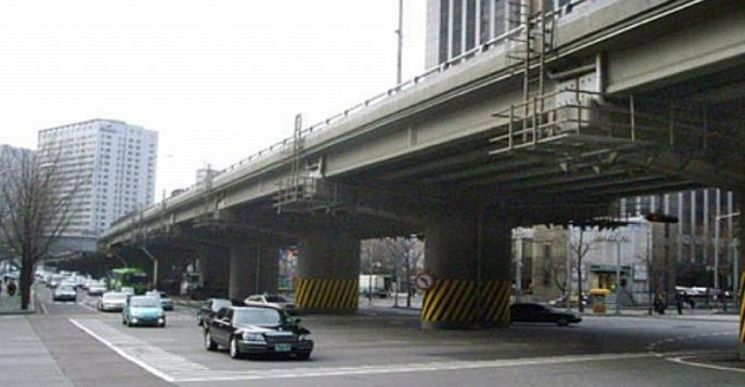
Built in 1966, the Seosomun Overpass is one of the main roads linking Seoul Station and the Euljiro area. Unlike other downtown overpasses that the city has successively demolished to improve traffic flow, the Seosomun Overpass has played a crucial role in the city center because the Gyeongui Line railway runs beneath it.
However, after receiving a B grade in a safety inspection in 2019, an incident occurred where cracked concrete fell from the overpass. In a subsequent detailed safety inspection, the structure was rated D, and the city has spent billions of won annually on reinforcement work since then.
Discussions about demolition have stalled for some time. Because the Gyeongui Line railway runs underneath, there were concerns that removing the overpass would cause the approximately 40,000 vehicles that use it daily to be concentrated in one area, which delayed the demolition plan. This is also why demolition and reconstruction have been discussed together until recently.
The Seoul Metropolitan Government has decided to begin demolition work at the end of July. Due to the Gyeongui Line railway below, the high volume of foot and vehicle traffic in the area, and the proximity of buildings, the city expects the construction period alone to take one year. During this period, detour roads will be operated, and the city plans to review mid- to long-term measures to maintain the dispersal effect.
The decision on whether to proceed with reconstruction of a new overpass will be made after monitoring traffic flow following demolition. The main reason is the potential for undergrounding the Gyeongui Line. The central government has been pursuing a railway undergrounding project since last year, and the current administration is also considering developing and improving the upper area through railway undergrounding.
In particular, Seodaemun-gu has designated the undergrounding of the Gyeongui Line as a key project. The core of the plan is to underground the 5.8-kilometer section from Seoul Station to Gajwa Station, which passes beneath the Seosomun Overpass. Seodaemun-gu has previously announced plans to create a residential complex hub, a medical-specialized complex hub, and a joint cultural hub in the upper area after undergrounding is completed.
Nearby Ahyeon Overpass and Seodaemun Overpass have already been demolished. After announcing the "Overpass Demolition Promotion Plan" in 2009, the Seoul Metropolitan Government dismantled several downtown overpasses, including Hyehwa Overpass, Ahyeon Overpass, and Seodaemun Overpass. When there were fewer vehicles in the city, overpasses allowed for faster travel, but now they are a cause of bottlenecks. Most recently, demolition of the Yeongdeungpo Rotary Overpass was completed in February, and demolition of the Samgakji Overpass is expected to begin as early as the end of next year. In the case of the Seoul Station Overpass, it was converted into a pedestrian park instead of being demolished. A Seoul city official stated, "Because this is an extremely important road located in the heart of the city, we plan to proceed with demolition while closely monitoring citizen safety and traffic flow conditions."
© The Asia Business Daily(www.asiae.co.kr). All rights reserved.

















