Brazilian Research Team Publishes Study in European Journal of Preventive Cardiology
"Sitting-Rising Test" Shows Higher Longevity Odds
Standing Up Without Using Hands Linked to Longer Life
A new study has found that the act of standing up from a sitting position without assistance can predict the likelihood of middle-aged and older adults dying from disease within the next decade.
On June 18 (local time), The Washington Post (WP) and NBC reported that a Brazilian research team conducted tests and follow-up examinations on 4,282 men and women aged 46 to 75 from 1998 to 2023, publishing their findings in the European Journal of Preventive Cardiology.
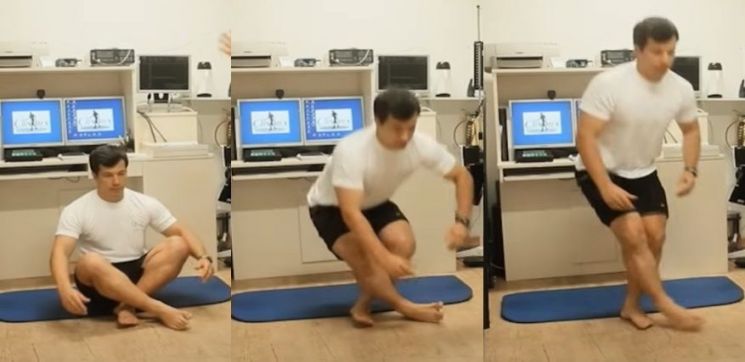
The research team from Clinimex, a sports medicine clinic in Rio de Janeiro, administered the Sitting-rising test to participants. This test evaluates whether individuals can sit down and stand up by crossing their feet, without using their hands for support or receiving assistance from others.
The scoring method allocates 5 points each for sitting and rising, for a total of 10 points, with a perfect performance earning the full 10 points. One point is deducted each time a participant uses their hand for support or changes foot position to stabilize themselves. Additionally, if the participant loses balance and wobbles during the movement, 0.5 points are deducted.
The researchers tracked the participants for 12 years. During this period, 665 individuals died from natural causes, excluding accidents or COVID-19. The follow-up revealed that most participants who achieved a perfect score were still alive at the end of the study, while only about half of those who scored between 0 and 4 points survived. Even after controlling for various factors, those who scored 0 to 4 points faced a 3.8 times higher risk of death from natural causes and a 6.0 times higher risk of death from cardiovascular causes compared to those who scored 10 points.
Dr. Claudio Gil Araujo, a member of the research team, explained that this test "can serve as an indicator for predicting longevity in middle-aged and older adults by comprehensively assessing muscle health, physical balance, and flexibility." However, he added, "A low score does not necessarily mean you will die within a few years," emphasizing that "it is simply a signal that a change might be needed."
This study is drawing attention for its potential as a practical tool to assess health status through a simple physical movement. However, the researchers recommended that the test should always be performed in the presence of another person to prevent injuries from falls, and that individuals with pre-existing conditions affecting the hip or spine should avoid taking the test.
© The Asia Business Daily(www.asiae.co.kr). All rights reserved.

















