Jeon Jinsook's Medical Service Act Amendment Faces Criticism as "Rushed Legislation"
"Fundamental Principles of Medical Care Must Not Be Undermined by Convenience or Efficiency"
As the amendment to the Medical Service Act, related to President Lee Jaemyung's campaign pledge to institutionalize non-face-to-face medical treatment, was proposed, the medical community is collectively expressing concerns about patient safety and voicing opposition.
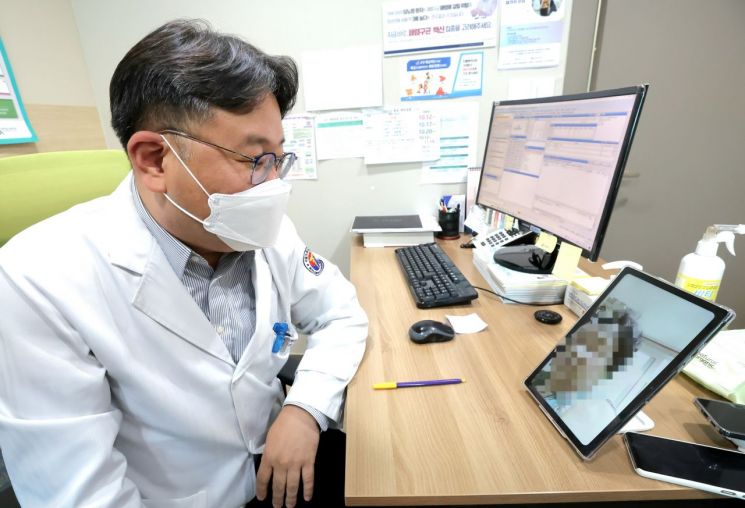 In June 2023, ahead of the transition to the pilot project for non-face-to-face medical treatment, a clinic in Dobong-gu, Seoul demonstrated the non-face-to-face medical treatment process. Photo by Yonhap News Agency, Ministry of Health and Welfare
According to the National Assembly and the medical community on June 20, the partial amendment to the Medical Service Act, spearheaded by Jeon Jinsook, a member of the Democratic Party of Korea, on June 11, defines non-face-to-face medical treatment and specifies its permissible scope, while fundamentally prohibiting non-face-to-face initial consultations for adults. In practice, this means that non-face-to-face medical treatment would only be allowed at clinics where the patient has previously visited in person for treatment. The amendment, however, makes exceptions for initial non-face-to-face consultations in the following cases: patients under 18 or over 65 years old, residents of medically underserved areas such as islands or remote regions, and unavoidable situations such as holidays or nighttime. Additionally, for post-surgical care or patients with severe or rare diseases, non-face-to-face treatment would also be permitted at hospital-level medical institutions.
Non-face-to-face medical treatment in Korea was first temporarily allowed in 2020 when hospital visits became difficult due to COVID-19. In 2023, it transitioned to a pilot project focused on follow-up consultations, but after the mass resignation of medical residents in February last year, initial consultations were again permitted to address the resulting medical service gaps. As a result, the new amendment actually imposes even stricter limitations on non-face-to-face medical treatment than the pilot project did.
The medical community agrees on the necessity of non-face-to-face medical treatment but insists that its legalization should only proceed after thorough consideration of safety. They criticize the political sector for pushing to expand non-face-to-face treatment without sufficiently considering the realities of the medical field and the fundamental nature of medical practice.
The Korean Medical Association stated, "We cannot help but have serious concerns regarding patient safety," and added, "In particular, allowing initial consultations for patients under 18 poses a high risk of neglecting serious issues, and we express strong regret." The Korean Association of Internal Medicine also issued a statement, saying, "For children and the elderly, it is very difficult to provide appropriate care with limited information, and prescribing medication without examinations carries a significant risk of worsening their condition." They asserted, "If the fundamental principles of medical care collapse under the pretext of convenience and efficiency, the harm will ultimately fall on the public."
The Korean Pediatric Association also criticized the proposal, stating, "Leaving open the possibility of allowing remote initial consultations for children and adolescents disregards the unique nature of pediatric care and is nothing more than a hasty political decision made without even considering safety." The association emphasized, "Children have difficulty expressing their symptoms themselves, and it is impossible to make an accurate diagnosis based solely on the guardian's account, so direct examinations such as inspection, palpation, and auscultation are essential." They warned, "Remote consultations for children, who often present with a variety of atypical symptoms such as fever, shortness of breath, convulsions, rashes, or abdominal pain, can directly lead to misdiagnosis and delays in treatment, which in turn can result in medical accidents directly linked to life-threatening situations."
The Future Medical Forum pointed out, "This amendment omits all of the core regulatory measures that were specified in similar previous bills to ensure patient safety, such as identity verification through video calls, restrictions on prescribing narcotics or medications prone to misuse, and provisions allowing medical professionals to halt treatment at their discretion."
© The Asia Business Daily(www.asiae.co.kr). All rights reserved.


















