"I grow attached to them"
"Relieves feelings of loneliness"
A pastime for 'lonely' elderly people
Unaware of fines for feeding pigeons
"They're so pitiful. It must be so hard for them to be hungry, especially in this hot weather."
Around 1 p.m. on the 19th, in a vacant lot in Nowon-gu, Seoul, a man in his 80s surnamed Hwang scattered grain on the ground, instantly attracting about 10 pigeons. Watching the pigeons, Hwang said, "Eat as much as you want." He brings grain from home once a day to feed the pigeons. Hwang said, "If you see pigeons every day, you grow attached to them," adding, "It also helps to relieve feelings of loneliness and isolation." When asked by the reporter if he knew that feeding pigeons could result in a fine, Hwang replied, "This is the first time I'm hearing about it."
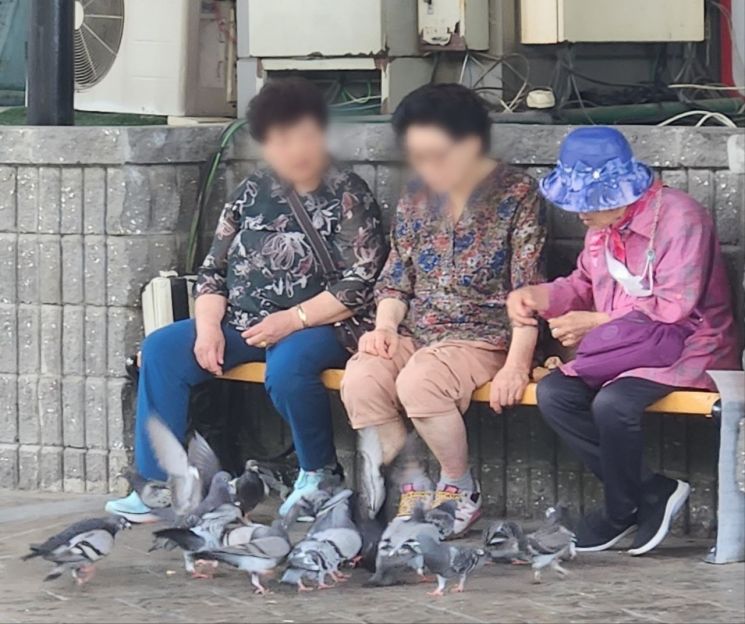 On the 19th, an elderly person is feeding pigeons in a vacant lot in Nowon-gu, Seoul. Photo by Byun Seonjin
In various parts of downtown Seoul, it is not uncommon to see elderly people feeding pigeons. This behavior is often interpreted as a way to alleviate social isolation. However, starting next month, anyone caught feeding pigeons could face a fine of up to 1 million won. There are calls for sufficient public awareness campaigns and guidance efforts.
On the same day, at Tapgol Park in Jongno-gu, another elderly man was seen scattering feed on the lawn. About 20 to 30 pigeons, which had been perched on nearby trees and utility poles, quickly gathered. Some elderly people even tossed a few leftover grains of rice from their lunchboxes. Another elderly man surnamed Seo, in his 70s, who was feeding pigeons, said, "Sometimes I talk to them, saying, 'How have you been?'" He added, "When I feed them, it feels like at least the pigeons are happy to see me." However, Seo was also unaware that feeding pigeons could result in a fine.
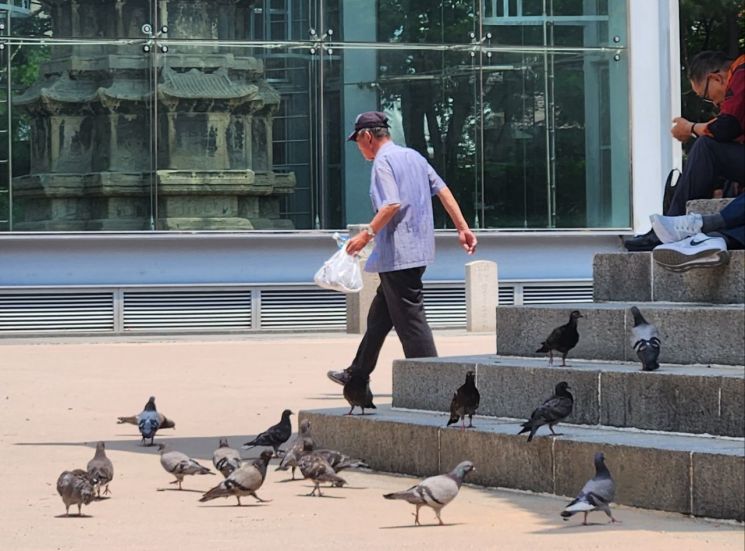 An elderly man scattering feed on the ground at Tapgol Park in Jongno-gu, Seoul, attracting pigeons. Photo by Byun Seonjin
Pigeons were designated as harmful wild animals in 2009. The reason was that pigeons, having adapted to urban environments and increased in numbers, were damaging the city's appearance and posing public health concerns. According to big data from the Anti-Corruption and Civil Rights Commission, the number of complaints related to bird droppings filed with local governments nationwide increased more than threefold, from 171 cases in 2019 to 643 cases last year. Already this year, 377 cases have been reported.
The increase in the pigeon population is attributed to food provided by humans. While wild pigeons lay eggs two to three times a year, urban pigeons can breed up to eight times a year. In December 2022, the Ministry of Environment enacted what is commonly referred to as the "Pigeon Feeding Ban Law," which allows local governments to prohibit the feeding of harmful wild animals in parks and other areas through ordinances and to impose fines for violations. This law has been in effect since the beginning of this year.
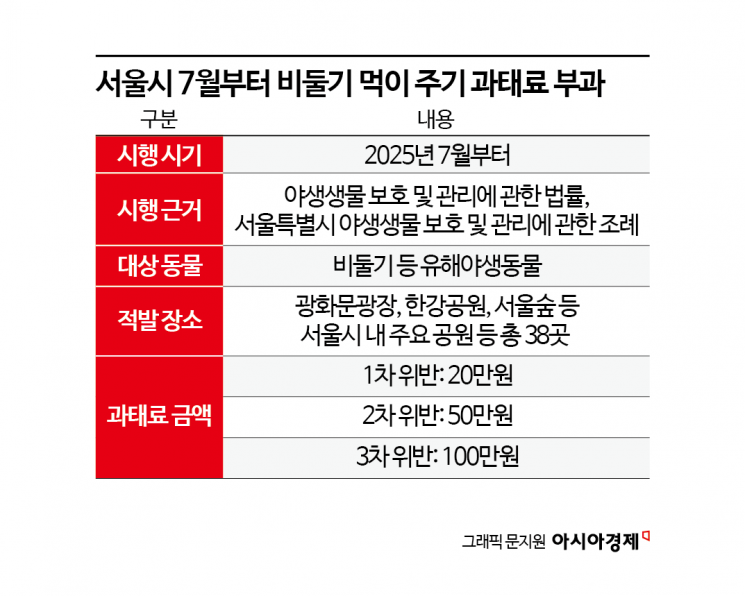
Starting July 1, the Seoul Metropolitan Government will impose fines of up to 1 million won on citizens who feed pigeons and other harmful wild animals at 38 locations, including Gwanghwamun Square, Hangang Park, and Seoul Forest. The fine is 200,000 won for the first offense, 500,000 won for the second, and 1 million won for the third. Considering that the maximum fines for leaving pet waste unattended or not using a leash are 500,000 won, and for littering cigarette butts is 50,000 won, this is a relatively high penalty.
A Seoul city official said, "We are not planning to indiscriminately crack down on minor acts such as occasionally tossing a piece of bread or a few grains of rice," explaining, "This measure targets cases where large amounts of food are habitually provided, such as with sacks of rice, which negatively impact the urban ecosystem."
Heo Changdeok, a professor of sociology at Yeungnam University, said, "Before imposing fines, it is important for public officials to go out into the field for a period of time and educate people on why feeding pigeons is not allowed." He added, "Since feeding pigeons may be an expression of loneliness for elderly people, emotional support should also be provided alongside these efforts."
© The Asia Business Daily(www.asiae.co.kr). All rights reserved.



















