On June 19, the Ministry of Environment announced that it has increased the budget for water-related social overhead capital (SOC) and flood prevention projects by 240 billion won in its second supplementary budget proposal, while reducing the budget for the zero-emission vehicle supply project by 540 billion won.
The Ministry of Environment explained that, during a Cabinet meeting held on the same day, it prepared this "New Government Supplementary Budget Proposal" aimed at boosting the economy and stabilizing livelihoods. This supplementary budget focuses on nine key projects, including sewage treatment plants, waste treatment facilities, national river maintenance, and improvements to hydrological survey facilities. The supplementary budget was primarily allocated to SOC in order to stimulate the economy and support the public.
Specifically, a total of 95.4 billion won was allocated to water-related social infrastructure such as sewage treatment plants, sewage pipelines, wastewater treatment facilities, and industrial water supply systems. This includes 57.56 billion won for the installation of sewage treatment plants, 7 billion won for sewage pipeline maintenance, 5.78 billion won for public wastewater treatment facilities, and 7.1 billion won for the stabilization of industrial water supply. Additionally, 15 billion won was allocated for the improvement of hydrological survey facilities.
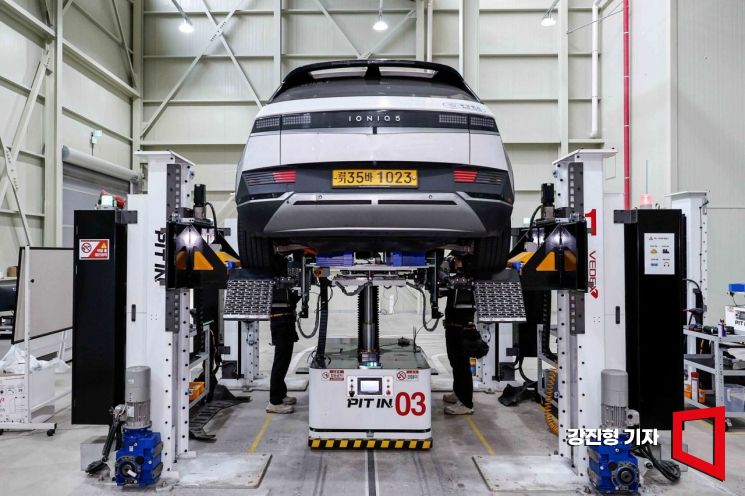 On the 29th, technicians are replacing electric vehicle battery packs at the Pitin headquarters in Anyang, Gyeonggi Province. Photo by Kang Jinhyung
Furthermore, 18.01 billion won was allocated for non-point source pollution reduction projects, 30.44 billion won for the creation of national parks and geoparks, and 41.8 billion won for national river maintenance. Non-point source pollution refers to the phenomenon in which pollutants such as soil, pesticides, fertilizers, and heavy metals, originating from sources like cities, roads, farmland, mountains, and construction sites, are washed into rivers by rainwater, thereby polluting the water.
On the other hand, the budget for the zero-emission vehicle supply project was reduced by 467.25 billion won, and the budget for the charging infrastructure construction project was also reduced by 63 billion won. Some ongoing projects, such as the establishment of a smart sewage management system (10 billion won) and the reuse of treated sewage water (7 billion won), were also adjusted to reflect the likelihood of execution.
© The Asia Business Daily(www.asiae.co.kr). All rights reserved.

















