‘Democracy Faces Crisis of Regression’
Experts Call for Institutional Reforms Amid Deepening Polarization and Concentration of Power
Amid warnings that the foundations of democracy are being shaken as Korean society faces structural problems such as political polarization and concentration of power, experts have stressed the urgent need for institutional reforms to restore democracy.
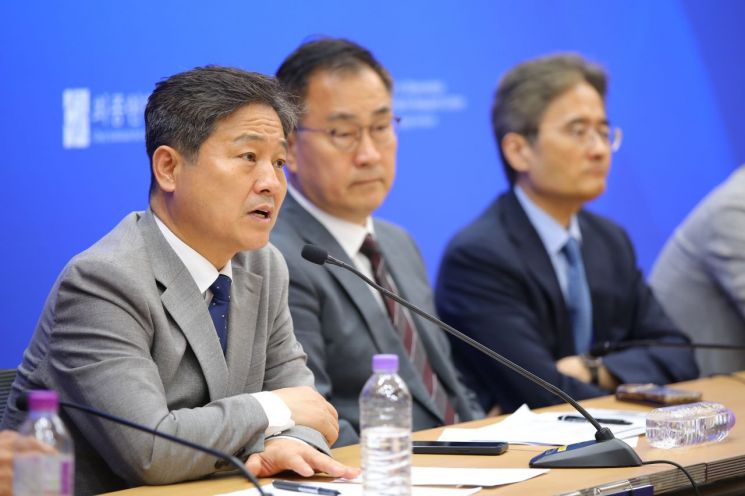 On the 19th, panelists of Session 1 are discussing at the 'Future of Democracy Forum' jointly hosted by the Choi Jonghyun Academic Foundation, Stanford University Asia-Pacific Research Center, and Indo-Pacific Democracy Forum held at the National Assembly Members' Office Building. From the left, Youngbae Kim, member of the Democratic Party of Korea, Hyungdoo Choi, member of the People Power Party, and Sunhyuk Kim, professor at Korea University. Provided by the Choi Jonghyun Academic Foundation
At the 'Future of Democracy Forum,' jointly hosted by the Choi Jonghyun Academic Foundation, Stanford University Asia-Pacific Research Center, and Indo-Pacific Democracy Forum and held at the National Assembly Members' Office Building on the 19th, figures from the political and academic spheres voiced a shared concern. They stated, "Korean democracy is facing a serious regression, and as long as political polarization and a rigid power structure persist, it will be difficult to expect long-term progress."
The forum, held under the theme 'Challenges and Tasks for Democracy,' featured participants including National Assembly Speaker Woo Wonshik; Francis Fukuyama, a renowned political scientist at Stanford University and author of the global bestseller 'The End of History'; Youngbae Kim, a member of the Democratic Party of Korea affiliated with the Indo-Pacific Democracy Forum (IPDF); and Hyungdoo Choi, a member of the People Power Party. The forum was moderated by Giwook Shin, Director of the Stanford Asia-Pacific Research Center, and Kang Wontack, Director of the Seoul National University Institute for Future Strategy.
In his congratulatory remarks, National Assembly Speaker Woo Wonshik emphasized, "Extreme polarization, unfairness, inequality, and a system of endless competition can undermine the values of civic engagement and tolerance," stressing that democracy and people's livelihoods are closely intertwined. He added, "I hope today's forum will provide the insights needed for Korean democracy to overcome its crisis and move toward a better direction."
The central agenda of the forum was 'political polarization.' Professor Lee Sukjong of Sungkyunkwan University stated, "According to a 2021 survey by the Pew Research Center in the United States, 90% of people in both Korea and the United States responded that 'conflict between supporters of different political parties is very severe,'" diagnosing that political polarization in Korea is at a very serious level, even compared to advanced countries and major Asian nations. In particular, she noted that two presidential impeachments and other political upheavals since the 2010s have entrenched conflict between progressive and conservative camps in an extreme manner, and that voters are expressing deep distrust and emotional hostility toward the opposing side.
Professor Lee pointed out that, despite the majority being moderates, the two-party-centered electoral system is pushing voters toward extreme choices, and political parties are preoccupied with fandom politics. As a result, mutual tolerance and institutional restraint are weakening, and the spread of misinformation and distrust in state institutions are shaking the very foundations of democracy.
Professor Lee Sunwoo of Jeonbuk National University, after comparing and analyzing various proposals for restructuring the power system, suggested the 'four-year two-term presidency' as a realistic alternative. He explained, "The current presidential system, under the antagonistic two-party structure, creates a dilemma of presidential dominance and governmental paralysis," and added that "electoral reforms such as expanding proportional representation, introducing multi-member districts, and adopting a runoff voting system should be implemented in parallel to establish a multi-party system."
Professor Heo Sungwook of Seoul National University diagnosed that "the new challenges democracy will face after 2025 are not traditional power struggles, but rather the ways of making choices in an era of technology and uncertainty." He outlined the following future challenges for democracy: ▲the potential for AI to replace human rational decision-making; ▲conflicts between choices made by the market and by politics; ▲tensions between individual and collective choices; ▲risk factors such as climate change; and ▲policy decisions made under extreme uncertainty. He emphasized that "democracy is, in the end, an institution that must continuously renew the social consensus on who makes choices and how those choices are made."
© The Asia Business Daily(www.asiae.co.kr). All rights reserved.

















