Fed Leaves Benchmark Rate at 4.25-4.5%
Powell: "Tariffs to Raise Prices, Burden Economic Activity"
Growth Forecast Lowered, Inflation Outlook Raised
Tariff Uncertainty Spurs Outlook for "One Rate Cut This Year"
The US central bank, the Federal Reserve (Fed), kept its benchmark interest rate unchanged as expected. Fed Chair Jerome Powell warned that inflation could arise from tariff policies in the coming months, and the Fed noted that concerns over stagflation?simultaneous price increases and economic slowdown?have intensified. Nevertheless, the Fed maintained the possibility of two rate cuts within the year. On Wall Street, some predict that uncertainty stemming from tariff policies will make policy responses more challenging for monetary authorities, possibly resulting in only one rate cut this year.
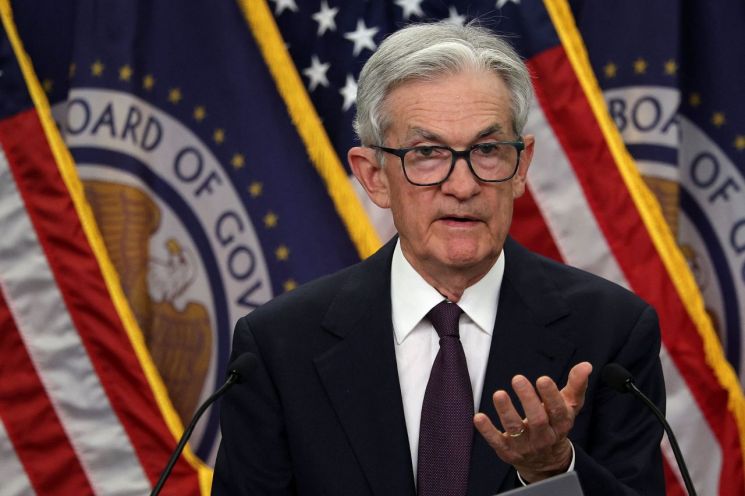
US Fed Holds Rates Again... Maintains Outlook for Two Cuts This Year
On June 18 (local time), following its regular Federal Open Market Committee (FOMC) meeting, the Fed announced in its policy statement that it had unanimously decided to keep the federal funds rate steady at 4.25?4.5% for the fourth consecutive time. As a result, the interest rate gap between South Korea and the US remains at 2 percentage points at the upper end.
In its policy statement, the Fed assessed that "economic activity continues to expand at a solid pace," and "the unemployment rate is low while inflation remains somewhat elevated." However, the phrase in the May statement, "uncertainty about the economic outlook is increasing," was revised this time to "uncertainty about the economic outlook has lessened but remains high." This change reflects the partial easing of concerns over tariff hikes, as the US postponed reciprocal tariffs for 90 days and began trade negotiations with major trading partners.
Regarding the interest rate outlook, the Fed maintained the possibility of two rate cuts this year. According to the newly released dot plot, the median projection for the federal funds rate at the end of the year remains at 3.9%, the same as before. This suggests the possibility of two 0.25 percentage point cuts from the current 4.25?4.5%. However, seven out of nineteen FOMC members now support holding rates steady this year, up from four in March. This indicates widening differences among committee members regarding the future rate path. The median projections for the federal funds rate at the end of 2026 and 2027 were raised to 3.6% and 3.4%, respectively, up from 3.4% and 3.1% in March. This suggests that rate cuts could be limited to one per year in 2026 and 2027.
In the Summary of Economic Projections (SEP) released alongside the decision, the Fed noted that concerns over stagflation have grown further. The forecast for this year's GDP growth was revised down from 1.7% to 1.4%, while the projection for 2026 was lowered by 0.2 percentage points to 1.6%, and the 2027 forecast remained at 1.8%. Inflation projections were also raised. Based on the core Personal Consumption Expenditures (PCE) price index, which the Fed closely monitors, the inflation forecast for this year was raised from 2.8% to 3.1%. The projections for 2026 and 2027 rose by 0.2 and 0.1 percentage points to 2.4% and 2.1%, respectively. This reflects the Fed's view that aggressive tariff policies are likely to push up prices while slowing growth.
Powell: "Tariff-Driven Inflation Possible Within Months"... Wall Street Sees "One Rate Cut This Year"
Chair Powell mentioned the possibility of inflation driven by tariffs during the press conference following the FOMC meeting. He stated, "Tariff increases push up prices and place a burden on economic activity," and added, "We need to consider that a significant level of inflation could emerge in the coming months." He especially noted that the effects of tariffs could be fully reflected in product prices around the summer. Powell explained, "The impact of tariff policy has begun to appear," and "price increases due to tariffs have been observed in some items, such as personal computers and audiovisual equipment." However, he added, "Everything about the magnitude, duration, and timing of the tariff effects is highly uncertain."
Emphasizing the need to monitor the impact of tariffs, Powell reaffirmed his stance not to rush rate cuts for the time being. He said, "We are in a good position to wait for more information about future economic trends before adjusting policy." In particular, as concerns over stagflation deepen, the Fed faces a growing dilemma: it must keep rates high if inflation rises, but should cut rates if growth slows. This is why the Fed is adopting a wait-and-see approach.
Regarding President Trump's overt pressure for rate cuts, Powell said, "It's not complicated for me," and added, "What FOMC members want is a strong US economy with a robust labor market and price stability." On the same day, ahead of the FOMC meeting, President Trump called Powell a "dumb person" and pressured, "He probably won't cut rates today, but we need to lower them by 2 percentage points."
After the Fed held its benchmark rate as expected, the New York stock market closed flat without a clear direction. On the New York Stock Exchange (NYSE), the Dow Jones Industrial Average fell by 0.11%, the S&P 500 index dropped by 0.03%, and the Nasdaq index rose by 0.13%. The interest rate futures market is pricing in more than a 60% chance that the Fed will resume rate cuts in September, with two 0.25 percentage point cuts within the year.
Some on Wall Street predict that, due to uncertainty in trade policy, the Fed may maintain a cautious easing stance, resulting in only one rate cut this year. In particular, Powell's remarks warning about next year's and the following year's rate outlook and inflation risks are being interpreted as hawkish (favoring monetary tightening).
Seema Shah, Global Chief Strategist at Principal Asset Management, said, "The economic outlook is still shrouded in significant uncertainty, making it likely that the Fed is not confident about future developments," and predicted, "The Fed will keep rates steady through the end of the fourth quarter and cut rates only once by 0.25 percentage points this year."
© The Asia Business Daily(www.asiae.co.kr). All rights reserved.
![User Who Sold Erroneously Deposited Bitcoins to Repay Debt and Fund Entertainment... What Did the Supreme Court Decide in 2021? [Legal Issue Check]](https://cwcontent.asiae.co.kr/asiaresize/183/2026020910431234020_1770601391.png)
















