Ministry of Science and ICT Reports to National Planning Committee
Focus on Securing Advanced GPUs and Core Talent
3 Trillion Won to Be Invested in Universal Telecommunications Services Over Five Years
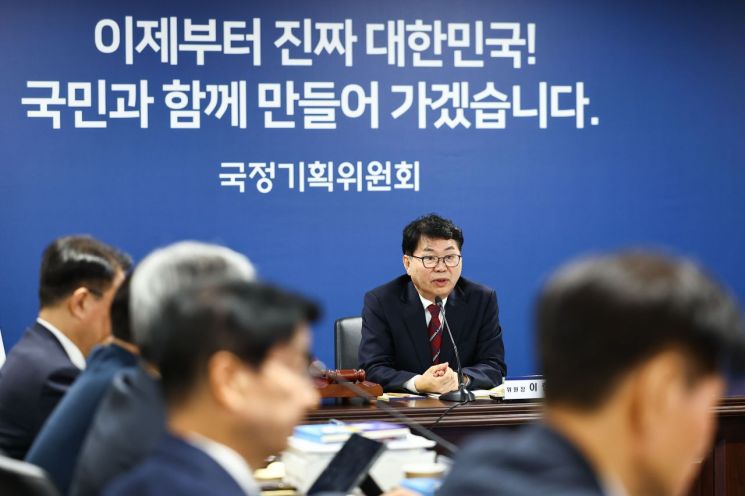
The Lee Jaemyung administration plans to invest over 16 trillion won in the next five years to become a global powerhouse in artificial intelligence (AI). On June 18, the Ministry of Science and ICT reported its work plan to the National Planning Committee, emphasizing technology-driven growth through AI advancement.
According to the Ministry of Science and ICT, a total of 16.07617 trillion won will be invested in the AI sector over the next five years. Of this, 12.3 trillion won will be concentrated on the goal of making Korea one of the world’s top three AI powers. The key strategies include securing 50,000 advanced graphics processing units (GPUs) and building AI data centers to establish an "AI highway." The ministry stated, "Through these efforts, we aim to solidify our status as a top-three AI nation by 2030 and usher in an era of 100 trillion won in AI investments from both the government and private sector."
Additional initiatives include establishing AI data cluster hubs to collect and link learning data owned by the public and private sectors, expanding research and development investment in areas such as artificial general intelligence (AGI), fostering national AI innovation hubs such as AI special zones, and providing policy finance support and fund creation. A total of 607.2 billion won will be invested to implement the "Global AI Initiative Strategy." The plan is to propose the creation of an AI technology and solutions development fund at major summits this year and to begin full-scale fund formation next year. The government will also establish global AI joint research labs in Europe and attract investments from overseas big tech companies in domestic AI infrastructure.
A total of 1.0245 trillion won will be allocated to build a basic AI society. This initiative will support the development of national AI models and promote the launch of AI services accessible to all citizens. To this end, the government will accelerate the enactment of subordinate regulations under the Digital Inclusion Act, which takes effect in January next year. Another 1.28 trillion won will be invested in nurturing national talent to lead AI innovation. This includes attracting top-tier global AI talent and providing comprehensive support for promising early-career researchers. Additionally, the government plans to establish 15 "AX (AI Transformation) Graduate Schools" by 2030 through university-industry collaboration.
For the creation of the Gwangju AI National Pilot City, 600 billion won will be invested. This will facilitate the development of an AX demonstration valley and the implementation of 155 research and development projects. Furthermore, 163.6 billion won will be allocated to revise subordinate regulations under the AI Basic Act and to create AI-specialized pilot cities as "regulation-free zones," while 180 billion won will be set aside to create a safe digital society by protecting women and youth.
More than 3 trillion won will be invested over five years to build digital infrastructure and enhance user convenience, ensuring universal telecommunications services as a basic right for all citizens. A total of 3.0882 trillion won will be spent on upgrading the national digital infrastructure, and 2.343 trillion won will be invested to establish a digitally secure society, including strengthening cybersecurity. The plan also includes improvements to information security systems, domestic development of AI and quantum security technologies, and measures to address digital risks such as phishing and smishing.
To reduce the burden of telecommunications costs on citizens, the government will pursue the inclusion of telecommunications expenses as a deduction item for income tax credits. This is expected to ease the financial burden for a large number of wage earners and other citizens, and the revision of the Income Tax Act will be promoted within this year. Even after data usage is exhausted, users will be able to continue using telecommunications data services at a basic speed of 400kbps, and a minimum speed of 1Mbps will be guaranteed for vulnerable groups to ensure their basic needs for livelihood, learning, and cultural activities. In particular, the plan will enable children from low-income families to access online lectures and seniors to watch standard-definition videos.
The discount rate for military personnel will be increased from the current 20% to 50%. Other policies under consideration include shortening the period for mobile number portability restrictions, promoting the use of eSIMs, revitalizing the market for unlocked phones and budget phones, and introducing mandatory notifications of optimal rate plans.
For major platform companies, including overseas big tech firms, the government will impose obligations for digital service safety management and require them to report domestic revenues. Through amendments to the Telecommunications Business Act, the government will encourage fair network usage contracts and require app market operators to allow external payments and set reasonable fees.
National support for all stages of K-content creation will also be expanded. To this end, 375.2 billion won will be invested, and initiatives will include supporting the global expansion of advertising-based free streaming (FAST) TV and operating funds to expand investment in large-scale content. In addition, a comprehensive overhaul of broadcasting laws and the introduction of minimal and autonomous regulations in the media sector have been announced.
© The Asia Business Daily(www.asiae.co.kr). All rights reserved.

















