National Policy Planning Committee's Economic Division 1 to Visit Bank of Korea on June 24
Governor Rhee Changyong Stresses Falling Potential Growth Rate and the Need for Structural Reform
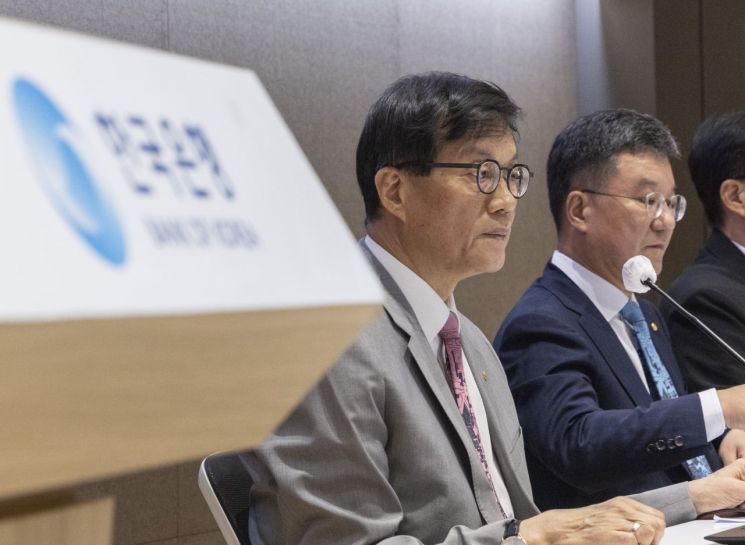
The National Policy Planning Committee, which serves as the transition team for the Lee Jaemyung administration, will visit the Bank of Korea in Jung-gu, Seoul on June 24 to receive a policy briefing. The meeting is expected to cover a wide range of topics, including this year's economic growth rate forecast for South Korea, which is expected to be only 0.8%, as well as industrial structural reforms aimed at stimulating the economy.
The Economic Division 1 of the Policy Planning Committee, which is responsible for drafting macroeconomic policy, includes Democratic Party lawmakers Jung Taeho, Oh Gihyeong, and Hong Seongguk, as well as Joo Byeonggi, professor of economics at Seoul National University; Kim Eunkyung, professor at Hankuk University of Foreign Studies Law School; and Lee Jonguk, director at StartRun. They are expected to use the Bank of Korea's policy briefing as a reference to set the direction of policies aimed at raising South Korea's potential growth rate over the five-year presidential term.
On June 12, at the 75th anniversary ceremony of the Bank of Korea held at its annex in Jung-gu, Seoul, Bank of Korea Governor Rhee Changyong stated, "If we rely excessively on stimulus policies just because the situation is urgent, even greater side effects may emerge later," and added, "I hope the newly launched administration will clearly prioritize structural reform tasks and demonstrate leadership in managing social conflict, turning the current crisis into an opportunity." This underscores that, in order for the Lee Jaemyung administration to revive the economy, it must focus not only on stimulus measures such as livelihood support payments, but also on structural reforms to prevent a decline in growth potential.
In the mid to late 2000s, South Korea's potential growth rate was around 4%, but as low birth rates and population aging have become more pronounced, it has now fallen below 2%. However, the country remains vulnerable to external economic shocks due to its high dependence on foreign markets and export structures concentrated in certain industries. Governor Rhee pointed out, "As a result, the probability of negative growth in the event of domestic or external shocks has risen to about 14% as of 2024, which is three times higher than a decade ago."
In its 'Structural Reform Paper,' the Bank of Korea stated, "At the root of the low birth rate and aging population issues are the concentration of population in the capital region and excessive competition for university entrance," and proposed fostering regional hub cities and introducing a proportional regional selection system. To mitigate the impact of an aging population, the paper also suggested measures such as continued employment for the elderly, improving care services, and utilizing reverse mortgages after retirement. In addition, to address vulnerabilities arising from high export dependence and industrial concentration in certain items, the paper advocated for the development of the knowledge service industry.
© The Asia Business Daily(www.asiae.co.kr). All rights reserved.

















