Federation of Korean Industries Survey of Top 101 Companies by Sales
56.4% Say "Korea-Japan Cooperation Has Contributed to Korean Economy"
62.4% Say "Korea-Japan Economic Cooperation Should Continue"
Semiconductors, AI, and Automobiles Selected as Promising Areas for Cooperation
Joint Response to Trade Issues Is Top Priority... R&D Collaboration Also Important
More than half of South Korean companies believe that economic cooperation between South Korea and Japan has contributed to the development of the South Korean economy and think that such cooperation should continue in the future.
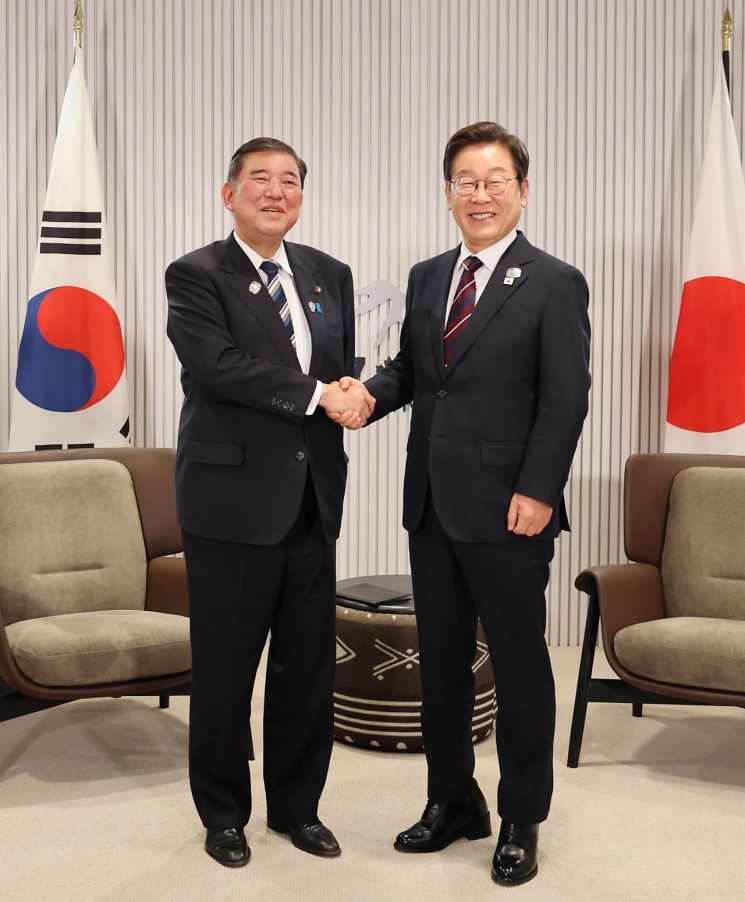 President Lee Jae Myung is shaking hands with Japanese Prime Minister Shigeru Ishiba and taking a commemorative photo at the South Korea-Japan summit held on the 17th (local time) at the G7 summit venue in Canmore, Alberta, Canada. Photo by Yonhap News
According to the "60th Anniversary of Korea-Japan Diplomatic Normalization Economic Cooperation Survey" conducted by the Federation of Korean Industries (FKI) on the top 1,000 non-financial companies by sales (with responses from 101 companies) on June 19, 56.4% of respondent companies said that economic cooperation between the two countries has promoted the development of the South Korean economy.
Among the respondents, 7.9% answered "significantly promoted," and 48.5% answered "somewhat promoted." Meanwhile, 33.7% said it was "irrelevant," and 9.9% said it "somewhat hindered" economic development.
When asked in which areas Korea-Japan economic cooperation had a positive effect (first and second priority), technology transfer and cooperation (53 points), market expansion through entry into Japan (35 points), development of tourism and cultural industries (29 points), and supply chain stabilization for materials, parts, and equipment (27 points) were cited. In addition, 62.4% of respondent companies said that Korea-Japan economic cooperation will continue to be necessary for South Korea's economic growth. Of these, 20.8% said it is "very necessary," and 41.6% said it is "somewhat necessary." Meanwhile, 34.6% answered "neutral," and 3.0% said it is "somewhat unnecessary."
Regarding the importance of stable Korea-Japan relations for economic cooperation, 60.4% answered "somewhat important," 27.7% said "very important," 5.9% said "no impact," 5.0% said "somewhat unimportant," and 1.0% said "very unimportant."
Industries where synergy with Japan is expected (first and second priority) included semiconductors (91 points), artificial intelligence (57 points), automobiles (39 points), bio and healthcare (32 points), and shipbuilding and batteries (26 points each).
When asked about the most necessary forms of economic cooperation (first and second priority), "joint response to global trade issues such as protectionism" (69 points), "joint research and development cooperation including talent cultivation" (52 points), "expansion of summit-level exchanges" (46 points), and "joint entry into third countries" (36 points) were cited in that order. The FKI stated, "We have confirmed a consensus among companies regarding Korea-Japan economic cooperation," and analyzed, "It is necessary to maintain stable relations between the two countries so that productive cooperation can continue."
Among the companies currently cooperating individually with Japan (61 companies), 42.7% responded that "cooperation with Japan is important for business." Meanwhile, 39.3% said it is "neutral," 16.4% said it is "not very important," and 1.6% said it is "not important at all." Regarding the expected time required to switch cooperation partners from Japan to another country, 27.9% answered "more than three years," 26.2% said "one to three years," 21.3% said "difficult to replace," and 13.1% said "six months to one year."
Kim Bongman, head of the International Division at the FKI, said, "Amid recent changes in the international situation and the reorganization of global trade order, the importance of Korea-Japan economic cooperation is being further highlighted." He added, "We plan to actively support the expansion of our companies' economic reach, focusing on promising cooperation areas such as advanced industries, and to strengthen cooperation with the Japan Business Federation."
© The Asia Business Daily(www.asiae.co.kr). All rights reserved.

















