"Even Spending 100 Million Won a Year on Naver Barely Shows Results"
Focus on Breaking the 'Rich Get Richer, Poor Get Poorer' Market Structure
"Even if you spend 100 million won a year on Naver ads, it barely makes a difference. Individual lawyers simply cannot compete with large law firms that pour in billions of won." (An independent lawyer in Seocho-dong, Seoul)
There has been ongoing criticism that keyword advertising (Cost Per Click·CPC) on search portals widens the exposure gap between large law firms with substantial capital and small or mid-sized law firms and individual lawyers, thereby distorting the legal market. Although more frequent and prominent exposure at the top of search results does not guarantee high-quality, reliable legal services, some law firms have taken advantage of this structure and driven up CPC rates to the maximum by aggressively investing in advertising and marketing.
Naver's CPC advertising system is structured so that law firms with greater financial resources and higher advertising budgets are more likely to secure top search rankings. It is not just a matter of bidding the highest advertising fee; the number of clicks is also factored in. A representative from a Naver search ad agency explained, "Even if you set your bid at the maximum of 100,000 won, it can still be difficult to secure the top spot," adding, "Ranking is determined based on factors such as the duration of the ad campaign, ad content, keywords, and site relevance, which together make up the ad quality score." Ultimately, this means that advertisers who consistently spend large amounts on ads are prioritized for exposure.
Consumers are easily misled into thinking that "the more exposure, the higher the search ranking, the more trustworthy" a law firm is. This distorts client choices and creates a vicious cycle in which lawyers who cannot afford high advertising costs find it increasingly difficult to compete. One lawyer running a private practice said, "With an ordinary budget, you can't even dream of getting your ad shown through Naver search," adding, "If lawyers have to pay such high advertising fees, they will inevitably ask clients for higher retainers, ultimately passing the cost on to clients." Another lawyer commented, "In the legal market, where information is asymmetric, law firms that appear at the top of portal search results may be mistakenly regarded as 'famous' or 'popular,' leading to a distorted qualitative evaluation," and added, "But in reality, the current ranking is simply a reflection of 'who spends the most.'"
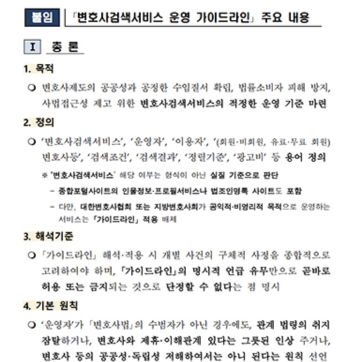
The Ministry of Justice's recently announced 'Attorney Search Service Operation Guidelines' is raising expectations as it is seen as a potential turning point for curbing CPC advertising. The legal industry is closely watching to see whether the competitive bidding prices for Naver Powerlink will decrease. Some law firms that have previously leveraged their financial strength to invest heavily in Naver and Google ads are reportedly considering changes to their marketing strategies.
However, there are still no signs of a meaningful drop in advertising rates on Naver or other portals. Another representative from a Naver ad agency said, "We anticipated some level of regulation on search ads," adding, "While the new guidelines may reduce issues such as exaggerated ads and fraudulent clicks (where competitors deliberately click ads to drive up costs), I don't think CPC rates will actually decrease."
Small and mid-sized law firms and individual lawyers who lack financial resources are cautiously optimistic but remain skeptical about the effectiveness of the new measures. One lawyer advertising on Naver said, "Even under the current system, everyone is desperate to pay Naver as much as they can," adding, "There's no reason to consider alternative advertising methods."
This skepticism stems from the fact that the scope of the Ministry of Justice's guidelines does not align well with the actual targets. In reality, the intended subjects of regulation are portals and lawyer advertising platforms, but the guidelines are not legally binding on them. Portals like Naver, which generate significant profits from keyword advertising, have little incentive to comply with the guidelines.
The effectiveness of the guidelines will ultimately depend on whether disciplinary action against lawyers can be taken under the Korean Bar Association's lawyer advertising regulations. The Ministry of Justice has stated that it intends to treat the guidelines as an authoritative interpretation of the Attorney-at-Law Act to ensure effectiveness. On the other hand, one independent lawyer said, "In order to discipline lawyers, it would be necessary to require lawyers or ad agencies to submit actual advertising expense data, but since this is an obligation, a legal amendment would be needed," adding, "Without a change in the law, the guidelines are unlikely to be effective." Another lawyer also commented, "The scope of regulation should be expanded to include business operators like Naver and other portals, as well as lawyer associations."
Seo Hayeon, Law Times Reporter
Lim Hyunkyung, Law Times Reporter
※This article is based on content supplied by Law Times.
© The Asia Business Daily(www.asiae.co.kr). All rights reserved.

















