Calls for Korea-Japan Solidarity Centered on the Younger Generation
Experts: Cooperation Needed in Security, Economy, and Advanced Technology
Concerns Raised Over Historical Issues and Balanced Partnership
There was a suggestion that Korea and Japan should break away from the confrontational stereotypes of the older generation, which are often characterized by so-called "anti-Japan" and "anti-Korea" sentiments, and instead focus on solidarity and unity centered on the younger generation. This is referred to as the so-called "Kyulil-ron" (theory of Korea-Japan unity). The argument is that, even though the two countries signed the Basic Treaty in 1965, they have experienced constant ups and downs over the past 60 years due to historical issues, and should no longer pass these conflicts on to future generations.
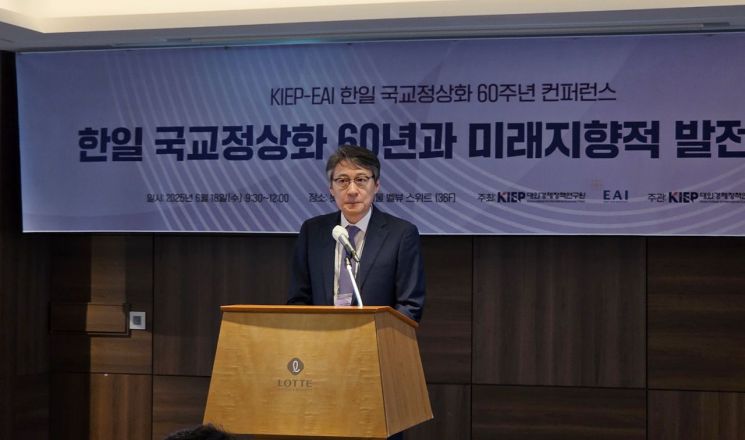 Son Yeol, President of the East Asia Institute (EAI), is delivering the keynote speech at the "60 Years of Korea-Japan Normalization of Diplomatic Relations Conference" hosted by the Korea Institute for International Economic Policy (KIEP) and EAI at Lotte Hotel in Jung-gu, Seoul on the 18th. Photo by KIEP
Son Yeol, President of the East Asia Institute (EAI), made these remarks during his keynote speech on "A Future-Oriented Vision for Korea-Japan Relations for Future Generations" at the "60 Years of Korea-Japan Normalization of Diplomatic Relations Conference," hosted by the Korea Institute for International Economic Policy (KIEP) and EAI at Lotte Hotel in Jung-gu, Seoul on the 18th.
Son explained, "With the decline of U.S. hegemony, the United States is selectively reducing and adjusting its foreign interventions and increasing the burden-sharing of its allies. In this context, Korea and Japan have found themselves in similar situations due to increased military spending and U.S. pressure to join its efforts to contain China." He added, "Japan's rise is not because its national power or diplomatic capabilities have grown, but because there are limits to self-reliance in managing and reducing the increasing external risks facing their own countries, and thus solidarity and unity with countries in similar positions have become necessary."
He cited the shared threats faced by Korea and Japan due to the U.S.-China strategic rivalry, as well as the recent sharp rise in favorability toward Japan among the younger generation, as evidence that "at least at the civilian level, we have entered a 'new era' in Korea-Japan relations." He warned, "The values and identities of future generations should not be influenced by the stereotypes of the older generation. If the older generation fails to make efforts to resolve historical issues and simply passes them on, we could face the unfortunate continuation of identity conflicts." He repeatedly emphasized, "We must pool our efforts to jointly design the future with a more long-term and broad-minded perspective."
Joo Ho-young, Deputy Speaker of the National Assembly and President of the Korea-Japan Parliamentarians' Union (a member of the People Power Party), also remarked in his congratulatory address, "It seems that the leaders of Korea and Japan have just reached a positive and desirable agreement about the future." He added, "We will work even harder at the National Assembly level to ensure that exchanges between the legislatures of both countries are more substantial and to enable policy linkages." KIEP President Lee Siwook also said in his opening remarks, "The future relationship between the two countries should be an era of cooperation, mutual benefit, and shared prosperity."
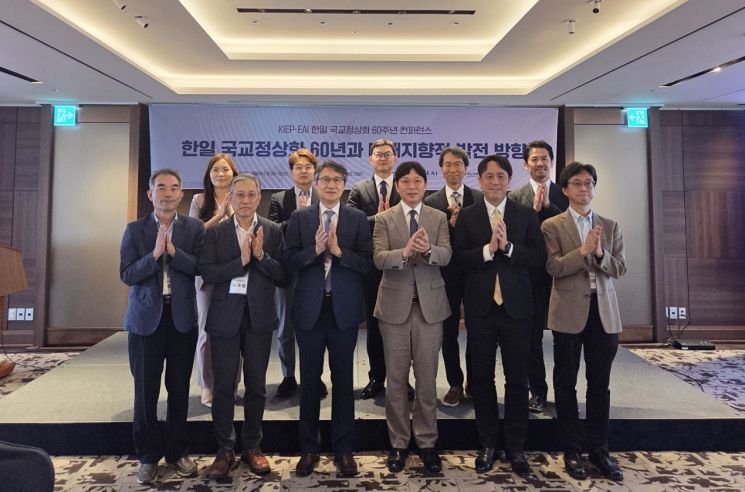 Participants of the "60th Anniversary Conference of Korea-Japan Normalization of Diplomatic Relations," hosted by the Korea Institute for International Economic Policy (KIEP) and the East Asia Institute (EAI), are taking a commemorative photo at Lotte Hotel, Jung-gu, Seoul on the 18th. Photo by KIEP
Experts advised that areas for future Korea-Japan cooperation should not be limited to diplomacy and security, but should also include the economy, advanced technology, and the humanities and social sciences. Lee Junghwan, a professor at the Department of Political Science and International Relations at Seoul National University, said, "The biggest factor in the changing security environment between Korea and Japan is the strengthening of China's nuclear capabilities," and raised "the possibility of nuclear cooperation among North Korea, China, and Russia." He emphasized, "It is necessary to secure joint deterrence capabilities between Korea and Japan and to institutionalize practical security cooperation among Korea, the United States, and Japan." Kim Kyupan, Senior Research Fellow at KIEP, suggested that for economic cooperation, "Korea can contribute to maintaining the global free trade order by joining the Comprehensive and Progressive Agreement for Trans-Pacific Partnership (CPTPP) led by Japan or by signing a bilateral Free Trade Agreement (FTA)." He added, "Korea's accession to the CPTPP is expected to have significant economic effects, such as a substantial increase in real GDP through trade and investment liberalization."
However, during the subsequent discussion, Nam Kijeong, Director of the Institute for Japanese Studies at Seoul National University, acknowledged that "identifying practical diplomatic cooperation agendas for a mature Korea-Japan relationship is meaningful," but questioned "the possibility of future-oriented cooperation that excludes historical issues." He argued, "The root cause of the current global order crisis can be found in unresolved historical problems coming to the forefront of world politics," and stressed, "Efforts to resolve the issues of forced labor and the Japanese military 'comfort women' must be pursued in parallel." Nam is an expert on Japan who earned his bachelor's and master's degrees in the Department of International Relations at Seoul National University and his doctorate at the Graduate School of Interdisciplinary Information Studies at the University of Tokyo. He has also served as president of the Korean Association of Modern Japanology and the Korean Association of Political and Diplomatic History.
Nam further suggested, "In particular, security and military cooperation must be approached with great caution, considering factors such as North Korea-Japan relations. It is important to manage these efforts so that they do not hinder future endeavors toward peace on the Korean Peninsula." He also warned, "If cooperation is pursued in an unbalanced way without taking into account surrounding factors such as the Taiwan issue, it could become a source of regional instability."
Regarding Korea-Japan cooperation in advanced technology, he expressed doubt, saying, "I wonder whether such cooperation is truly on equal terms." He further cautioned, "We must also consider that cooperation in advanced technology, which is closely linked to economic security, could potentially be wielded as a weapon against the other party."
Nam also pointed out that the possibility of economic cooperation, such as joining the CPTPP or signing an FTA, "has ultimately not progressed because it became entangled with historical issues," and stressed, "Efforts to resolve historical issues must be pursued in parallel."
© The Asia Business Daily(www.asiae.co.kr). All rights reserved.


















