First Meeting at G7 Summit: South Korea, US, and Japan to Strengthen Cooperation on North Korea and Other Issues
Leaders of South Korea and Japan Reaffirm Commitment to Resuming Shuttle Diplomacy
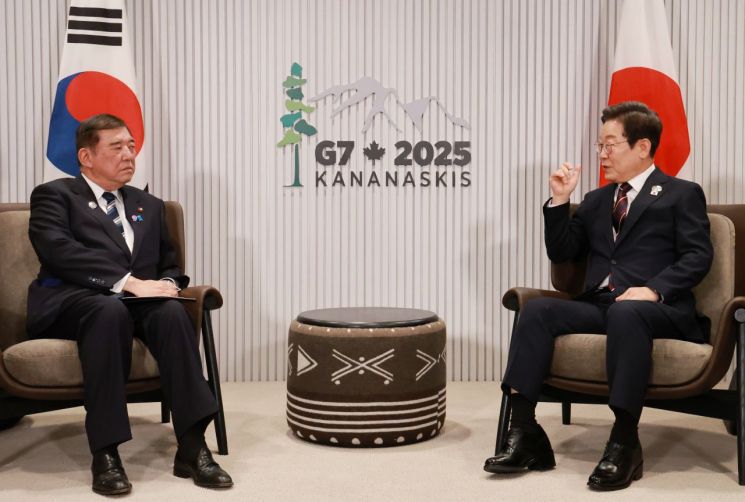
President Lee Jaemyung, who is visiting Canada to attend the Group of Seven (G7) Summit, held his first summit meeting with Japanese Prime Minister Shigeru Ishiba on June 17 (local time) in Kananaskis. This meeting took place just 14 days after President Lee's inauguration, making it exceptionally early compared to previous administrations. During the 30-minute summit, the two leaders expressed shared concerns about the worsening international situation. They agreed to continue and further develop trilateral cooperation among South Korea, the United States, and Japan in response to various geopolitical crises, including the North Korea issue, and to deepen bilateral cooperation between South Korea and Japan. In particular, the two leaders reaffirmed their commitment to resuming "shuttle diplomacy," as discussed on June 9, and agreed to advance discussions between their respective authorities to achieve this.
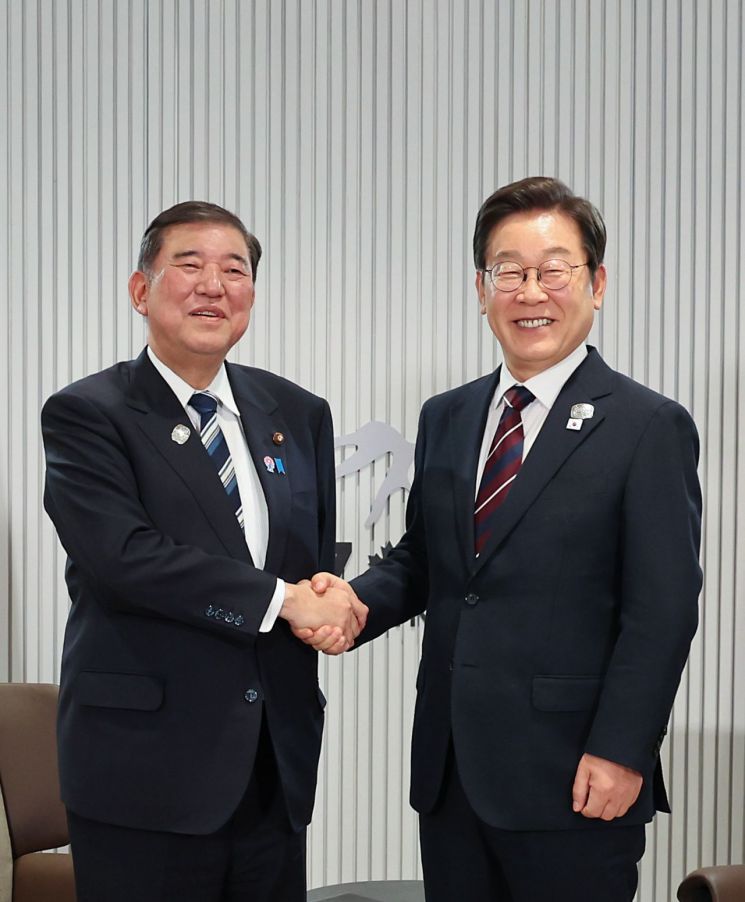
In his opening remarks, President Lee said, "It is often said that Japan and Korea are close yet distant neighbors. Our relationship is inseparable, much like neighbors sharing a front yard. While there are minor differences and disagreements, I hope that Korea and Japan can overcome these differences and develop a mutually beneficial relationship through cooperation in various areas." Accompanying President Lee at the meeting were National Security Office Director Wi Sunglak and Presidential Spokesperson Kang Yujeong.
President Lee also emphasized, "As challenges in the international trade environment and international relations intensify, our close and complementary relationship means that cooperation in many areas will be greatly beneficial for both sides." He added, "I hope that today will serve as an opportunity for Korea and Japan to move toward an even better relationship."
Prime Minister Ishiba responded, "Since you appear on Japanese TV every day, it doesn't feel like this is our first meeting," and noted, "This year marks the 60th anniversary of the normalization of diplomatic relations, making it a truly monumental year." He continued, "A 60th anniversary reception was recently held in Seoul, and I heard that a great many people attended. Although I understand you could not attend because of your participation in this international summit, I was informed that you sent a truly heartwarming message."
Prime Minister Ishiba further stated, "As was discussed at today's G7 Summit, I recognize that the international situation is becoming extremely serious. This is true in Ukraine, in the Middle East, and in Asia; I believe there are both common and diverse factors at play in these regions."
He added, "I sincerely hope that, marking the 60th anniversary, exchanges between not only our governments and businesses but also our peoples will become even more active, and that cooperation and partnership between our two countries will contribute even more to this region and the world."
Following the conclusion of the Korea-Japan summit, the Presidential Office issued a press release stating, "The two leaders agreed to continue and further develop trilateral cooperation among South Korea, the United States, and Japan in response to various geopolitical crises in the region, including the North Korea issue, and to deepen bilateral cooperation between South Korea and Japan." The statement also noted, "Following their phone call last week (June 9), they reaffirmed their commitment to resuming shuttle diplomacy and agreed to advance discussions between their respective authorities to this end."
This Korea-Japan summit was held at an exceptionally early stage following the launch of the new administration, even when compared to previous cases. Former President Yoon Sukyeol met then-Japanese Prime Minister Fumio Kishida at a multilateral dinner during the North Atlantic Treaty Organization (NATO) Summit on June 2022, the day after his inauguration, but a formal summit was not held until September 2022, four months after his inauguration, in New York.
In the case of former President Park Geunhye, her first meeting with then-Japanese Prime Minister Shinzo Abe took place at a South Korea-U.S.-Japan summit in March 2014, one year after her inauguration, and a bilateral summit was not held until November 2015. Only former Presidents Roh Moo-hyun and Lee Myungbak had their first meetings with then-Japanese Prime Ministers Junichiro Koizumi and Yasuo Fukuda, respectively, on the day of their inaugurations, as the Japanese leaders attended their inauguration ceremonies.
© The Asia Business Daily(www.asiae.co.kr). All rights reserved.
![Clutching a Stolen Dior Bag, Saying "I Hate Being Poor but Real"... The Grotesque Con of a "Human Knockoff" [Slate]](https://cwcontent.asiae.co.kr/asiaresize/183/2026021902243444107_1771435474.jpg)

















