Warning on SNS: "We Know the Supreme Leader's Whereabouts"
NSC Meeting Held After Urgent Return from G7 Summit
U.S. Response Options Discussed Amid Middle East Conflict
CNN: "Greater Emphasis on Military Action Over Diplomacy"
U.S. President Donald Trump is actively considering a plan for the United States to directly intervene in the armed conflict between Israel and Iran by carrying out precision strikes on Iran's nuclear facilities. He also indicated the possibility of targeting Iran's Supreme Leader, stating that the U.S. knows his whereabouts, and called for Iran's unconditional surrender, thereby raising the level of pressure on Iran to its highest point. Some analysts suggest that President Trump is not only aiming to destroy Iran's nuclear facilities but is also contemplating 'regime change' in Iran.
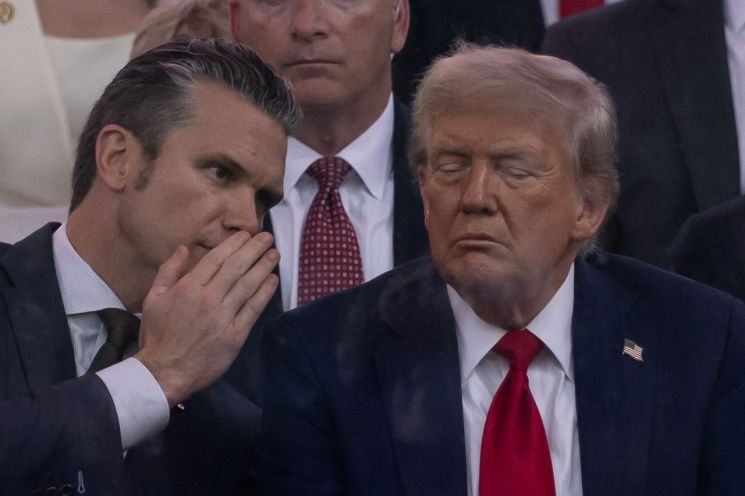
On the afternoon of the 17th (local time), President Trump convened a National Security Council (NSC) meeting in the White House Situation Room for about one hour and twenty minutes to discuss the ongoing conflict between Israel and Iran and possible U.S. responses.
He chaired the meeting after abruptly returning to the U.S. a day earlier than scheduled from the Group of Seven (G7) summit. U.S. media reported that scenarios discussed included direct U.S. military strikes on Iran's nuclear facilities and increased military support for Israel as possible forms of intervention. Fox News stated, "The possibility of U.S. intervention and plans for airstrikes were on the table," while CNN reported that President Trump is increasingly leaning toward using U.S. military assets to attack Iran's nuclear facilities.
In particular, President Trump is reportedly considering providing Israel with strategic weapons such as bunker-buster bombs capable of striking Iran's underground nuclear facilities, as well as B-2 stealth bombers to deliver them.
U.S. media outlet Axios reported that President Trump spoke by phone with Israeli Prime Minister Benjamin Netanyahu after the NSC meeting. While the details of the call were not immediately disclosed, Axios cited two Israeli officials who said that Prime Minister Netanyahu and Israeli defense authorities believe there is a strong possibility that the U.S. will join a military operation to bomb Iran's underground uranium enrichment facilities within days.
President Trump, who had previously emphasized a diplomatic solution, gave Iran a 60-day deadline in April to accept nuclear negotiations. However, when Iran refused to meet U.S. demands, his stance shifted dramatically. On the day after the negotiation deadline expired, June 13, Israel launched a surprise airstrike on Iran's nuclear facilities and military bases. Since then, President Trump has rapidly shifted to a position supporting Israel's military actions.
On this day, President Trump further escalated pressure by mentioning the possibility of an operation to eliminate Iran's Supreme Leader.
On his self-created social networking service, Truth Social, he wrote, "We know exactly where the so-called 'Supreme Leader' is hiding. He is an easy target, but he will be safe there. At least for now, we will not eliminate (kill!) him." He added, "Our patience is running out," and shortly afterward posted, "Surrender unconditionally!"
In another post, he warned, "We now have complete and total control over Iranian airspace. Iran has excellent aerial tracking and other defensive equipment, but it cannot compare to equipment designed and manufactured in the United States." The use of "we" here is interpreted as meaning that the U.S. is substantially supporting Israel's operation to control Iranian airspace.
There have also been signs that the U.S. military is reinforcing its forces in the Middle East. Citing U.S. military officials, Reuters Yonhap News reported that the U.S. is boosting its military power in the region by deploying additional fighter jets such as F-16s, F-22s, and F-35s, as well as other military aircraft, to the Middle East. While U.S. officials emphasized that this deployment is defensive in nature, such as intercepting Iranian drones and missiles, the possibility that these assets could be used offensively cannot be ruled out, given the U.S. declaration of air superiority over Iran.
The international community is closely watching the possibility that President Trump, together with Israel, will launch a full-scale regime change operation aimed at toppling Iran's Islamic theocracy. President Trump's remarks and the consideration of military options on this day are seen as signals that the U.S. is shifting its strategy toward fully supporting Israel's military action against Iran.
© The Asia Business Daily(www.asiae.co.kr). All rights reserved.
![Clutching a Stolen Dior Bag, Saying "I Hate Being Poor but Real"... The Grotesque Con of a "Human Knockoff" [Slate]](https://cwcontent.asiae.co.kr/asiaresize/183/2026021902243444107_1771435474.jpg)
















