Minimum Wage Commission Holds 5th Plenary Meeting
Labor and Management Clash Over Industry-Based Differentiation
As discussions continue over next year's minimum wage, labor and management are at odds over whether to apply differentiated rates by industry. The business community argues that industries struggling with minimum wage increases should be considered, while labor groups have expressed concerns about side effects from what they see not as differentiation but as discriminatory pay.
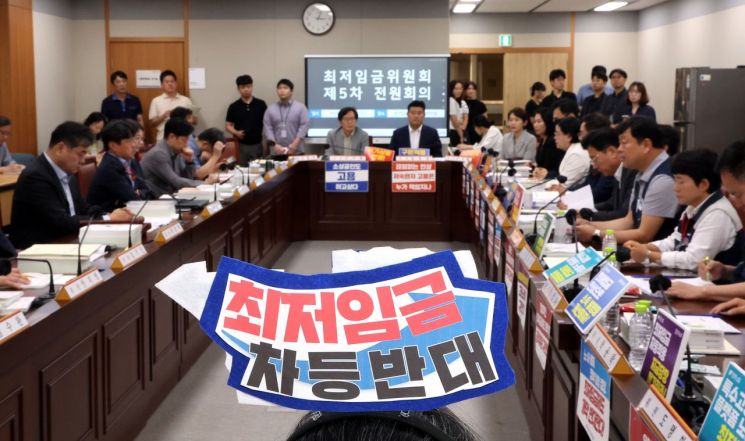 The 5th plenary meeting of the Minimum Wage Commission to decide next year's minimum wage held at the Government Complex Sejong on the 17th. Photo by Yonhap News
The Minimum Wage Commission held its 5th plenary meeting at the Government Complex Sejong on the afternoon of the 17th. All 27 commission members attended, including 9 employee representatives, 9 employer representatives, and 9 public interest members, as the commission discussed for the first time the possibility of differentiated minimum wage rates by industry.
Business Community: "Need to Distinguish Industries Unable to Bear Minimum Wage"
Ryu Gijeong, Executive Managing Director of the Korea Employers Federation, stated, "So far, minimum wage increases have been applied uniformly without distinction by industry," and added, "This has become an undeniable burden that is difficult for small and micro businesses to bear."
He also said, "Last year, the sub-minimum wage rate reached 12.5%, and in some sectors such as lodging and food services, it exceeded 30%, indicating a significant decline in on-site acceptance of the minimum wage." He emphasized, "Given this reality, at least for this year, it is necessary to introduce differentiated application for industries that cannot cope with the current minimum wage level."
Regarding the recent demand by labor groups for next year's minimum wage to be set at 11,500 won, he said, "If weekly holiday allowances are included, the actual minimum wage becomes 13,800 won," criticizing the proposal as "excessive and unreasonable, ignoring the desperate management realities of small businesses that must pay the minimum wage."
Lee Myungro, Director of Human Resources Policy at the Korea Federation of SMEs, explained, "While low-wage workers are protected by the minimum wage system, employers who generate low profits and have low income levels receive no legal protection." He stated, "Differentiated application is necessary to lower the sub-minimum wage rate and improve compliance."
Lee also argued that concerns about stigmatization, discrimination, and hiring difficulties resulting from differentiated application by industry are "misunderstandings." He pointed out that Article 11 of the Constitution includes the principle of relative equality, stating, "Applying a uniform minimum wage without regard to the realities of each industry can result in reverse discrimination that leans toward formal equality."
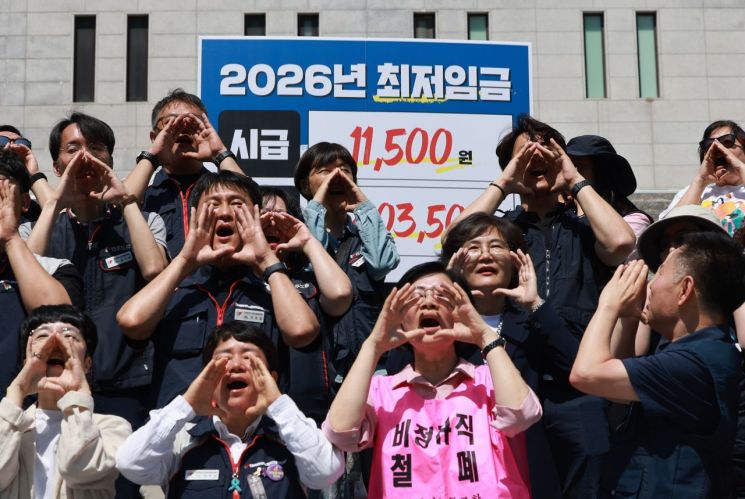 Labor groups announced their minimum wage demands for next year on the 11th in front of Sejong Center for the Performing Arts in Jongno-gu, Seoul. Photo by Yonhap News
Labor Groups: "Differentiated Pay Is Discriminatory... Should Be Avoided"
Ryu Giseop, Secretary General of the Federation of Korean Trade Unions, countered, "Differentiated application by industry raises concerns about side effects such as the entrenchment of low wages, stigmatization, intensified labor shortages due to labor concentration, hollowing out of certain industries and sectors, and avoidance of employment in those fields." He argued, "It essentially means institutionalizing discrimination through the minimum wage."
He also pointed out, "In most overseas cases, differentiated application means establishing higher minimum wage standards to promote and protect specific industries." He continued, "There are various mixed causes, such as lack of payment capacity and differences in legal compliance awareness depending on industry size," and argued, "Discriminatory application obscures the fundamental issues and misleads public opinion."
Ryu added, "We should minimize deliberations that only fuel social conflict and focus on revitalizing the economy in line with the prolonged domestic economic downturn. This year, we must break the vicious cycle in which the minimum wage fails to reflect basic living costs, further worsening the livelihoods of low-wage workers."
Lee Miseon, Vice Chair of the Korean Confederation of Trade Unions, also stated, "The International Labour Organization (ILO) explicitly calls for higher minimum wages in industries with greater payment capacity," and added, "Korea currently holds the ILO presidency." She emphasized, "Discussions that attempt to justify discrimination by region, industry, or generation must come to an end."
Lee further noted, "On the 12th, Seoul Mayor Oh Sehoon withdrew a policy to apply differentiated minimum wages to foreign domestic workers, citing concerns that introducing cheap labor would harm the nation's dignity and sustainability." She added, "Those responsible for causing social confusion through misguided policies must bear heavy responsibility."
© The Asia Business Daily(www.asiae.co.kr). All rights reserved.


















