Application Submitted to Government
Apple Also Willing to Accept Security Processing Requests
Apple has applied for permission to export high-precision domestic map data overseas, following Google. As major global tech companies continue to request the export of map data, it is expected that the South Korean government will face increasing challenges in addressing these requests.
According to the IT industry and the Ministry of Land, Infrastructure and Transport on June 17, Apple submitted an application to the National Geographic Information Institute the previous day, requesting approval to export domestic high-precision map data at a 1:5,000 scale overseas. Under current law, maps with a scale more detailed than 1:25,000 cannot be exported abroad without the approval of the Minister of Land, Infrastructure and Transport. In Apple’s case, the company stated that it would use SK Tmap for the map data.

In accordance with the regulation that requires the government to notify applicants of the result within 60 days of application, the South Korean government must inform Apple of its decision regarding the export of map data by September 8.
This is Apple’s second application to export map data. In February 2023, Apple also requested to export map data, but the government denied the request, citing concerns that it could affect national security.
Apple pre-installs its own map app on its devices, including the iPhone, iPad, and Mac. In South Korea, Apple’s map app currently provides car navigation and pedestrian route guidance, but does not offer public transportation (such as bus and subway) or bicycle routes.
However, unlike Google, Apple is known to take a more flexible approach in accommodating requests from the South Korean government. For example, Apple operates its servers within South Korea, unlike Google. Having servers located domestically allows for immediate corrective action if security facilities are exposed, which is a key factor the government considers when reviewing map data export applications. In contrast, Google maintains that, for operational reasons, Korean map data must be distributed across data centers located in various countries around the world.
Apple has also stated that it will implement measures to obscure major domestic security facilities, such as military bases. Domestic companies such as Naver and Kakao currently provide maps with security facilities processed according to government requirements, including ▲blur (obscuring), ▲camouflage, and ▲low-resolution treatment. Apple has expressed its willingness to comply with government requirements regarding blur, camouflage, and low-resolution processing, in accordance with local conditions. In contrast, Google has stated that it can only provide blur processing.
A Ministry of Land, Infrastructure and Transport official stated, "Apple has expressed its intention to resolve the government’s requirements through negotiation," adding, "Compared to Google, Apple is approaching this issue with a much more forward-looking attitude." Regarding the schedule for face-to-face negotiations with Apple, the official said, "The date has not yet been set, but internal preparations are ongoing." The negotiations are expected to begin in earnest after the appointments of the vice minister and minister, who are responsible for the final decision, are finalized.
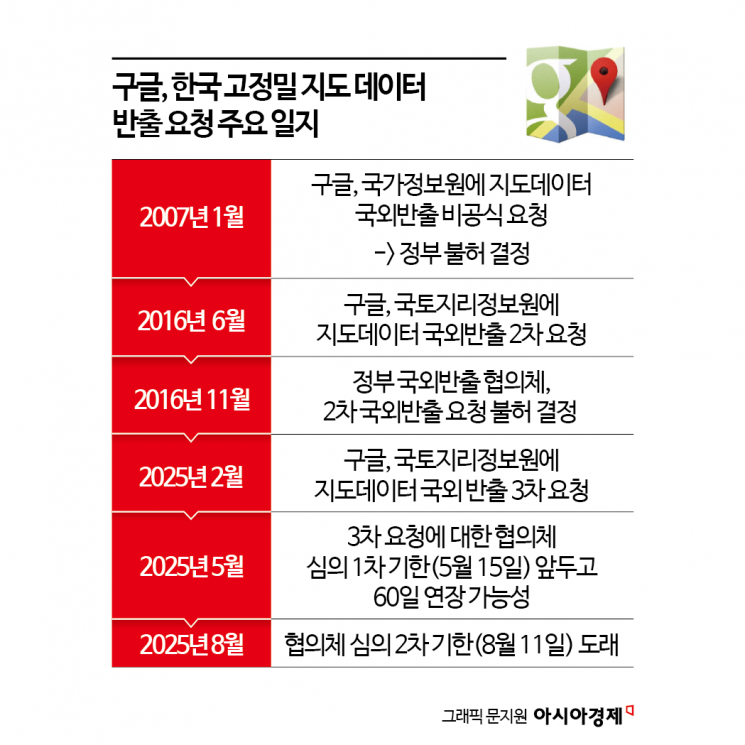
With Apple following Google in applying for the export of high-precision maps, the newly inaugurated South Korean government is expected to face increasing challenges. This is because the Trump administration in the United States is demanding the removal of non-tariff barriers from various countries by using tariffs as leverage. The United States Trade Representative (USTR), in its annual National Trade Estimate (NTE) report, has pointed out that the South Korean government’s restrictions on the overseas export of high-precision map data constitute a "trade barrier."
Previous applications by Google and Apple to export map data were denied for reasons including national security. However, there is speculation that this time, the application may be approved, coinciding with the launch of the second Trump administration. President Trump is using tariffs as leverage to demand the removal of non-tariff barriers worldwide, and it is possible that the South Korean government may offer approval for Google’s map data export as a condition for resolving trade issues.
The domestic map industry believes that the repeated applications by global big tech companies to export high-precision maps are motivated by purposes beyond simply providing map services such as navigation. The industry’s view is that if the purpose were to provide services for overseas tourists, the currently available 1:25,000 scale maps would be sufficient. The 1:5,000 high-precision maps are detailed enough to be used for urban planning, social overhead capital (SOC) construction, and autonomous driving, among other purposes.
Meanwhile, regarding Google’s application submitted in February to export 1:5,000 scale maps, the South Korean government has postponed its decision once. As a result of this postponement, the National Geographic Information Institute has extended the review period by 60 days and must reach a conclusion regarding the export by August 11.
© The Asia Business Daily(www.asiae.co.kr). All rights reserved.


















